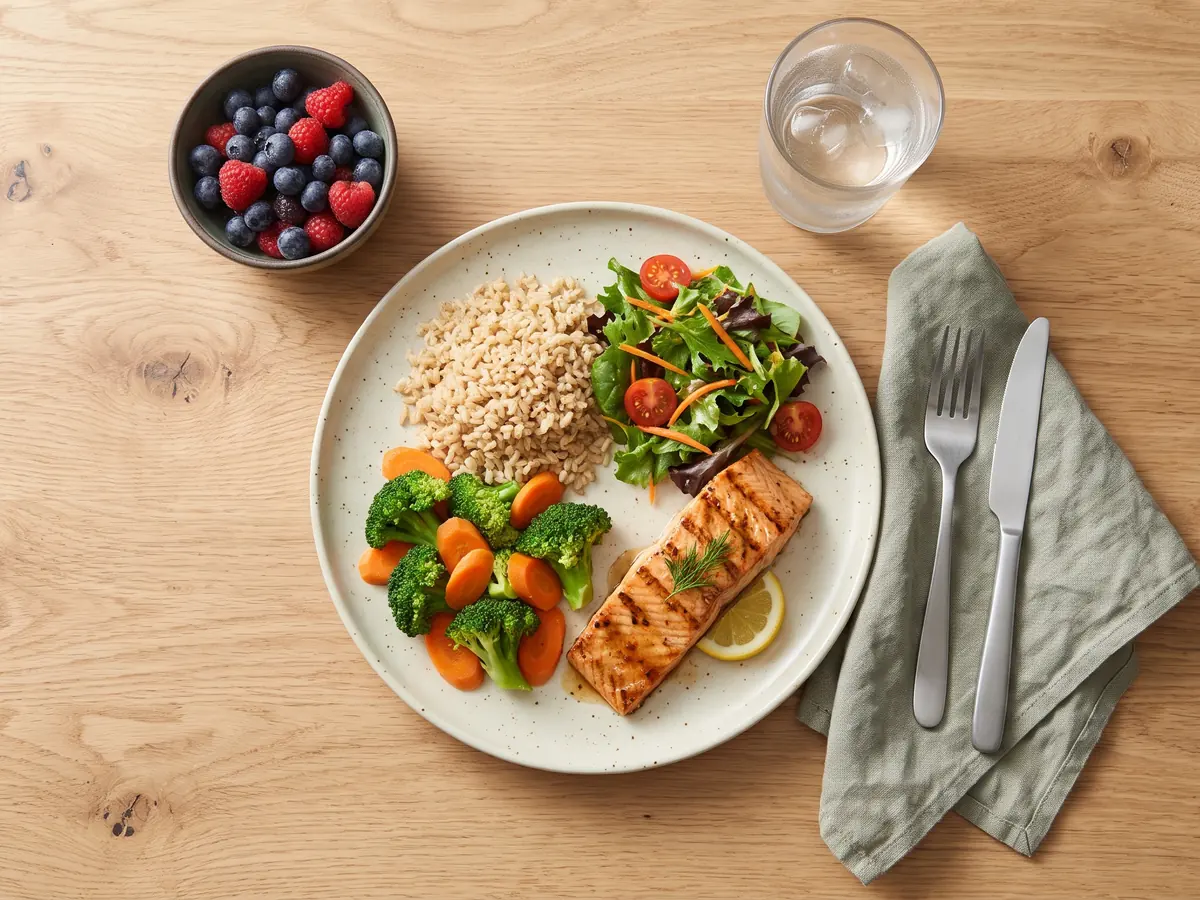
Short answerA balanced diet includes foods from every food group, in amounts that match your calorie needs: protein foods, dairy, vegetables, fruits, whole grains and healthy fats. On a 2,000-calorie pattern (the one our 7 day 2000 calorie meal plan follows), the 2025–2030 Dietary Guidelines suggest about 3 servings of vegetables, 2 of fruit, 3 of dairy, 2 to 4 of whole grains and 2½ to 3½ of protein foods a day, while keeping highly processed foods, added sugars and salt low.
In this article
- What is a balanced diet?
- The food groups and daily servings
- Protein, carbs and fat
- Vitamins, minerals, fiber and water
- What to limit
- A balanced and varied diet
- A sample balanced day
- US, UK and WHO advice compared
- At different life stages
- A balanced diet for weight loss
- Eating balanced on a budget
- Common myths
- FAQ
What is a balanced diet?
A balanced diet is a way of eating that gives your body enough energy and all the nutrients it needs, without too much of anything. In practice that means three things:
- The right mix: foods from every food group, because each group brings nutrients the others don't.
- The right amount: total calories that match what you burn, so your weight stays where you want it.
- The right quality: mostly whole, minimally processed foods, with added sugars, salt and highly processed foods kept low.
The Dietary Guidelines for Americans, 2025–2030, put it in three words: "eat real food." They ask Americans to build meals on whole, nutrient-dense foods (protein, dairy, vegetables, fruits, healthy fats and whole grains) and to cut back sharply on highly processed foods. The World Health Organization and the UK's NHS say much the same in their own words, as you'll see below. To compare foods by how much they give for their calories, see what nutritional value means.
What is the definition of a diet?
In everyday speech "diet" means a weight loss plan, but in nutrition it simply means everything you usually eat and drink. Everyone has a diet. A balanced diet, a healthy diet and a good diet all describe the same goal: a usual way of eating that supports health over years, not a short-term plan.
Is a balanced diet the same as a healthy diet?
Close to it. "Balanced" puts the focus on proportions: enough vegetables, enough protein, not too much of one thing. "Healthy" is the broader idea, which also covers what to avoid, like excess salt and sugary drinks; our heart-healthy diet guide covers those limits. What is a healthy diet, then? A balanced diet built mostly from whole foods. What is a good diet? The same thing, adjusted to your age, size, activity and health. For 50 foods to build it from, see our healthy food list.
The food groups and how many servings to eat
So what is a healthy diet in practice? The 2025–2030 Dietary Guidelines describe a healthy pattern with six groups. Their official serving chart gives daily amounts for every calorie level from 1,000 to 3,200; here are three common ones:
| Food group | 1,600 calories | 2,000 calories | 2,400 calories |
|---|---|---|---|
| Protein foods | 2½–3½ | 3–4 | 3½–4½ |
| Dairy | 3 | 3 | 3 |
| Vegetables | 2½ | 3 | 3½ |
| Fruits | 1½ | 2 | 2 |
| Whole grains | 1¾–3¼ | 2–4 | 2¾–5¼ |
| Healthy fats (teaspoons) | 3½ | 4½ | 5 |
What counts as one serving
The same chart defines a serving for each group, one of the components of a good diet:
- Protein foods: 3 oz of cooked meat, poultry or seafood; 1 egg; ½ cup of beans, peas or lentils; 1 oz of nuts or seeds; 2 tablespoons of nut or seed butter; or 3 oz of soy.
- Dairy: 1 cup of milk, ¾ cup of yogurt or 1 oz of cheese.
- Vegetables: 1 cup raw or cooked, or 2 cups of leafy greens.
- Fruits: 1 cup raw or ½ cup dried.
- Whole grains: ½ cup of cooked oats, brown rice, barley, quinoa or buckwheat; 1 slice of bread; or 1 tortilla.
- Healthy fats: 1 teaspoon of olive oil or butter. Fats are also naturally present in foods like nuts, salmon, eggs and cheese.
Your number of servings in a balanced and varied diet depends on your calorie needs, which depend on age, sex, height, weight and activity. The TDEE calculator gives you a daily calorie figure to pick the right column.
Protein foods
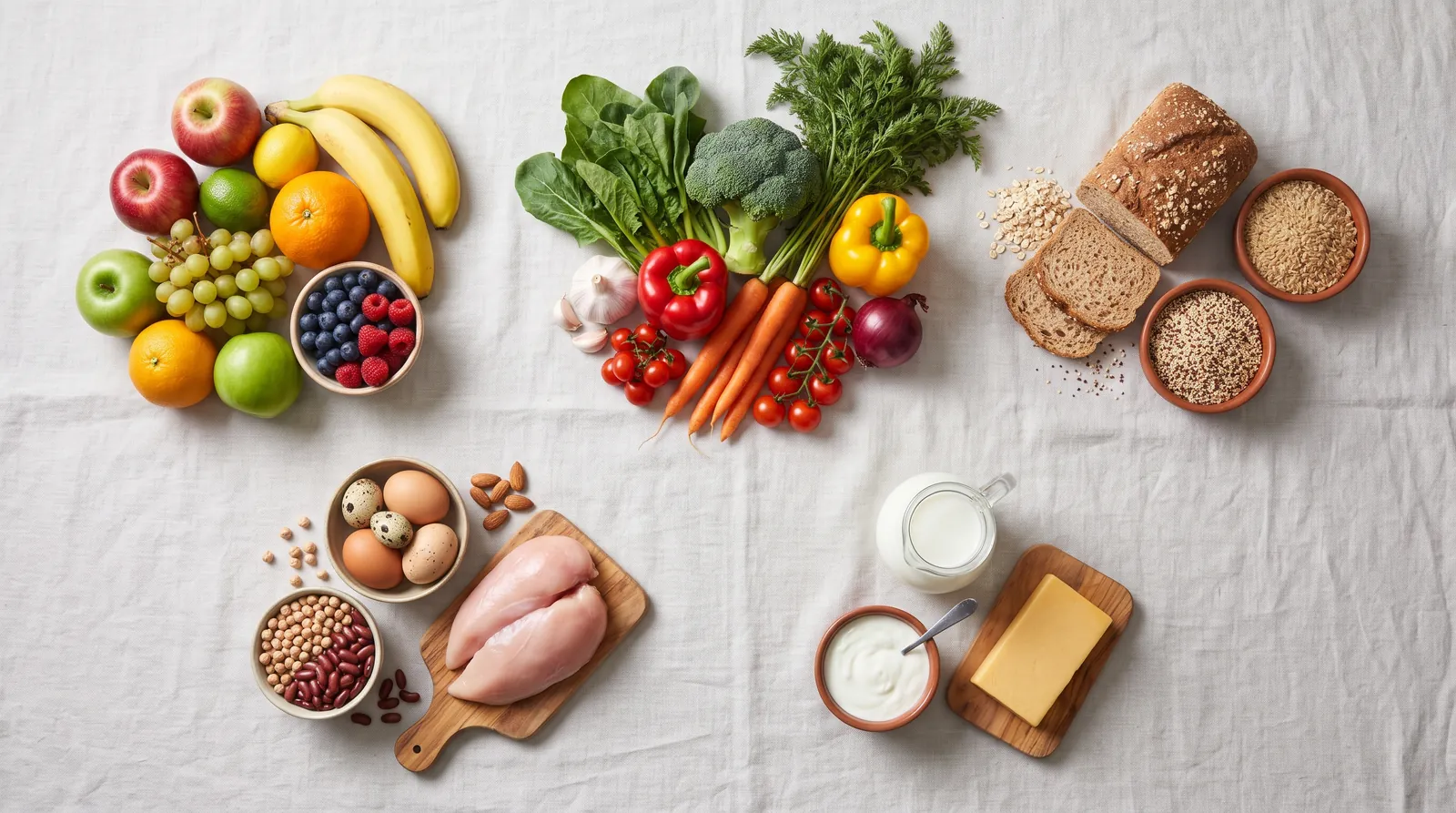
The new guidelines ask you to prioritize protein at every meal, from a variety of animal sources (eggs, poultry, seafood and red meat) and plant sources (beans, peas, lentils, nuts, seeds and soy). They also recommend baking, broiling, roasting, stir-frying or grilling instead of deep-frying. Lean choices like chicken breast and fish give a lot of protein for few calories.
Dairy
Three servings a day on most calorie levels. The 2025–2030 guidelines recommend including full-fat dairy with no added sugars, and their serving chart also counts reduced-fat and nonfat versions, lactose-free milk and fortified dairy alternatives.
Vegetables and fruits
Eat a variety of colors, and eat them whole where you can. Frozen, dried and canned versions with little or no added sugar count. 100% juice should be kept to small portions or diluted with water. Vegetables of every kind count, including beans and lentils, starchy vegetables like potatoes, and leafy greens. See how many servings of vegetables per day you need at your calorie level.
Whole grains
Whole grains like oats, brown rice and whole-wheat bread bring fiber and minerals. The guidelines now ask people to significantly reduce refined, highly processed carbohydrates such as white bread, packaged breakfast foods, flour tortillas and crackers.
Healthy fats
Healthy fats are found in meat, poultry, eggs, omega-3-rich seafood, nuts, seeds, full-fat dairy, olives and avocados. For cooking, the guidelines put olive oil first. They keep the long-standing limit on saturated fat: no more than 10% of daily calories.
Protein, carbs and fat in a balanced diet
Food groups are one way to answer what is a balanced diet. Macronutrients are another. For adults, the National Academies set acceptable ranges as a share of daily calories:
Those ranges are wide on purpose, because there's no single answer to what is a good diet: many different eating patterns can be balanced. Within them, the 2025–2030 Dietary Guidelines add a protein goal of 1.2 to 1.6 grams per kilogram of body weight a day. For a 70 kg (154 lb) adult that's about 84 to 112 grams. The macro calculator turns your calories and goal into grams of each.
- Carbohydrates are your main fuel. Choose whole grains, beans, fruit and vegetables over refined starches and sugar.
- Protein builds and repairs muscle and keeps you full. Spread it across meals.
- Fat carries vitamins A, D, E and K and provides essential fatty acids. Favor fats from whole foods and olive oil, and keep saturated fat under 10% of calories.
Each gram of protein or carbohydrate has about 4 calories and each gram of fat about 9, which is why small amounts of oil or nuts add up quickly. The calorie converter shows the math.
Vitamins, minerals, fiber and water
Micronutrients, the smallest components of a good diet, are needed in small amounts but can't be skipped. Eating across all the food groups is the simplest way to get them: dairy for calcium, vegetables and fruit for vitamin C, potassium and folate, protein foods for iron, zinc and vitamin B12, whole grains for B vitamins and magnesium. Some groups have extra needs; the guidelines highlight iron, folate and iodine in pregnancy, and protein, vitamin B12, vitamin D and calcium for older adults. See the 6 main nutrients for what each one does.
Fiber
Fiber keeps digestion regular and helps you feel full. The National Academies set an adequate intake of 14 grams per 1,000 calories, about 25 grams a day for women and 38 for men. Beans, lentils, whole grains, vegetables, fruit and nuts are the main sources. Use the fiber calculator to see how your usual foods add up.
Water
Hydration is one of the components of a good diet too. The Dietary Guidelines recommend water, still or sparkling, and unsweetened drinks. The NHS suggests 6 to 8 cups or glasses of fluid a day as a guide. Plain water has no calories at all, which makes it the easiest drink to fit into any plan.
What to limit in a balanced diet
A good diet for good health isn't only about what you add. The current guidance is clear about what to keep low:
- Highly processed foods. The 2025–2030 guidelines say to avoid highly processed packaged, prepared or ready-to-eat foods that are salty or sweet, such as chips, cookies and candy.
- Added sugars. No amount of added sugar is recommended, and one meal should contain no more than 10 grams. The WHO advises keeping free sugars under 10% of daily energy, ideally under 5%.
- Sugary drinks. Avoid sugar-sweetened beverages like soda, fruit drinks and energy drinks.
- Salt. Under 2,300 mg of sodium a day for ages 14 and up, according to the guidelines. The WHO sets a lower target: less than 5 g of salt, which is 2 g of sodium.
- Saturated fat. No more than 10% of daily calories.
- Alcohol. Drinking less is better for health, and some people, including pregnant women, should avoid it completely.
Reading labels helps with all of these. Added sugars appear under many names, including words ending in "-ose" and anything called a syrup; the guidelines list examples such as high-fructose corn syrup, agave syrup, dextrose and fruit juice concentrate.
What a balanced and varied diet means
A balanced and varied diet means choosing different foods within each group, not the same few every day. Variety matters because foods in the same group differ: spinach and carrots are both vegetables but bring different vitamins, and salmon brings omega-3 fats that chicken doesn't. The guidelines ask for a variety of colorful vegetables and fruits and a variety of protein foods from both animal and plant sources. The NHS says the same: eat at least 5 portions of a variety of fruit and vegetables a day. Our guide to the Eatwell Guide explains the UK model in full.
A simple way to keep a balanced and varied diet is to rotate: a different vegetable at each dinner, beans or lentils a couple of times a week, fish once or twice a week, and a mix of fruits over the week.
A sample balanced day
To make what is a balanced diet concrete, here's what one balanced day can look like, built on the 2,000-calorie pattern's food groups. Every number comes from USDA FoodData Central.
Breakfast 402 calories · 21 g protein
- Oatmeal1 cup cooked oats (½ cup dry) made with 1 cup of 2% milk275
- Fruit1 cup strawberries49
- Protein1 hard-boiled egg78
Lunch 543 calories · 25 g protein
- Sandwich2 slices whole-wheat bread, 1 oz cheddar276
- Salad2 cups spinach, 1 cup red pepper, ½ cup chickpeas187
- Dressing2 tsp olive oil80
Snack 248 calories · 21 g protein
- Yogurt170 g plain nonfat Greek yogurt100
- Fruit and nuts1 cup chopped apple, ½ oz almonds147
Dinner 555 calories · 34 g protein
- Salmon4 oz baked salmon234
- Sides½ cup brown rice, 1 medium sweet potato227
- Vegetables1 cup broccoli with 1 tsp olive oil95
| Nutrient | Total | Reference |
|---|---|---|
| Calories | 1,747 | Fits a 1,600 to 2,000 calorie day |
| Protein | 100 g (23% of calories) | 1.4 g/kg for a 70 kg adult |
| Carbohydrate | 200 g (46%) | 45–65% of calories |
| Fat | 65 g (34%) | 20–35% of calories |
| Saturated fat | 17 g (9%) | Under 10% of calories |
| Fiber | 37 g | 25 g women, 38 g men |
| Sodium | 952 mg | Under 2,300 mg |
| Added sugars | 0 g | None recommended |
How the day matches the food groups
Counting servings with the guidelines' definitions: about 4 servings of protein foods (egg, chickpeas, almonds and salmon), 3 of dairy (milk, cheese, yogurt), 3½ of vegetables, 2 of fruit and 5 of whole grains, plus 3 teaspoons of added olive oil. That's right on target for dairy and fruit, and a little generous on protein, vegetables and whole grains, which suits an active adult. To bring whole grains down to 4, make the oatmeal ½ cup cooked.
All 63 grams of sugar in this day are natural sugars from milk, fruit and vegetables, with no added sugar. Notice that it lands under 2,000 calories even with full portions: whole foods fill you up for fewer calories. On a 2,000-calorie budget, there's room for a larger dinner, full-fat dairy or an extra piece of fruit.
A balanced meal plan for the week
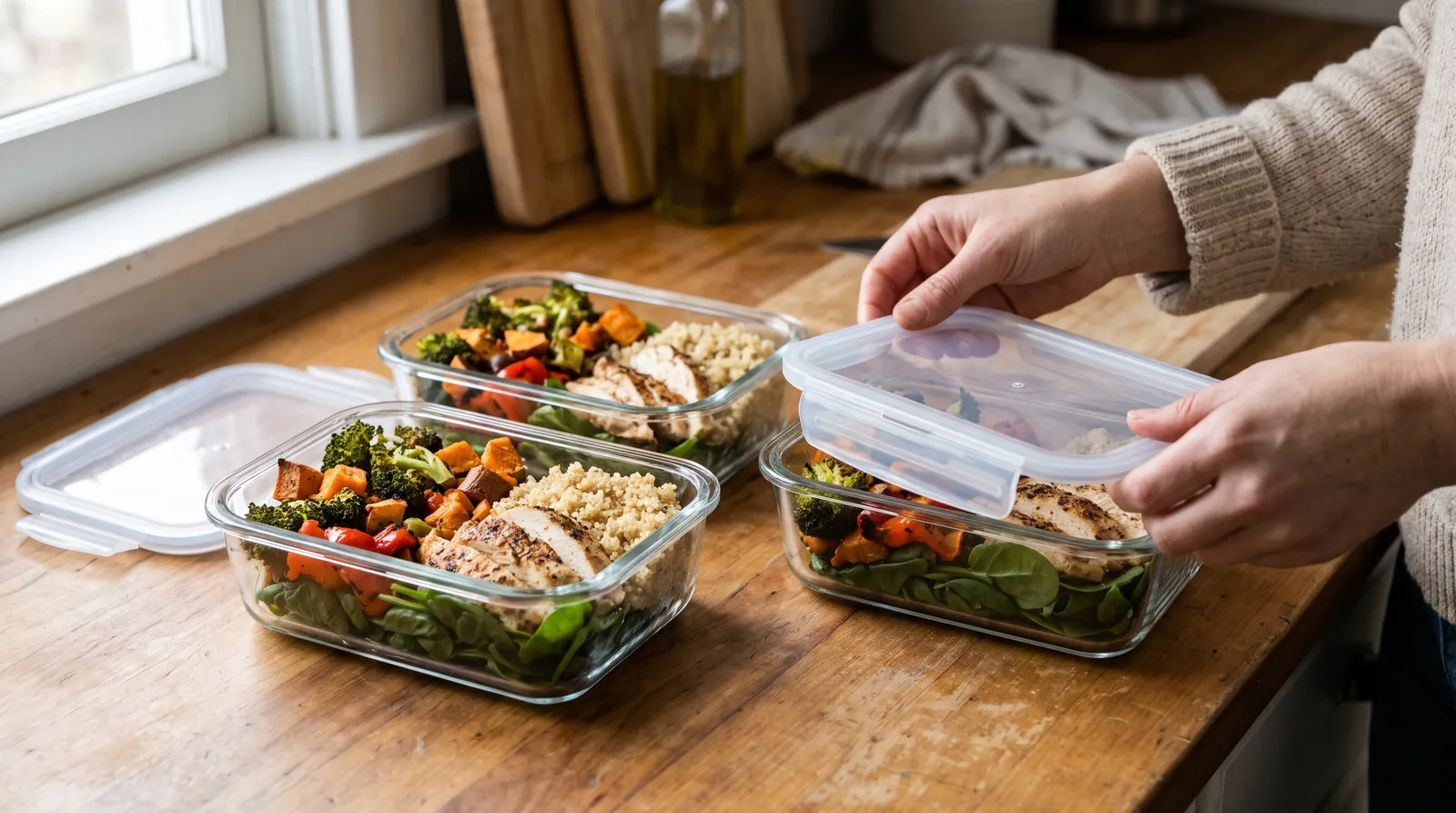
A meal plan for a balanced diet doesn't need seven different recipes. Pick two breakfasts, three lunches and four dinners you like, keep each one built around a protein food, a vegetable and a whole grain or starchy vegetable, and rotate. Cooking a batch of grains and roasting a tray of vegetables twice a week covers most meals. For a full week of meals with calories counted, see our upcoming meal plans, or build your own with the recipe nutrition calculator.
US, UK and WHO advice compared
Different health bodies answer what is a balanced diet in slightly different ways, but they agree on the core:
| Topic | US Dietary Guidelines 2025–2030 | UK NHS Eatwell Guide | WHO |
|---|---|---|---|
| Fruit and vegetables | 3 servings of vegetables and 2 of fruit (2,000 kcal) | At least 5 portions a day | At least 400 g a day |
| Starches and grains | Whole grains, 2–4 servings; cut refined carbs | Base meals on potatoes, bread, rice, pasta or other starchy carbohydrates | — |
| Protein | 1.2–1.6 g/kg a day, at every meal | Some beans, pulses, fish, eggs, meat | — |
| Dairy | 3 servings; full-fat allowed | Some dairy or alternatives | Not set as a group |
| Sugar | No added sugar recommended; max 10 g per meal | — | Free sugars under 10% of energy, ideally under 5% |
| Salt | Sodium under 2,300 mg | — | Salt under 5 g (sodium 2 g) |
| Fat | Saturated fat ≤ 10% of calories | Unsaturated oils, in small amounts | Total fat ≤ 30%, saturated < 10%, trans < 1% |
The biggest difference is emphasis. The new US guidelines put protein and whole foods first and are more open to full-fat dairy and animal fats like butter; the NHS Eatwell Guide still builds the plate around starchy carbohydrates and unsaturated oils; the WHO focuses on limits for sugar, salt and fat. Any of them, followed sensibly, gives you a balanced diet.
A balanced diet at different life stages
The food groups stay the same for everyone, but the 2025–2030 guidelines point out what each stage of life needs most. So what is a balanced diet for you? Start from the general pattern and adjust for these:
- Teenagers: rapid growth raises needs for energy, protein, calcium and iron, especially for girls. Dairy, leafy greens and iron-rich animal foods help, along with cutting back on sugary and energy drinks.
- Young adults: bone density is still building toward its peak, so calcium-rich foods and regular meals matter.
- Pregnancy: iron, folate and iodine are the top priorities, from iron-rich meats, folate-rich greens and legumes, eggs, dairy and low-mercury seafood such as salmon, sardines and trout. Ask your health professional about a prenatal vitamin.
- Breastfeeding: energy and nutrient needs rise. The breastfeeding calorie calculator estimates how much more to eat.
- Older adults: many need fewer calories but the same or more protein, vitamin B12, vitamin D and calcium, so nutrient-dense foods matter even more.
- Vegetarians and vegans: a balanced vegetarian diet relies on dairy, eggs, beans, lentils, nuts, seeds, tofu and tempeh for protein. The guidelines warn that vegan diets can fall short in several nutrients, including vitamin B12, vitamin D, calcium, iron and iodine, and suggest checking those with a professional.
People with a chronic disease should talk with their doctor or a registered dietitian about adapting the pattern; the guidelines note that some do better on a lower-carbohydrate diet.
A balanced diet for weight loss
You can lose weight on a balanced and varied diet; in fact it's the easiest way to keep weight off. Weight loss comes from eating fewer calories than you burn, and a balanced diet helps because:
- Protein at each meal helps keep you full and protects muscle while you lose fat.
- Fiber-rich foods like vegetables, beans and whole grains fill you up for few calories.
- Whole foods are harder to overeat than highly processed snacks and sugary drinks.
Keep the same food groups and shrink the portions to fit a lower calorie target (our weight loss plan walks through setting one), choosing the 1,600-calorie column instead of 2,000, for example. To set a realistic target and see how long it takes, use the weight loss simulator, then track your meals in the calorie counter for a week or two to check you're on course.
Eating a balanced diet on a budget
A good diet for good health doesn't have to be expensive. Some of the most nutrient-dense foods are among the cheapest:
- Beans, lentils and chickpeas, dry or canned, count as both protein foods and vegetables.
- Oats, brown rice and whole-wheat bread cover whole grains for little money.
- Frozen vegetables and fruit keep for months and count just as much; the guidelines include frozen and canned options with little or no added sugar.
- Eggs and canned fish are cheap, quick protein.
- Carrots, cabbage, apples and bananas are usually inexpensive. See carrot nutrition and the lowest calorie fruits.
Cooking at home is the other big saver, and the new guidelines recommend home-prepared meals over ready-to-eat processed food.
Common balanced diet myths
"Carbs are bad"
Carbohydrate is the largest acceptable share of calories for adults, 45 to 65%. The issue is refined, highly processed carbs, not carbs from whole grains, beans, fruit and vegetables. Some people with chronic conditions do better on lower-carb eating, and the guidelines suggest working that out with a health professional.
"Fat makes you fat"
Fat is calorie-dense at 9 calories a gram, but it's essential, and the guidelines list many whole-food sources of healthy fats. Total calories matter more for weight than any one nutrient.
"You need supplements"
Most people can meet their needs from food. The guidelines mention supplements only for specific situations, such as some needs in pregnancy, older adults with low intake or absorption, and gaps in vegan diets, and advise doing so with a health professional.
"Healthy eating means never having treats"
What is a good diet over a lifetime? Balance is about your usual pattern. An occasional dessert doesn't undo a balanced week; a diet built mostly on processed snacks does.
The components of a good diet, in short
- Protein foods at every meal, from both animal and plant sources.
- Three servings of dairy, or fortified alternatives.
- Plenty of vegetables and fruits of many colors, mostly whole.
- Whole grains instead of refined ones.
- Healthy fats from whole foods and olive oil, with saturated fat under 10%.
- Water as your main drink.
- Very little added sugar, salt or highly processed food.
- Calories that match your needs.
That list is a good diet for good health in a nutshell. Which is the healthiest diet? The one built on these points that you can keep eating for years; the Mediterranean and DASH patterns are well-studied examples, and we'll compare them in a separate article.
Balanced diet FAQ
What is a balanced diet?
A balanced diet gives your body the energy and nutrients it needs by including foods from every food group in the right amounts: protein foods, dairy, vegetables, fruits, whole grains and healthy fats, while keeping highly processed foods, added sugars and excess salt low.
What are the food groups in a balanced diet?
The Dietary Guidelines for Americans, 2025–2030, use six groups: protein foods, dairy, vegetables, fruits, whole grains and healthy fats. On a 2,000-calorie pattern that's about 2½ to 3½ servings of protein foods, 3 of dairy, 3 of vegetables, 2 of fruit, 2 to 4 of whole grains and 4½ teaspoons of healthy fats a day.
What is the difference between a balanced diet and a healthy diet?
They mean almost the same thing. A balanced diet stresses the right mix of food groups and nutrients; a healthy diet is the broader idea of eating in a way that supports health, which also includes limiting salt, added sugars and highly processed foods.
How much protein, carbs and fat should a balanced diet have?
For adults, the National Academies' acceptable ranges are 45 to 65% of calories from carbohydrate, 10 to 35% from protein and 20 to 35% from fat. The 2025–2030 Dietary Guidelines set a protein goal of 1.2 to 1.6 grams per kilogram of body weight a day.
Can you lose weight on a balanced diet?
Yes. Weight loss depends on eating fewer calories than you burn, and a balanced diet makes that easier because protein, fiber and whole foods keep you full. Keep the same food groups and reduce portions to fit a calorie target.
Sources
- U.S. Departments of Health and Human Services and Agriculture. Dietary Guidelines for Americans, 2025–2030, January 2026.
- U.S. Departments of Health and Human Services and Agriculture. Daily Servings by Calorie Level, Dietary Guidelines for Americans, 2025–2030.
- World Health Organization. Healthy diet fact sheet.
- NHS. The Eatwell Guide.
- National Academies. Dietary Reference Intakes for Energy, Carbohydrate, Fiber, Fat, Fatty Acids, Cholesterol, Protein, and Amino Acids, 2005 (acceptable macronutrient distribution ranges); dietary, functional and total fiber.
- U.S. Department of Agriculture, FoodData Central (SR Legacy): oats (173904), milk 2% (171267), egg hard-boiled (173424), whole-wheat bread (172688), cheddar (170899), spinach (168462), red pepper (170108), chickpeas (173757), olive oil (171413), Greek yogurt (170894), apple (171688), strawberries (167762), almonds (170567), salmon (175168), brown rice (169704), sweet potato (168483), broccoli (169967).