
Short answerTo lose weight, eat about 500 calories a day less than you burn, which gives roughly 1 pound of loss a week. Find your maintenance calories, keep protein high, fill up on vegetables, fruit, beans and whole grains, cut sugary drinks and highly processed snacks, move more, and track your progress for a few weeks. The CDC notes that losing 1 to 2 pounds a week makes it more likely you'll keep the weight off.
In this article
- How weight loss works
- Step 1: Find your calories
- Step 2: Choose a safe deficit
- Step 3: Prioritize protein and fiber
- Step 4: Plan your meals
- Step 5: Move more
- Step 6: Track and adjust
- Step 7: Build habits that last
- Which diet is best?
- Common mistakes
- The plan on one page
- Good diet foods for weight loss
- Plateaus
- For women and for men
- When to get help
- FAQ
How weight loss works
Your body uses energy all day: to keep you alive at rest, to digest food and to move. That total is your daily calorie burn, often called TDEE. When you eat fewer calories than that, your body makes up the difference from stored energy, mostly body fat, and your weight goes down over time. When you eat more, it stores the extra.
That's why every weight loss plan that works, whether it's low-carb, low-fat, intermittent fasting or a simple calorie target, works the same way underneath: it helps you eat less than you burn. The differences between diets are mostly about which approach makes that easier for you. So the question of how to lose weight has a simple answer and a harder one. The simple answer is a calorie deficit. The harder one is finding a way to keep that deficit week after week without feeling miserable, and that's what the rest of this plan is about.
Step 1: Find your maintenance calories
Every weight loss plan starts with one number. Before you can eat less, you need to know how much you burn. The TDEE calculator estimates this from your age, sex, height, weight and activity, using the Mifflin-St Jeor equation, which a systematic review found to be the most accurate of the common equations for both normal-weight and heavier adults.
Two worked examples
- Sarah, 35, 165 cm (5 ft 5 in), 80 kg (176 lb), lightly active. Her resting burn (BMR) is about 1,495 calories, and with light activity her maintenance is about 2,056 calories a day.
- Mark, 40, 180 cm (5 ft 11 in), 95 kg (209 lb), moderately active. His BMR is about 1,880 calories, and his maintenance is about 2,914 calories a day.
Those two people need very different calorie targets to lose weight at the same pace, which is why one-size-fits-all plans so often fail. Your number is an estimate; the tracking in step 6 shows whether it's right for you.
Step 2: Choose a safe calorie deficit
In a weight loss plan, a deficit of about 500 calories a day is a good starting point for most people. Using the common estimate of about 7,700 calories per kilogram of body weight (3,500 per pound), here's roughly what different deficits mean at the start:
The CDC notes that people who lose weight at a gradual, steady pace of about 1 to 2 pounds a week are more likely to keep it off than people who lose faster. For Sarah, a 500-calorie deficit means about 1,550 calories a day. For Mark, it's about 2,400, and he could choose a bigger deficit and still eat well.
Why the pace slows over time
For a long weight loss plan, the 3,500-calories-per-pound rule only works for the first weeks. As you lose weight, your body burns less, so the same food intake gives a smaller deficit; researchers have shown that the simple rule overestimates loss over months. The weight loss simulator uses a dynamic model that accounts for this, so it gives you a realistic goal date instead of a straight line.
How long will it take to reach your goal?
Take Sarah, who wants to go from 80 kg to 70 kg. Ten kilograms of body weight is roughly 77,000 calories of stored energy. At a 500-calorie daily deficit, or 3,500 a week, the simple math says about 22 weeks, a little over five months. In practice it takes longer, because her maintenance calories fall as she gets lighter: at 70 kg she burns roughly 140 calories a day less than at 80 kg, so the same 1,550-calorie intake gives a smaller deficit each month. Plan for six months or so, and either accept the slower pace near the end or trim your target slightly as you go.
Mark, aiming to lose 15 kg from 95 kg, could reach his goal in a similar time with a deficit of about 750 calories a day, eating about 2,150 to 2,200 calories, which is still a generous amount of food. Putting your own numbers into the simulator takes the guesswork out.
How low is too low?
Very low-calorie diets, around 800 calories a day, are typically used under medical supervision (see our 800 calorie a day diet guide). For most adults, eating fewer than about 1,200 calories a day (see our 1000 calorie diet guide) makes it hard to get enough protein, fiber, vitamins and minerals without careful planning, and it's harder to stick with. A moderate deficit you can keep for months beats an aggressive one you abandon after two weeks.
Step 3: Prioritize protein and fiber
Two nutrients make any weight loss plan far easier to live with, and they are part of healthy eating habits for weight loss.
Protein
Protein keeps you full and helps you hold on to muscle while you lose fat, so more of the weight you lose comes from fat. The 2025–2030 Dietary Guidelines for Americans set a goal of 1.2 to 1.6 grams of protein per kilogram of body weight a day. For Sarah at 80 kg, that's 96 to 128 g a day; spread over three meals, about 30 to 40 g each. A palm-sized portion of chicken, fish or meat, a cup of Greek yogurt or a cup of lentils each provides a big share. The macro calculator works out your protein, carbs and fat in grams.
Fiber
Fiber-rich foods are bulky and slow to digest, so they fill you up for few calories. The National Academies' adequate intake is 14 grams per 1,000 calories, about 25 g a day for women and 38 for men, and most people eat far less. Vegetables, fruit, beans, lentils and whole grains are the main sources; the fiber calculator shows where you stand.
Step 4: Plan your meals
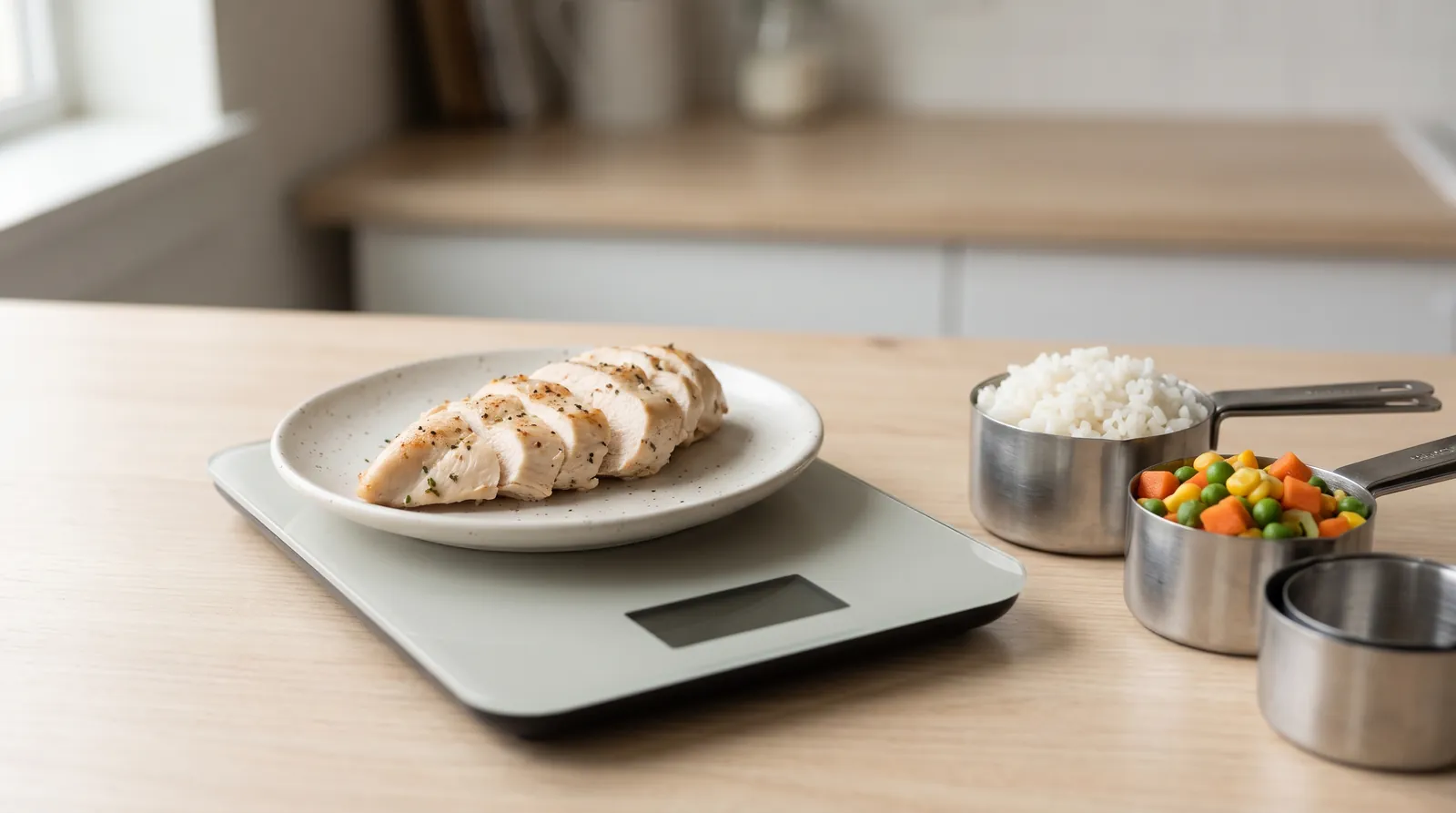
Planning meals is the core of a weight loss plan. Deciding what to eat in advance takes willpower out of the moment you're hungry. You don't need a complicated system:
- Build each meal the same way: a protein food, at least one vegetable, a whole grain or starchy vegetable, and a small amount of healthy fat.
- Pick a handful of meals you like for each slot and rotate them.
- Plan one snack for the time of day you usually get hungry, so it's a yogurt or fruit rather than whatever is nearby.
- Cook in batches twice a week: a pot of grains, a tray of roasted vegetables and a few portions of protein.
If you'd rather start with a ready-made plan, our 7-day meal plan for weight loss gives you a full week at about 1,500 calories, with every meal counted and a grocery list, plus how to scale it to 1,200, 1,800 or 2,000 calories. For the bigger picture of what to include, see what a balanced diet is.
What is a proper diet to lose weight?
A proper diet to lose weight is a balanced diet with fewer calories, not a special set of "diet foods". The 2025–2030 Dietary Guidelines' advice fits weight loss well: prioritize protein at every meal, eat vegetables and fruit throughout the day, choose whole grains over refined carbohydrates, use healthy fats in small amounts, and avoid highly processed snacks and sugar-sweetened drinks. Those changes alone cut a lot of calories for most people.
Drinks matter
In a weight loss plan, drinks are an easy place to save calories because they don't fill you up. A 20 oz bottle of regular cola has about 258 calories, a 16 oz orange juice about 244, while plain water has none. See water and drink calories for more comparisons.
Step 5: Move more
Exercise belongs in every weight loss plan: it burns calories and, just as importantly, helps you keep muscle and stay healthy while you lose weight. The CDC advises adults to get at least 150 minutes of moderate activity a week, such as brisk walking, plus muscle-strengthening activity on 2 or more days.
- Walking is the easiest place to start. See what yours burns with the walking calorie calculator, or convert your step count with steps to calories.
- Strength training two or three times a week protects muscle, which matters more the longer your diet lasts.
- Everyday movement (taking stairs, standing, walking to errands) adds up across a week.
Don't eat back every calorie a fitness tracker says you burned; estimates can run high (see net calories vs total calories). Treat exercise as a bonus on top of your planned deficit.

Step 6: Track and adjust
Your calorie target is an estimate, so your weight loss plan needs a way to check it:
- Log your food for 2 to 3 weeks. The free calorie counter works in your browser with no account, or pick one of the best calorie counter apps. Weighing food for the first weeks teaches you what portions really contain.
- Weigh yourself regularly, at the same time of day, and look at the weekly average, not daily swings. Water, salt and digestion can move the scale noticeably from one day to the next.
- Adjust after 2 to 3 weeks. If your average isn't moving, lower your target by 100 to 200 calories or add activity. If you're losing faster than 2 pounds a week after the first fortnight, eat a little more.
- Measure more than weight. Your waist measurement and how your clothes fit often change even when the scale is stubborn; our guide to losing belly fat explains how to measure.
Re-calculate your maintenance calories every 5 kg or so; a smaller body needs fewer calories.
Step 7: Build healthy eating habits for weight loss
Calorie targets get you started; healthy eating habits for weight loss keep the weight off. These are the ones that make the biggest difference for most people:
- Eat regular meals. Long gaps lead to big portions later.
- Start meals with vegetables or soup to take the edge off hunger.
- Serve food on a plate instead of eating from the package.
- Keep tempting foods out of easy reach and keep fruit, yogurt and cut vegetables in sight.
- Get enough sleep. Tiredness makes it harder to stick to plans.
- Plan for social meals by eating a little lighter earlier in the day, and enjoy the occasion.
- Expect setbacks. A bad day or week doesn't erase progress; the next planned meal is the fix.
An online weight loss plan you can build for free
You don't need a paid online weight loss plan to follow a structured plan. Our free calculators cover each step: the TDEE calculator for your target, the weight loss simulator for your timeline, the macro calculator for protein, the meal plan for what to eat and the calorie counter to track it. Everything runs in your browser and nothing you enter is stored on a server.
Which diet is best for weight loss?
Low-carb, low-fat, Mediterranean, intermittent fasting, high-protein: each has passionate fans, and each can work, because each is a different way of eating fewer calories. Head-to-head trials back this up. In the DIETFITS randomized trial, published in JAMA in 2018, overweight adults followed either a healthy low-fat or a healthy low-carbohydrate diet for a year. Average weight loss at 12 months was 5.3 kg on the low-fat diet and 6.0 kg on the low-carb diet, a difference too small to matter. Both groups were coached to eat whole, minimally processed foods and vegetables. We compare ten of them in different types of diets.
So pick the style that suits how you like to eat:
- Like structure and simple rules? A set meal plan, like our 7-day plan, removes daily decisions.
- Don't miss bread and pasta much? A lower-carb approach may feel easy; the macro calculator has low-carb and keto settings.
- Not hungry in the morning? A time-restricted eating window can help; map one out with the fasting calculator.
- Want flexibility? Count calories and protein, eat what you like within them, and keep most of your food whole.
Whichever weight loss plan you choose, the same basics apply: a moderate deficit, enough protein and fiber, and habits you can keep.
Common weight loss plan mistakes
- Cutting too hard at the start. Big deficits feel motivating for a week, then hunger wins. A 500-calorie deficit is sustainable.
- Forgetting liquid calories. Juice, soda, sweet coffee drinks and alcohol add up without filling you.
- Underestimating oils, nuts and sauces. A tablespoon of olive oil has about 119 calories; a handful of nuts can be 200 or more.
- Eating too little protein. More of the weight lost comes from muscle, and you feel hungrier.
- Weighing yourself and reacting to every daily change. Look at the weekly average instead.
- Saving all your calories for the evening. Skipping meals often leads to overeating later.
- Making the plan all-or-nothing. A plan that leaves no room for a meal out or a dessert rarely lasts.
Your weight loss plan on one page
- Find your maintenance calories with the TDEE calculator.
- Subtract about 500 for a pace of about 1 pound a week; stay above about 1,200 calories without medical supervision.
- Aim for 1.2 to 1.6 g of protein per kg of body weight, spread over your meals.
- Build meals from protein, vegetables, a whole grain or starchy vegetable and a little healthy fat; aim for 25 to 38 g of fiber.
- Drink water instead of sugary drinks and keep highly processed snacks occasional.
- Walk most days and add strength training twice a week.
- Log your food and weigh yourself for 2 to 3 weeks, then adjust by 100 to 200 calories if needed.
- Recalculate every 5 kg, and plan for social meals and setbacks.
What are good diet foods for weight loss?
What are good diet foods? No single food makes you lose weight, but some make a calorie deficit easier because they're filling for their calories. Good diet foods to build your meals around:
| Food | Portion | Calories | Why it helps |
|---|---|---|---|
| Chicken breast, roasted | 3 oz | 140 | 26 g protein |
| Greek yogurt, plain nonfat | 170 g container | 100 | 17 g protein |
| Eggs | 2 large | 155 | 13 g protein |
| Cod, baked | 5 oz | 158 | 34 g protein, almost no fat |
| Lentils, cooked | 1 cup | 230 | 18 g protein, 16 g fiber |
| Raspberries | 1 cup | 64 | 8 g fiber |
| Broccoli, cooked | 1 cup | 55 | 5 g fiber |
| Oats | ½ cup dry | 152 | 4 g fiber, slow to digest |
| Watermelon | 1 cup diced | 46 | Large volume, few calories |
| Baby carrots | 3 oz | 30 | Crunchy, low-calorie snack |
For more food-by-food numbers, see our food nutrition facts and the lowest calorie fruits.
Best weight loss foods for women
The best weight loss foods for women are the same as for men; the difference is usually the amount, because many women have lower calorie needs. That makes protein and fiber density even more useful: foods like Greek yogurt, eggs, fish, chicken, beans, lentils, berries and vegetables give the most nutrition and fullness per calorie. Women also need enough iron and calcium, so keep dairy or fortified alternatives and iron-rich foods like lean meat, beans and leafy greens in the plan, especially before menopause.
How to lose weight without feeling hungry all the time
Some hunger is normal on any weight loss plan, but it shouldn't dominate your day. If it does, the plan usually needs adjusting rather than more willpower:
- Move calories toward volume. Swap part of a pasta or rice portion for vegetables; you eat the same amount of food for fewer calories.
- Put protein in every meal, including breakfast, where it's most often missing.
- Eat fruit whole instead of juiced; a navel orange has 69 calories and 3 g of fiber, a cup of orange juice 122 calories and almost none.
- Check the deficit. If you're hungry, tired and irritable every day, your target may be too low; add 100 to 200 calories and accept a slightly slower pace.
What to do when weight loss stalls
Almost everyone on a weight loss plan hits a plateau. The usual causes, in order of how often they're the culprit:
- Portion creep. Weigh and log your food for a week to check.
- A smaller deficit. You now burn less than when you started; recalculate at your current weight.
- Water retention. A salty meal, a hard workout or hormonal changes can hide fat loss for a week or two. Look at the trend over three to four weeks.
- Less movement. People often move less without noticing when they eat less; check your daily steps.
If nothing has changed for a month and you're tracking carefully, cut another 100 to 200 calories or add a session of activity. If you've been dieting for months, some people find a planned week or two at maintenance makes the next phase easier to stick with.
A weight loss plan for women and for men
The steps of a weight loss plan are the same for everyone, but the numbers differ. Men tend to be taller and carry more muscle, so their maintenance calories are usually higher, as Sarah's and Mark's examples show. That gives men more room: a 500-calorie deficit still leaves Mark well over 2,000 calories a day, while Sarah's leaves her near 1,550. Ready-made menus near both levels: the 2000 calorie meal plan and the 1600 calorie diet. For many women, especially smaller or less active ones, that means:
- Accepting a slower pace, like 0.5 to 1 pound a week, rather than going under about 1,200 calories.
- Leaning on activity to widen the gap, since a daily walk is a bigger share of a smaller calorie budget.
- Choosing the most filling foods per calorie: protein, vegetables, beans and fruit.
- Keeping enough iron and calcium in the plan from lean meat, beans, leafy greens and dairy or fortified alternatives.
Pregnancy and breastfeeding change calorie needs entirely; the breastfeeding calorie calculator covers nursing mothers, and anyone pregnant should plan weight changes with their doctor.
When to get help
Talk to your doctor or a registered dietitian before starting a weight loss plan if you have diabetes, heart or kidney disease, take medication that affects appetite or blood sugar, or have a history of disordered eating. It's also worth asking for help if you've followed a plan carefully for a couple of months without results, or if you have a lot of weight to lose; there are medical treatments and structured programs that can help when diet and activity alone aren't enough.
Weight loss plan FAQ
What is the best weight loss plan?
The one you can keep up. Any plan that puts you in a moderate calorie deficit, about 500 calories a day, with enough protein and fiber and foods you enjoy will work. Many different diets succeed for that same reason.
How fast can I safely lose weight?
The CDC says people who lose about 1 to 2 pounds a week are more likely to keep the weight off than people who lose weight faster. That's roughly a 500 to 1,000 calorie daily deficit.
What is a proper diet to lose weight?
A diet with fewer calories than you burn, built mostly from whole foods: protein at every meal, plenty of vegetables, fruit, whole grains and beans, healthy fats in small amounts, and few highly processed foods and sugary drinks.
Do I have to count calories to lose weight?
No, but it helps at the start. Counting for two or three weeks shows you what your portions really contain; after that many people can keep losing with set meals and portion habits.
Why did my weight loss stop?
As you lose weight your body burns fewer calories, so the same intake gives a smaller deficit. Portions also tend to creep up. Recalculate your calories at your new weight and check portion sizes.
Sources
- Centers for Disease Control and Prevention. Steps for losing weight.
- Centers for Disease Control and Prevention. Physical activity guidelines for adults.
- U.S. Departments of Health and Human Services and Agriculture. Dietary Guidelines for Americans, 2025–2030, January 2026.
- Mifflin MD, St Jeor ST, et al. A new predictive equation for resting energy expenditure in healthy individuals. Am J Clin Nutr, 1990.
- Frankenfield D, et al. Comparison of predictive equations for resting metabolic rate in healthy nonobese and obese adults: a systematic review. J Am Diet Assoc, 2005.
- Hall KD, Chow CC. Why is the 3500 kcal per pound weight loss rule wrong? Int J Obes, 2013.
- Gardner CD, et al. Effect of Low-Fat vs Low-Carbohydrate Diet on 12-Month Weight Loss in Overweight Adults: The DIETFITS Randomized Clinical Trial. JAMA, 2018.
- National Academies. Dietary Reference Intakes: dietary, functional and total fiber, 2005.
- U.S. Department of Agriculture. FoodData Central (food values in the table).