Short answerAn 800 calorie a day diet is a very low calorie diet (VLCD). Research supports it for people with obesity, and for some people with type 2 diabetes, when it's medically supervised and time-limited, usually with meal replacement shakes and soups. Weight loss is fast, often 1.5 to 2.5 kg a week, but gallstones and medication problems are real risks. Don't start one without your doctor. If you're planning your own diet, a 1,200 to 1,500 calorie plan is the safer choice.
Medical note: This article explains how very low calorie diets work. It isn't medical advice. Talk to your doctor before eating 800 calories a day, especially if you take medicine for diabetes or blood pressure, are pregnant or breastfeeding, are under 18, or have had an eating disorder. See our medical disclaimer.
In this article
- What is an 800 calorie diet?
- VLCD diets: what the research says
- The NHS soups and shakes programme
- Who it's for, and who shouldn't try it
- How fast weight comes off
- Risks and side effects
- 800 calorie meal plan: 3 sample days
- VLCD meal plan with shakes
- Rules if your doctor approves it
- After the diet
- Safer alternatives
- FAQ
What is an 800 calorie diet?
An 800 calorie diet is exactly what it sounds like: eating about 800 calories a day, every day, for a set period. That puts it in the category of a very low calorie diet. A 1993 National Institutes of Health task force defined VLCDs as diets of 800 calories a day or less, and most research on them uses that cutoff.
To see how low that is, compare it with what your body burns at rest. In our metabolism guide, a lightly active 35-year-old woman at 165 cm and 80 kg burns about 1,495 calories a day just at rest, and about 2,056 in total. An 800 calories a day diet leaves her short by over 1,200 calories every day. You can check your own numbers with the BMR calculator and the TDEE calculator.
There are two ways people do an 800 calorie diet plan:
- Total diet replacement. All meals are replaced with nutritionally complete shakes, soups or bars. This is how most clinical programmes work, including the NHS programme described below.
- Food-based. Small meals built around lean protein and vegetables. This is harder to make nutritionally complete at 800 calories, which is why clinical programmes prefer formula products.
Either way, an 800 calorie a day diet isn't a long-term way of eating. VLCDs are run for a fixed number of weeks and then followed by a slow return to normal food.
VLCD diets: what the research says
VLCD diets have been studied for decades. The main findings:
They're safe and effective with supervision
The 1993 NIH task force concluded that VLCDs are safe and effective for people with obesity when they're done under medical supervision. It reported average weight loss of about 1.5 to 2.5 kg (3.3 to 5.5 lb) a week. The task force also found that, over the long term, people didn't keep off more weight than with other approaches.
They work faster, but the lead shrinks
A 2006 meta-analysis by Tsai and Wadden compared VLCDs with standard low calorie diets. In the short term, VLCDs produced more weight loss: 16.1% of starting weight against 9.7%. In the long term, results were similar: 6.3% against 5.0%.
That's the main trade-off with an 800 calorie a day diet. You lose weight faster, but most of the extra loss comes back unless what you do afterwards holds it.
They can put type 2 diabetes into remission
The DiRECT trial, published in The Lancet in 2018, tested an 825 to 853 calorie formula diet for 3 to 5 months in people with type 2 diabetes in UK primary care, followed by stepped food reintroduction and support. After a year, 46% of the diet group were in remission, against 4% in the control group. The diet group lost about 10 kg on average.
DiRECT is the reason the NHS now offers a VLCD-style programme. It's also a good example of what makes these diets work: a fixed formula, close support from clinicians, and a planned exit.
The NHS soups and shakes programme
In England, the NHS Type 2 Diabetes Path to Remission Programme is the main official use of a very low calorie diet. It's often called the "NHS Soups and Shakes" diet and was formerly known as the NHS Low Calorie Diet Programme.
According to NHS integrated care boards that run the service, it works like this:
- 12 weeks of total diet replacement. Normal meals are replaced with low-calorie soups and shakes.
- Food reintroduction. A managed plan brings healthy food back into the diet.
- Support for 12 months in total, with sessions with a practitioner and online modules.
Eligibility is strict. To be referred, people generally need to be:
- aged 18 to 65
- diagnosed with type 2 diabetes within the last 6 years
- at a BMI of 27 or higher (25 or higher for people of Black, Asian or minority ethnic origin)
- within set HbA1c limits, and up to date with diabetes reviews
People are excluded if they use insulin, are pregnant or planning pregnancy in the next six months, are breastfeeding, or have conditions such as active cancer, a heart attack or stroke in the last six months, severe heart failure, severe kidney impairment, active liver disease (other than fatty liver), an active eating disorder or substance use disorder, or untreated proliferative retinopathy. People who have had or are waiting for bariatric surgery are also excluded.
One detail matters for anyone thinking of trying this alone: referrals must come from a prescribing clinician, "due to the requirement of a medication review and potential drug changes." Diabetes and blood pressure medicine can become too strong when calories drop this far, and doses may need to change from the first day.
The NHS also sets expectations. One service page says people who stick with the programme "can expect to lose ~10% of your starting weight or more," and that remission isn't guaranteed: "the research so far suggests that it isn't possible for everyone."
Who it's for, and who shouldn't try it
Based on the research and the NHS criteria, an 800 calories a day diet is meant for:
- adults with obesity, under medical supervision
- some adults with type 2 diabetes, diagnosed recently, through a supervised programme
It isn't meant for:
- people who want to lose a few pounds, or who are at a healthy weight
- children and teenagers
- pregnant or breastfeeding women
- anyone with a current or past eating disorder
- people on insulin or other medicines that need monitoring, unless their doctor is managing it
- people with the medical conditions listed above
If you're not sure which group you're in, that's a sign to talk to your doctor before cutting to 800 calories.
How fast does weight come off on 800 calories?
The speed of an 800 calorie diet plan comes from the size of the gap between what you eat and what you burn. Take the example woman from earlier, who burns about 2,056 calories a day. Here's her daily deficit at different intakes:
| Eating per day | Daily deficit | Weekly deficit |
|---|---|---|
| 800 calories | about 1,256 | about 8,790 |
| 1,000 calories | about 1,056 | about 7,390 |
| 1,200 calories | about 856 | about 5,990 |
| 1,500 calories | about 556 | about 3,890 |
The old rule of thumb says a pound of fat is 3,500 calories, which would turn an 8,790 calorie weekly deficit into 2.5 lb a week. Real weight loss doesn't follow that line for long. Hall and Chow showed the 3,500 calorie rule overestimates weight loss over time, because the body burns less as it gets smaller.
Notice also how small the step from 800 to 1,000 calories is: about 200 calories a day, or roughly 1,400 a week. That's why many people do almost as well on a 1,000 or 1,200 calorie plan with fewer risks. The weight loss simulator models this slowdown, so you can compare an 800 kcal a day meal plan with a gentler one over several months.
What 800 calories looks like on a plate
800 calories disappears quickly with calorie-dense food. Using USDA values, each of these alone is about 800 calories: 138 g of almonds (about a cup), 195 g of cheddar cheese, or 134 g of peanut butter (about 8 tablespoons). The same 800 calories buys about 485 g (17 oz) of cooked chicken breast, or more than 2 kg of raw broccoli. On an 800 calorie diet meal plan, that budget has to cover four meals, which is why the sample days lean so heavily on vegetables, lean fish and poultry, eggs and yogurt. Looking for a single meal of that size instead? See our 800 calorie meals.
Risks and side effects
Gallstones
Gallstones are the best-documented risk of an 800 calorie a day diet or any VLCD. The NIH task force named them the most common serious complication of VLCDs. NIDDK explains that when you lose weight quickly, "your liver releases extra cholesterol into the bile," and fast weight loss "can also prevent the gallbladder from emptying properly."
A 2013 Swedish study of a commercial weight loss programme put numbers on it. It compared a 500 calorie liquid diet for 6 to 10 weeks with a 1,200 to 1,500 calorie diet, in matched groups of 3,320 people each. Over a year, gallstones needing hospital care occurred at 152 per 10,000 person-years on the VLCD and 44 on the low calorie diet, about three times as often. The authors described the absolute risk as low. The VLCD group also lost more weight: 11.1 kg against 8.1 kg after a year.
NIDDK lists the people at highest risk: those who had gallstones before, those with a lot of extra weight before starting, and those who lose weight very quickly. It says the medicine ursodiol can help prevent gallstones during rapid weight loss, and advises anyone starting a VLCD to "talk with your doctor about how to lower your chances of developing gallstones." The Swedish study also noted that a fat intake of about 7 to 10 g a day has been reported as a threshold for keeping the gallbladder emptying well, while its VLCD gave only 7 to 9 g.
Medication problems
When calories fall as far as an 800 calorie a day diet takes them, medicines for diabetes and blood pressure can push blood sugar or blood pressure too low. That's why the NHS programme requires a medication review before anyone starts. If you take any regular medicine, this is the main reason not to start an 800 calorie diet plan on your own.
Not getting enough nutrients
800 calories leaves little room for everything your body needs. Formula products used in clinical programmes are designed to be nutritionally complete. A food-based day can come close on protein and fiber, as the sample days below show, but it's harder to cover every vitamin and mineral, which is one more reason to plan it with a professional.
Weight regain
The long-term results above show that weight comes back for many people after an 800 calorie diet plan. NIDDK also notes that weight cycling, losing and regaining weight repeatedly, may lead to gallstones. The diet only works as part of a longer plan.
800 calorie meal plan: 3 sample days
Here's what an 800 calorie meal plan looks like with ordinary food. Each day is built around lean protein and vegetables, with a little fruit and fat. Every number comes from USDA FoodData Central, so you can check it. Show it to your doctor or dietitian rather than starting it alone.
Day 1 797 calories · 94 g protein · 22 g fiber
- Breakfast170 g plain nonfat Greek yogurt with ½ cup raspberries133
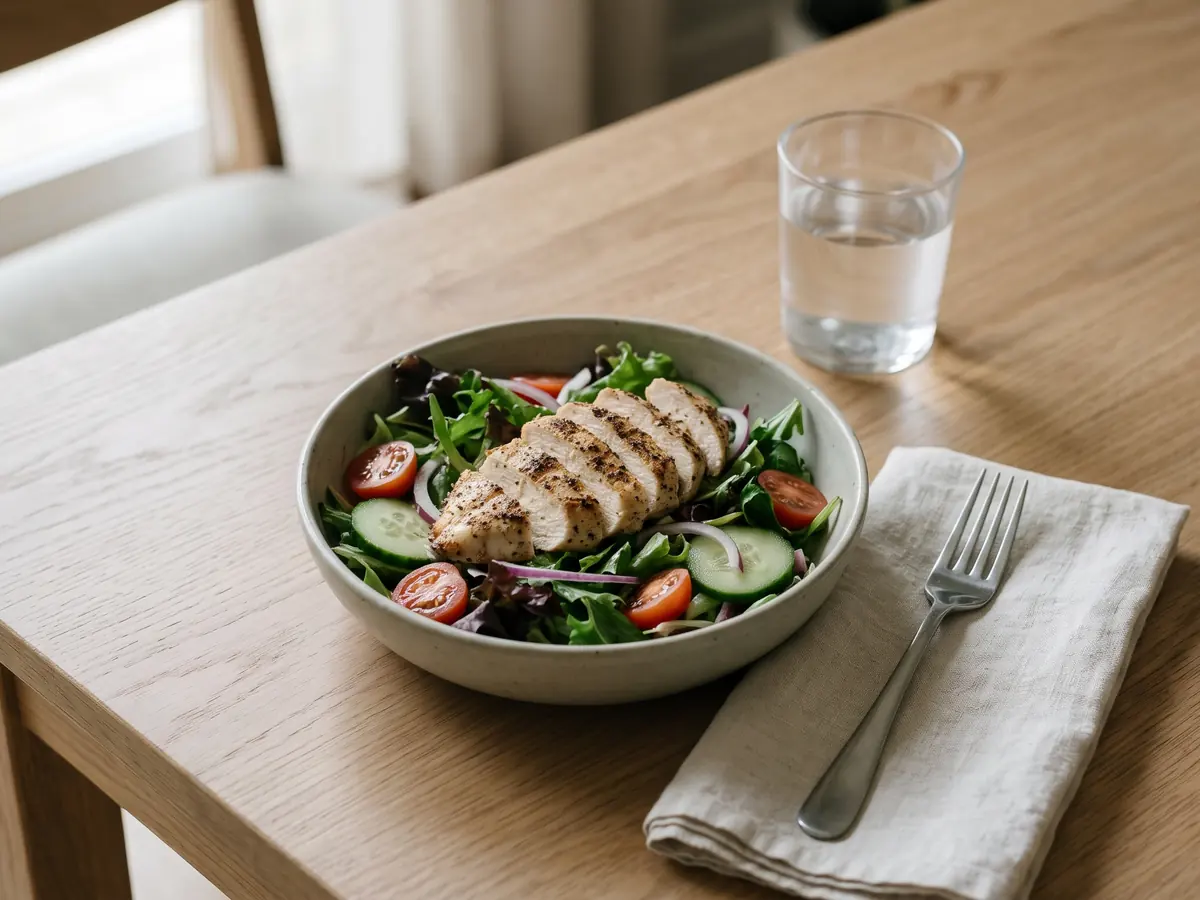
- LunchChicken salad: 3 oz grilled chicken, 2 cups romaine, 1 tomato, ½ cup cucumber, 1 tsp olive oil226
- Snack1 boiled egg, 3 oz baby carrots, 1 apple202
- Dinner5 oz baked cod, 1 cup broccoli, 1 cup cauliflower237
Day 2 810 calories · 86 g protein · 19 g fiber
- Breakfast2 scrambled eggs with 2 cups spinach and 1 cup mushrooms184
- LunchTuna salad: 3 oz tuna, 2 cups romaine, ½ cup red pepper, ¼ cup chickpeas176
- Snack½ cup cottage cheese with ½ cup strawberries116
- Dinner4 oz shrimp, 1 cup zucchini, 1 cup green beans, 1 tsp olive oil, ½ cup quinoa334
Vegetarian day 786 calories · 70 g protein · 31 g fiber
- Breakfast170 g plain nonfat Greek yogurt with ½ cup blueberries142
- LunchLentil and spinach stew: ½ cup lentils, 2 cups spinach, ½ cup canned tomatoes, 1 carrot, 1 slice whole-wheat bread253
- Snack½ cup shelled edamame94
- Dinner4.5 oz tofu stir-fried with 1 cup broccoli and ½ cup red pepper in 1 tsp olive oil295
Calories from USDA FoodData Central for the amounts shown. Seasonings like herbs, lemon and spices add almost nothing.
A few things to notice about these days:
- Protein stays high. 70 to 94 g a day. At very low calories, protein helps protect muscle and keeps meals filling.
- Vegetables do the heavy lifting. They add volume and fiber for very few calories. 2 cups of romaine or spinach add only about 15 calories.
- There's a little fat. Each day has 17 to 24 g, from eggs, olive oil, fish and tofu. That's above the 7 to 10 g a day the Swedish study mentioned for gallbladder emptying.
- Fiber varies. The meat-based days have 19 to 22 g; the vegetarian day reaches 31 g thanks to the lentils and edamame.
Even with careful choices, an 800 calorie a day diet meal plan made from food won't cover every vitamin and mineral every day. Clinical programmes use formula products for that reason.
Building your own 800 calorie day
If your doctor wants you on a food-based 800 calories a day meal plan, a simple template is:
| Meal | Build it with | About |
|---|---|---|
| Breakfast | Greek yogurt or eggs, plus fruit or vegetables | 130–190 kcal |
| Lunch | 3 oz lean protein over a big salad, 1 tsp oil or a few beans | 180–250 kcal |
| Snack | Egg, cottage cheese or edamame, with fruit or raw vegetables | 90–200 kcal |
| Dinner | 4–5 oz fish, shrimp or tofu, 2 cups vegetables, a small portion of grain | 230–330 kcal |
The calorie counter lets you add up a day like this, and the macro calculator shows how protein, carbs and fat split for any calorie target.
VLCD meal plan with shakes
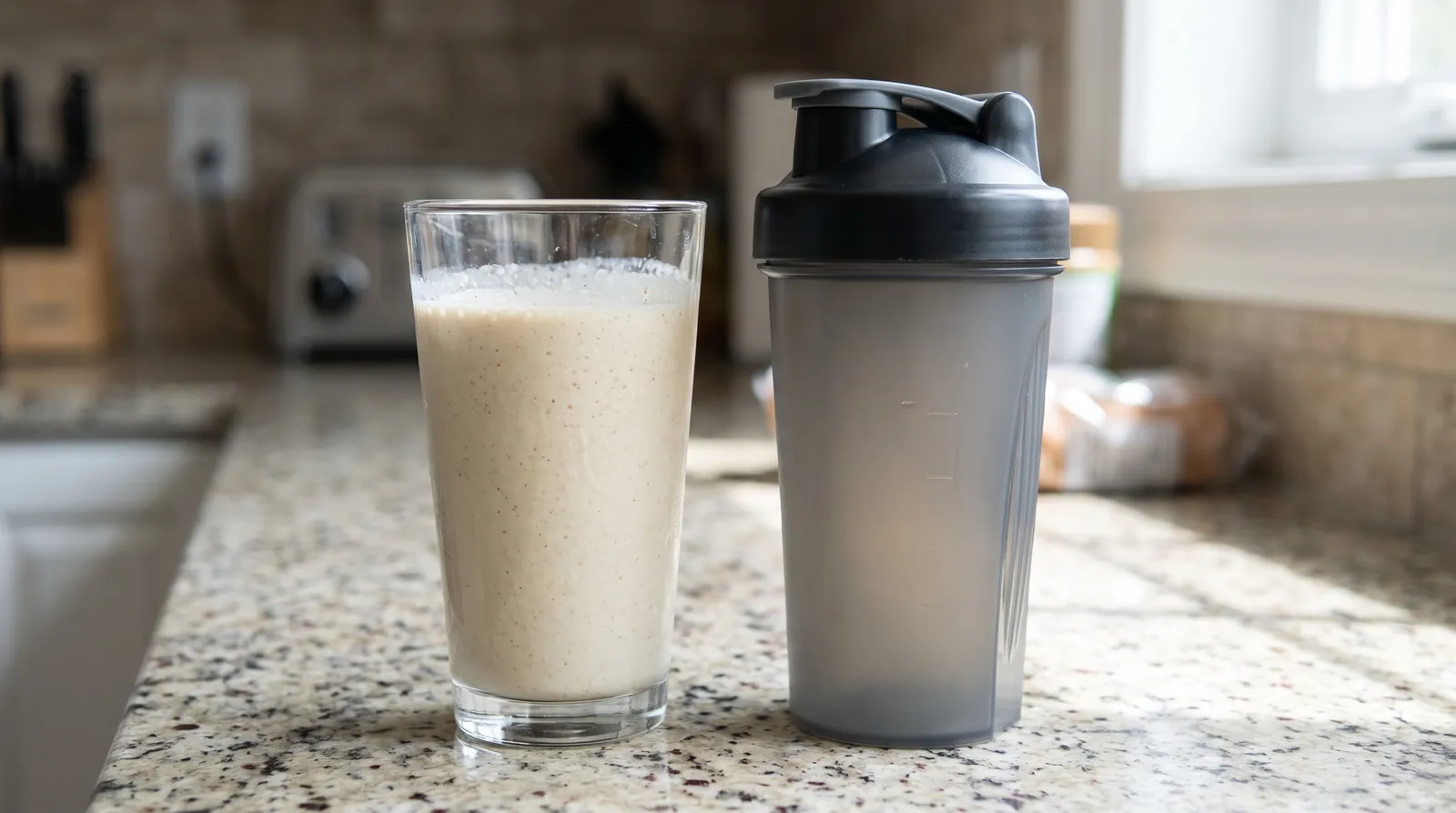
Most supervised VLCD meal plans use total diet replacement: every meal is a formula shake, soup or bar, in place of normal meals. That's how DiRECT worked, at 825 to 853 calories a day for 3 to 5 months, and how the NHS programme works for its first 12 weeks.
A typical VLCD diet meal plan with shakes looks like this:
- Morning: one shake
- Midday: one soup or shake
- Afternoon: one shake or bar
- Evening: one soup or shake
- All day: plenty of water and calorie-free drinks
The product amounts, which brand, and how long you stay on it are decided by the programme, not by you. The formula is designed to give enough protein, vitamins and minerals at that calorie level, which is the main advantage over a food-based VLCD diet plan. The main disadvantage is that you don't practise eating real food, which is why food reintroduction and long-term support are built into every serious programme.
Over-the-counter shakes sold for weight loss aren't the same as a supervised programme. If you're thinking about using them to reach 800 calories, the same advice applies: get medical sign-off first.

Rules if your doctor approves it
- Get a medication review first. The NHS programme requires one, because diabetes and blood pressure medicines may need to change.
- Agree a fixed end date. Clinical programmes run for a set number of weeks, such as 12, then move to food reintroduction.
- Ask about gallstone prevention. NIDDK advises talking to your doctor about how to lower your chances of gallstones before starting.
- Keep protein high. Build every meal around a protein source if it's food-based.
- Drink plenty of water. Calorie-free drinks help fill the gap between small meals.
- Keep your check-ups. Supervised programmes include regular reviews; tell your doctor about anything that feels wrong.
After the diet
What happens after an 800 calorie a day diet decides whether the weight stays off. Stepping up through a planned level such as a 1300 calorie diet makes the change easier to manage. The long-term data above show how easily it returns.
Supervised programmes handle this in stages. The NHS programme moves from 12 weeks of soups and shakes to a managed reintroduction of food and then ongoing support, for 12 months in total. DiRECT used stepped food reintroduction followed by a structured weight maintenance phase.
A sensible exit plan includes:
- raising calories in steps to your maintenance level, worked out with the TDEE calculator
- keeping protein high and vegetables at most meals
- weighing yourself regularly so small regains are caught early
- adding strength training to protect muscle, as covered in our metabolism guide
The weight loss simulator shows how weight changes over time at different calorie levels, including what happens when you move from a deficit back to maintenance.
Safer alternatives
Compared with an 800 calorie a day diet, a smaller deficit works nearly as well over the long term for most people losing weight on their own, and is far easier to live with. The NHS advises aiming to lose 0.5 to 1 kg (1 to 2 lb) a week, and NIDDK suggests that people who are overweight aim for 5 to 10% of their starting weight over 6 months.
Some options on this site:
- The 1000 calorie meal plan covers the next step up, with the same safety framing.
- The 7-day meal plan for weight loss averages about 1,500 calories a day, with 104 g of protein.
- The weight loss plan guide explains how to set a deficit that fits you.
Remember the Tsai and Wadden result: after the first months, people on low calorie diets ended up close to those on VLCDs. A slower diet you can keep often beats a faster one you can't.
800 calorie diet FAQ
Is an 800 calorie a day diet safe?
It can be, for the right person under medical supervision. A National Institutes of Health task force concluded very low calorie diets of 800 calories or less are safe and effective for people with obesity when they're medically supervised. They aren't meant for people who are only a little overweight, or to be done alone without a doctor.
How much weight can you lose on 800 calories a day?
The NIH task force reported average losses of about 1.5 to 2.5 kg (3.3 to 5.5 lb) a week on very low calorie diets. In the DiRECT trial, people on an 825 to 853 calorie formula diet lost about 10 kg on average after a year, including the time spent reintroducing food.
What is a VLCD?
VLCD stands for very low calorie diet, usually 800 calories a day or less. It's often done with meal replacement shakes and soups, under medical supervision, for a set number of weeks.
What are the side effects of a very low calorie diet?
Gallstones are the most common serious complication. In one study, hospital-treated gallstones were about three times more common on a 500 calorie diet than on a 1,200 to 1,500 calorie diet, although the absolute risk was low. Anyone taking diabetes or blood pressure medicine needs a review first, because doses may need to change.
What can I eat on an 800 calorie diet?
Mostly lean protein and vegetables, with small amounts of fruit, beans and healthy fat. A sample day: Greek yogurt with raspberries, a chicken salad, a boiled egg with carrots and an apple, then baked cod with broccoli and cauliflower, about 797 calories and 94 g of protein.
Sources
- National Task Force on the Prevention and Treatment of Obesity. Very low-calorie diets. JAMA, 1993.
- Tsai AG, Wadden TA. The evolution of very-low-calorie diets: an update and meta-analysis. Obesity, 2006.
- Lean MEJ, et al. Primary care-led weight management for remission of type 2 diabetes (DiRECT). Lancet, 2018.
- Johansson K, et al. Risk of symptomatic gallstones and cholecystectomy after a very-low-calorie diet or low-calorie diet in a commercial weight loss program. Int J Obes, 2014.
- Hall KD, Chow CC. Why is the 3500 kcal per pound weight loss rule wrong? Int J Obes, 2013.
- National Institute of Diabetes and Digestive and Kidney Diseases. Dieting and gallstones.
- NHS Black Country Integrated Care Board. NHS Type 2 Diabetes Path to Remission Programme.
- NHS North West London Integrated Care Board. Diabetes type 2 path to remission NHS programme (eligibility and exclusions).
- NHS. Tips to help you lose weight.
- U.S. Department of Agriculture. FoodData Central.