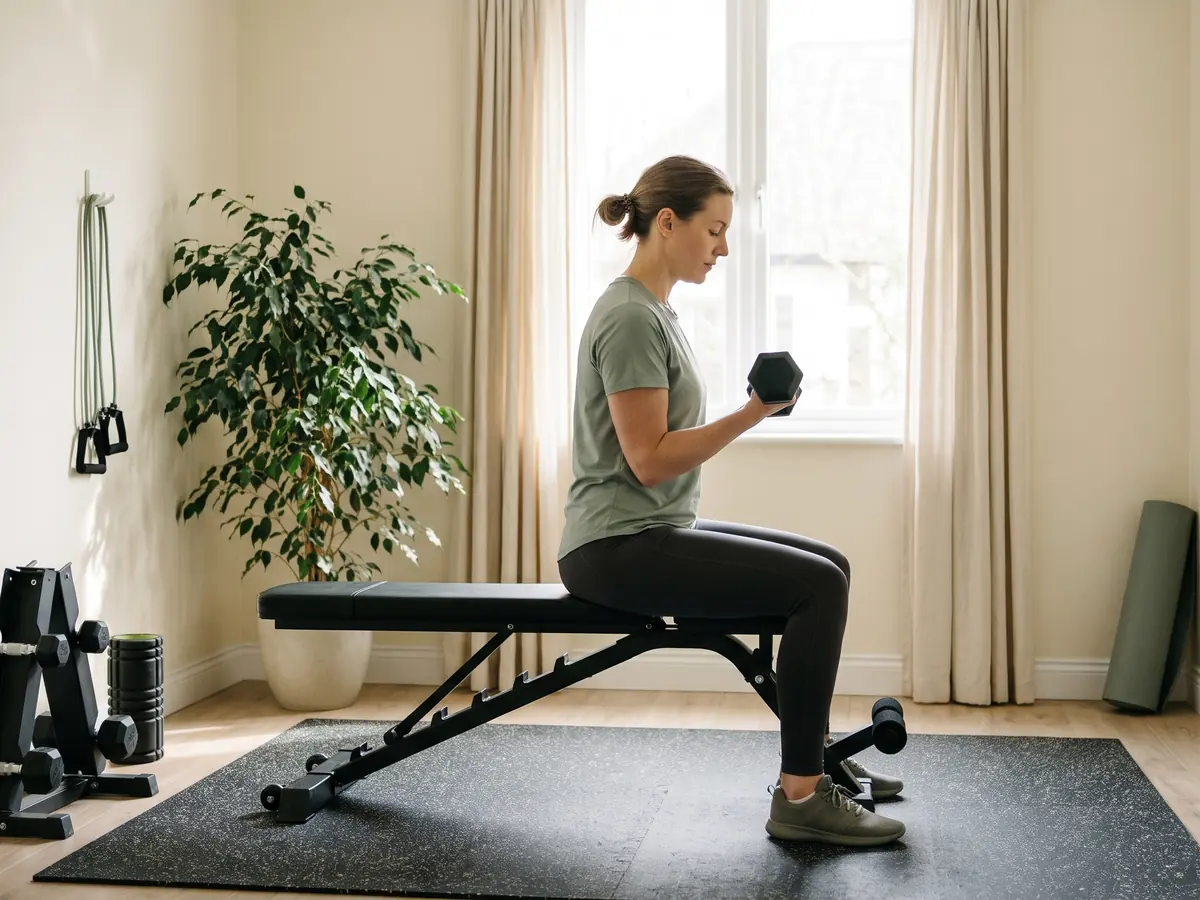
Short answerThe biggest levers are muscle and movement. Strength training raised resting metabolic rate by about 96 calories a day in a meta-analysis, and moving more through the day, such as standing, walking and taking stairs, can burn hundreds more. Eating enough protein helps a little, and avoiding crash diets protects the muscle you have. Green tea and coffee add only a few percent. Genes matter, but less than habits you control.
In this article
What metabolism means in science
The metabolism meaning in science is all the chemical reactions that keep you alive: breaking food down for energy, building and repairing tissue, and getting rid of waste. In everyday speech, "metabolism" usually means something narrower: how many calories your body burns in a day. That's the meaning in this article.
Metabolism and calories are linked simply: the faster your metabolism, the more you can eat without gaining weight. If two people of the same size eat the same amount and one stays slimmer, the usual explanation is that they burn more, mostly through muscle and movement rather than a mysterious "fast metabolism".
Metabolic activity meaning
"Metabolically active" describes tissue that burns a lot of energy at rest. Per kilogram, organs like the heart, kidneys, brain and liver are far more active than muscle, and muscle is far more active than fat. Using the tissue rates from a 2010 study of organ metabolism, a kilogram of heart or kidney burns about 440 calories a day at rest, the brain about 240, the liver about 200, muscle about 13 and fat about 4.5.
| Tissue | Calories per kg per day |
|---|---|
| Heart and kidneys | about 440 |
| Brain | about 240 |
| Liver | about 200 |
| Skeletal muscle | about 13 |
| Fat tissue | about 4.5 |
Organs are small, so even though they burn the most per kilogram, you can't change them much. Muscle is the one metabolically active tissue you can grow, and because there's so much of it, it adds up.
Where your calories go each day
Your daily calorie burn, or total daily energy expenditure (TDEE), has three parts:
- Resting metabolic rate (RMR or BMR): the energy to keep you alive at rest. For most people it's the largest part of the day's burn.
- The thermic effect of food: energy used to digest and process food. A review puts it at 5 to 15% of daily energy expenditure on a mixed diet.
- Activity: everything else, from exercise to walking, fidgeting, standing and chores. It's the part that varies most between people and from day to day.
Our BMR calculator estimates your resting burn and the TDEE calculator adds activity and digestion. For a lightly active 35-year-old woman, 165 cm and 80 kg, BMR is about 1,495 calories and TDEE about 2,056, so resting metabolism is roughly 73% of the total.
How to get a fast metabolism: what works
1. Build and keep muscle
If you're asking how to improve the metabolism, start here. Strength training is the most reliable way to raise your resting burn. A 2020 meta-analysis of exercise studies found that resistance exercise increased resting metabolic rate by about 96 calories a day compared with controls, while aerobic exercise alone showed no significant change. Part of that comes from added muscle, which burns about 13 calories per kilogram a day at rest, and part likely from the training itself.
Muscle also matters for what it prevents. Without training, people tend to lose muscle as they diet and as they age, which lowers resting burn. Two or three strength sessions a week, covering the major muscle groups, is a practical target; the CDC recommends muscle-strengthening activity on 2 or more days a week for adults.
2. Move more through the day
The energy you spend on everyday movement, outside formal exercise, is called non-exercise activity thermogenesis (NEAT). It varies hugely between people. In a well-known study published in Science, sedentary people with obesity sat, on average, 2 hours longer each day than lean people. The researchers estimated that if they adopted the lean group's movement habits, they might burn about 350 extra calories a day.
Wondering how to get fast metabolism gains without a gym? That's the easiest way to raise your daily burn: stand while on the phone, walk short trips, take stairs, park further away, and break up long sitting time. A daily walk counts too; see what yours burns with the walking calorie calculator or the steps to calories calculator.

3. Eat enough protein
Digesting food uses energy, and protein uses more than carbohydrate or fat. A review of diet-induced thermogenesis found the effect follows the order alcohol, protein, carbohydrate, then fat, and is higher on a relatively high-protein diet. The difference is modest, tens of calories a day rather than hundreds, but protein also helps you keep muscle and stay full. The 2025–2030 Dietary Guidelines suggest 1.2 to 1.6 g of protein per kg of body weight a day; the macro calculator works out yours.
4. Don't crash diet
Having a fast metabolism doesn't stop this: when you lose weight, your body burns less, because a smaller body costs less to run and to move. Very large deficits make this worse by costing more muscle. A moderate deficit with plenty of protein and strength training keeps more muscle, so your resting burn falls less. Our weight loss plan covers how to set one.
5. Stay active as you age
The decline in metabolism with age is closely tied to losing muscle and moving less, both of which training and an active routine can slow. More on what the research shows about age below.
What barely speeds up your metabolism
Green tea and coffee
A meta-analysis of respiration-chamber studies found that catechin-caffeine mixtures and caffeine alone increased 24-hour energy expenditure by about 4.7%. For someone burning 2,000 calories, that's under 100 calories a day, and the studies measured short-term effects in controlled settings. A cup of coffee or tea is fine, but it won't replace the bigger levers.
"Metabolism-boosting" foods and supplements
Many products claim to boost metabolism, but none has an effect anywhere near building muscle or moving more. Supplements aren't reviewed for effectiveness the way medicines are, and stimulant-based "fat burners" can raise heart rate. Talk to a doctor or pharmacist before taking any.
Eating small, frequent meals
The thermic effect of food depends on how much and what you eat over the day, not how many times you eat. Eat on a schedule that helps you control hunger and portions.
Is metabolism genetic?
Partly. A review of twin and parent-child studies reported that the heritability of resting metabolic rate, the thermic response to food and the energy cost of exercise, after adjusting for body size and other factors, is as high as 40%. That means genes explain some of the difference between people, but most of the variation comes from body size, muscle, activity and age.
Is high metabolism genetic, then? Somewhat. But two people of the same weight can differ widely in their daily burn mainly because one carries more muscle and moves more, both of which you can change.
Does metabolism slow down with age?
Less than most people think. A large study published in Science in 2021 measured daily energy expenditure across the life course. After adjusting for fat-free mass, expenditure rose quickly in babies to about 50% above adult values around age 1, declined slowly to adult levels by about age 20, stayed stable from 20 to 60 (even during pregnancy), and then declined in older adults.
So the weight many people gain in their 30s, 40s and 50s usually isn't because their metabolism suddenly slowed; it's more often less activity, less muscle and more food. After 60, staying strong and active becomes even more valuable. The metabolic age calculator compares your body composition with what's typical for your age.
Metabolism after 50 and 60
Because size-adjusted expenditure stays stable until about 60, your 50s are a good time to build habits that carry you through the decline that follows. Strength training two or more days a week, enough protein spread across meals, and staying on your feet through the day all help preserve the muscle that keeps resting burn up. Our diet for good abs shows how to eat for that while losing fat. Older adults who need fewer calories still need the same or more protein, vitamin B12, vitamin D and calcium, according to the 2025–2030 Dietary Guidelines, so food quality matters even more.
How long until you notice a difference?
Everyday movement raises your daily burn immediately: a walk burns calories the day you take it, and an incline walk burns more (the treadmill calorie calculator shows how much). Building muscle takes longer, so expect any change in resting burn over months of regular training, not days. Expect strength gains within a few weeks of starting, and changes in body composition over a few months. Track your waist, your strength and your weight trend rather than waiting to feel a "faster metabolism".
Signs you have a fast metabolism
What about high metabolism signs? There isn't a reliable symptom of a fast metabolism. Feeling warm, hungry or energetic can have many causes. The practical sign of a high metabolism is simple: you maintain a steady weight on more calories than equations predict for your size. To check:
- Estimate your maintenance with the TDEE calculator.
- Log what you eat for 2 to 3 weeks with the calorie counter.
- Weigh yourself regularly. If your weight is stable while you eat well above the estimate, you burn more than average.
Very rapid, unexplained weight loss, a racing heart, shaking or heat intolerance aren't signs of a "good" fast metabolism; they can point to a medical problem such as an overactive thyroid, and should be checked by a doctor.
How do you know if your metabolism is high?
So how do you know you have high metabolism? Put simply, when your weight holds steady on more food than calculators predict for someone your size, sex and age. Having a fast metabolism isn't something you can feel reliably; it shows up in the numbers over a few weeks.
Can a fast metabolism go away?
Can fast metabolism go away? It can change. Losing muscle, becoming less active, losing weight and getting older (especially after 60) all lower daily calorie burn. That's why people who "could eat anything" in their 20s often find things change when their routine does. Keeping up strength training and daily movement is the best protection.
How to find out your metabolic type
How do you find your metabolic type, or work out your metabolic type at home? Here's what's real and what isn't.
Search for how to know your metabolic type, or how to find out my metabolic type, and you'll find diets and websites offering tests that match a diet to your "metabolic type". That isn't a recognized medical classification. What can be measured is your resting metabolic rate: clinics and some gyms use indirect calorimetry, which estimates energy use from the oxygen you breathe in and the carbon dioxide you breathe out. Without a lab, equations like Mifflin-St Jeor, used in our BMR calculator, give a good estimate for most people, and a systematic review found it the most accurate of the common equations.
If you want a real answer to how to find your metabolic type, compare your measured or estimated RMR with what's typical for your size and age, and track how your weight responds to what you eat.

Why some people stay thin on more food
Everyone knows someone who seems to eat anything without gaining weight. When researchers measure carefully, the differences usually come down to a few things:
- Body size and muscle: a taller, more muscular person burns more at rest.
- Everyday movement: the sitting study above found a 2-hour-a-day difference in seated time between lean and obese people, which the researchers said appeared biologically driven.
- Less food than it looks: people who seem to eat a lot at meals often eat less at other times. A week of honest food logging often surprises both sides.
- Genes: up to 40% of the variation in resting metabolism has been attributed to heredity.
Metabolism in women and men
Men usually burn more calories than women, mostly because they're larger and carry more muscle. Even at the same height, weight and age, the Mifflin-St Jeor equation gives men about 166 calories a day more at rest. For example, a 35-year-old woman of 160 cm and 60 kg has an estimated BMR of about 1,264 calories, while a 35-year-old man of 180 cm and 85 kg has about 1,805. The same levers work for both: strength training, daily movement and enough protein. Women may find strength training especially useful, since starting from less muscle means more room to gain.
What a small boost adds up to
What speeds up your metabolism sounds small, but the changes compound. The 96-calorie-a-day rise in resting metabolism from resistance training, kept up for a year, comes to about 35,000 calories, roughly the energy in 4.5 kg of body weight by the usual estimate. Add a daily 30-minute walk and a few hours less sitting each week, and the difference between an active, strong routine and a sedentary one easily reaches several hundred calories a day. That's why metabolism is best thought of as something you build over months, not something you boost overnight.
Thyroid, medications and medical causes
Some medical conditions and medicines change metabolism. An underactive thyroid can lower it and an overactive thyroid raise it; some medications affect appetite and weight. If you notice unexplained weight gain or loss, tiredness, feeling unusually cold or hot, or a racing heart, see a doctor rather than trying to fix it with diet. A simple blood test can check thyroid function.
Metabolism myths
- "Eating late slows your metabolism." Total calories over the day matter far more than the clock.
- "Skipping breakfast ruins your metabolism." It may make you hungrier later, but it doesn't lower your daily burn on its own.
- "Metabolism crashes at 30 or 40." Size-adjusted expenditure is stable from about 20 to 60 in the 2021 study.
- "Fat burners speed up your metabolism a lot." Caffeine-based products have a small effect, and some carry risks.
- "Cardio is the best way to raise your resting metabolism." In the 2020 meta-analysis, aerobic exercise alone didn't significantly change resting metabolic rate; resistance training did. Cardio is still great for your heart and adds to your daily burn while you do it.
Dieting and your metabolism
Losing weight lowers your daily burn, which is why weight loss slows over time. Researchers have shown that the simple "3,500 calories per pound" rule overestimates long-term weight loss for this reason. Our weight loss simulator uses a dynamic model that accounts for the slowdown, so it gives a realistic goal date.
To limit the drop:
- Keep your deficit moderate, about 500 calories a day.
- Keep protein high and lift weights two or three times a week.
- Keep moving through the day; NEAT tends to fall without you noticing when you eat less.
- Recalculate your target every 5 kg or so.
Estimating your own metabolism at home
Wondering how to work out your metabolic type at home? You don't need a lab to get a useful number. Here's a simple way to find your real maintenance calories:
- Get a starting estimate from the TDEE calculator, for example 2,200 calories.
- Eat close to that for 3 weeks and log it in the calorie counter.
- Weigh yourself 3 or more times a week at the same time and compare the first and last weekly averages.
- If your weight held steady, your maintenance is close to what you ate. If you lost about 0.5 kg over the 3 weeks, you burned roughly 175 to 185 calories a day more than you ate (about 3,850 calories over 21 days, using 7,700 per kg). If you gained, you burned less.
So how do I find my metabolic type in practice? That real-world figure is the most useful "metabolism test" for planning your diet, and it accounts for your actual activity, which no equation can know.
A week of metabolism-friendly habits
| Day | Training | Everyday movement |
|---|---|---|
| Monday | Full-body strength, 40 minutes | Walk at lunch, stand on calls |
| Tuesday | Brisk walk, 30 minutes | Stairs instead of the lift |
| Wednesday | Rest or easy stretching | Walk to errands |
| Thursday | Full-body strength, 40 minutes | Get up every hour at work |
| Friday | Cycling or swimming, 30 minutes | Walk after dinner |
| Saturday | Long walk or hike | Gardening or chores |
| Sunday | Rest | Short family walk |
Pair it with protein at every meal and a moderate calorie target, and you have the core of any plan to raise your metabolism. The calories burned calculator shows what each activity adds.
A simple plan to improve your metabolism
- Lift twice a week: squats, presses, rows and deadlifts or their machine versions.
- Walk daily: aim to add steps gradually, for example 1,000 more a day each week.
- Sit less: stand or move for a few minutes every hour.
- Eat protein at every meal (the simplest answer to how to boost up my metabolism through food): 25 to 40 g each time for most adults.
- Avoid big crash diets; keep deficits moderate.
- Enjoy coffee or tea if you like it, but don't count on them for much.
- Check your numbers every few months with the BMR and TDEE calculators.
None of these is dramatic on its own, but together they can add a few hundred calories a day to what you burn, and keep that burn up as you get older.
Putting metabolism to work for weight loss
For weight loss, a faster metabolism is helpful but not essential. What matters is the gap between the calories you eat and the calories you burn. Raising your burn with muscle and movement makes that gap easier to create without eating very little, which is why the most successful plans combine a moderate calorie target with strength training and an active day. Use the TDEE calculator for your starting target, then let your weight trend tell you whether to adjust. For the full set of steps, see our weight loss plan, and for what to eat, our balanced diet guide.
If you're maintaining rather than losing, the same habits let you eat more while holding your weight, which makes it easier to get all the nutrients you need from food.
Metabolism FAQ
How can I get a fast metabolism?
Build and keep muscle with strength training, move more through the day, eat enough protein, and avoid very low-calorie diets. A meta-analysis found resistance training raised resting metabolic rate by about 96 calories a day compared with controls.
Is metabolism genetic?
Partly. Based on twin and family studies, the heritability of resting metabolic rate has been reported as high as 40%. Body size, muscle, age and activity explain much of the rest.
Does metabolism slow down with age?
Less than most people think. A large 2021 study found that energy expenditure adjusted for body size stays stable from about age 20 to 60 and then declines in older adults.
Do green tea or coffee boost metabolism?
Slightly. A meta-analysis found catechin-caffeine mixtures and caffeine raised 24-hour energy expenditure by about 4.7%. That's small, and it won't replace a calorie deficit.
What is a metabolic type?
"Metabolic type" isn't a recognized medical classification. What can be measured is your resting metabolic rate, by a lab test called indirect calorimetry or estimated with equations like Mifflin-St Jeor.
Sources
- MacKenzie-Shalders K, et al. The effect of exercise interventions on resting metabolic rate: a systematic review and meta-analysis. J Sports Sci, 2020.
- Levine JA, et al. Interindividual variation in posture allocation: possible role in human obesity. Science, 2005.
- Westerterp KR. Diet induced thermogenesis. Nutr Metab, 2004.
- Hursel R, et al. The effects of catechin rich teas and caffeine on energy expenditure and fat oxidation: a meta-analysis. Obes Rev, 2011.
- Bouchard C. Heredity and the path to overweight and obesity. Med Sci Sports Exerc, 1991.
- Pontzer H, et al. Daily energy expenditure through the human life course. Science, 2021.
- Wang Z, et al. Specific metabolic rates of major organs and tissues across adulthood. Am J Clin Nutr, 2010.
- Frankenfield D, et al. Comparison of predictive equations for resting metabolic rate in healthy nonobese and obese adults: a systematic review. J Am Diet Assoc, 2005.
- Hall KD, Chow CC. Why is the 3500 kcal per pound weight loss rule wrong? Int J Obes, 2013.
- Centers for Disease Control and Prevention. Physical activity guidelines for adults.
- U.S. Departments of Health and Human Services and Agriculture. Dietary Guidelines for Americans, 2025–2030, January 2026.