Short answerTo convert kilocalories to calories on a food label, don't change anything: 1 kcal is 1 food Calorie. In science, 1 kcal is 1,000 small calories. One kcal is also 4.184 kJ. A gram of protein or carbs has 4 calories, a gram of fat 9, and a pound of body fat about 3,500.
What the kilocalories to calories converter does
- kcal, cal and kJ: type a number in any unit and the others update, with how it would look on a U.S. or a European label.
- Grams to calories: a grams into calories calculator for protein, carbs, fat and alcohol, with a chart of where the calories come from.
- Kcal to grams: the reverse box is a calorie to gram calculator, so you can convert cal to grams of any nutrient for a diet plan.
- Body fat: turns pounds or kilograms of fat into calories and back, so it also works as a cal to kg or cal to lbs converter for fat loss.
kcal vs cal vs Cal: what's the difference?
Here's where the confusion comes from. Scientists define two calories. The small calorie (cal) is the energy needed to warm 1 gram of water by 1 °C. The kilocalorie (kcal) is 1,000 of those. In nutrition, nobody uses the small one. When food packs, apps and diet plans say "calories", they mean kilocalories.
Some books write the food unit with a capital C, "Calorie", to show it's the big one. U.S. labels just say Calories. So the difference between kcal and cal only matters in a chemistry class, and kcal versus calories on a label is no contest: they're the same. The calorie and kilocalorie difference is a factor of 1,000. On a food label, a 250-calorie snack bar is 250 kcal, not 250,000 of anything you need to worry about. For the other lines on the panel, see how to read nutrition facts labels.
| Unit | Symbol | Equals | Where you see it |
|---|---|---|---|
| Kilocalorie | kcal | 1,000 cal · 4.184 kJ | Food labels worldwide |
| Food Calorie | Cal | 1 kcal | U.S. labels, menus, apps |
| Small calorie | cal | 0.001 kcal · 4.184 J | Physics and chemistry |
| Kilojoule | kJ | 0.239 kcal | EU, UK, Australia, New Zealand |
| Joule | J | 0.000239 kcal | Science (SI unit) |
Is kcal the same as calories?
For food, yes. Is kcal the same as cal in a science lab? No: there, 1 kcal is 1,000 cal. The kcal symbol is lowercase, with "k" for kilo, just like km for kilometer.
Kilocalories in other languages
Italian labels use the plural chilocalorie next to kJ, while everyday speech just says calorie, the Italian plural of caloria. In Spanish, 1 kilocaloria is the same 1 kcal. French and German labels write kcal, which keeps things simple.
kJ vs calories on food labels
Kilojoules are the metric unit of energy, and many countries put them first on the label. To convert, multiply kcal by 4.184 to get kJ, or divide kJ by 4.184 to get kcal.
| kcal (Calories) | kJ |
|---|---|
| 1 | 4.2 |
| 100 | 418 |
| 250 | 1,046 |
| 500 | 2,092 |
| 2,000 | 8,368 |
A quick way to do it in your head: divide kJ by 4 and take off a bit. 1,000 kJ is about 240 kcal.
How to convert grams to calories
Calories come from three nutrients, plus alcohol. (To set daily targets for each, use the macro calculator.) To turn grams into calories, multiply each by its factor and add them up:
- Protein: 4 calories per gram
- Carbohydrate: 4 calories per gram
- Fat: 9 calories per gram
- Alcohol: 7 calories per gram
Take a meal with 30 g of protein, 50 g of carbs and 15 g of fat: 30 × 4 + 50 × 4 + 15 × 9 = 120 + 200 + 135 = 455 calories. That's exactly what the grams to calories mode of the converter does. It's a g to calories converter and a grams to kcal calculator in one, with a chart showing where the calories come from.
How do you convert grams to calories without a calculator? Look at the grams on the label, multiply each by its factor, and add. Any calories and grams calculator, including this one, uses the same simple math.
Calories = (protein g × 4) + (carbs g × 4) + (fat g × 9) + (alcohol g × 7)
The conversion of grams to calories uses general factors called Atwater factors, after the scientist who worked them out. They're averages. Fiber, for example, is a carbohydrate but gives only about 2 calories per gram, and some fats are absorbed less well than others. That's why a label's calories don't always match the sum of its grams exactly. For how those factors were measured, and what a calorie actually is, see what does a calorie measure?
Each gram of protein is how many calories?
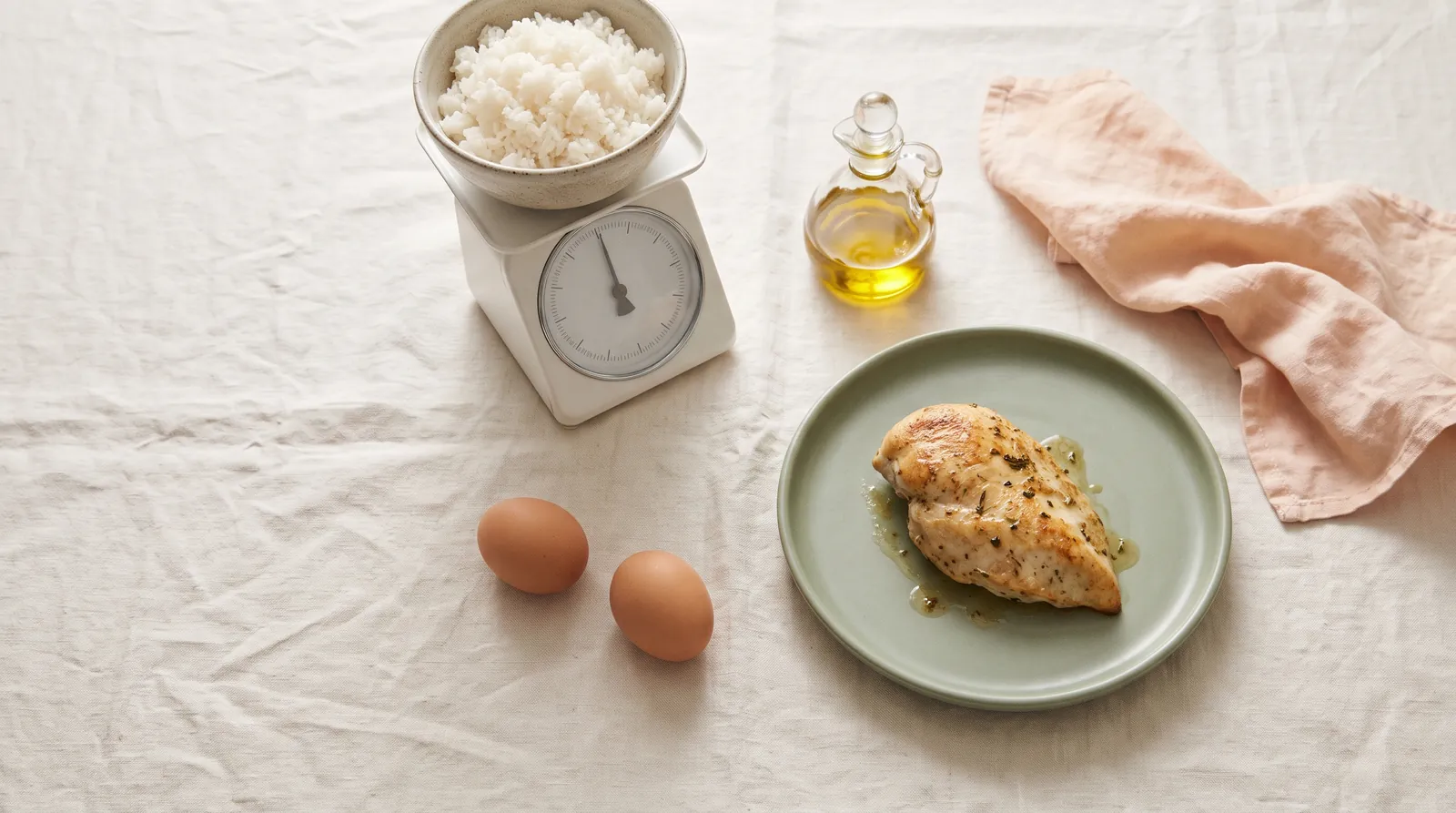
Four. So 25 g of protein is 100 calories, and a 150 g chicken breast with about 46 g of protein gets around 185 of its calories from protein. Don't mix up grams of protein with the weight of the food; our guide to how many grams of protein are in an ounce of meat explains the difference.
How many eggs is 20 grams of protein? About 3 large eggs, since a large egg has roughly 6.3 grams of protein.
How many calories are in one gram of carbohydrates?
Four, the same as protein. How many calories are in a gram of carbs from sugar? 4. How many calories in 1 gram of carb from starch? Also 4. How many calories are in 1g of carbs from fruit? Still 4, which is why nearly all the calories in a mandarin come from its carbs. Carbohydrates kcal per gram is the same for bread, rice, fruit and table sugar, so carb kcal per gram is an easy number to remember. The one exception is fiber, at about 2.
Nutrition labels count calories in 1g of carbohydrate the same way, so 1 gram of carbohydrates to calories is always 4. To see how many calories come from carbohydrates in a meal, multiply the carb grams by 4: 50 g of carbs is 200 calories.
How many calories in a gram of fat?
Nine calories per gram, more than twice protein or carbs. So which macronutrient provides the most energy? Fat. Alcohol comes second at 7, though it isn't a nutrient your body needs. Which macronutrient is the most energy dense is easy to see in the kitchen: a tablespoon of oil (about 14 g) has around 120 calories, while a tablespoon of sugar (about 12 g) has under 50.
Kcal to grams conversion
To go the other way, divide calories by the factor. 100 calories to grams is:
- 25 g of protein or carbs (100 ÷ 4)
- 11.1 g of fat (100 ÷ 9)
- 14.3 g of alcohol (100 ÷ 7)
This is handy when a diet plan gives you calories for each nutrient. If 800 kcal should come from carbs, kcal to grams of carbohydrate is 800 ÷ 4 = 200 g. The kcal to grams calculator box in the converter does this for any nutrient. For a full daily split, the macro petals in the TDEE calculator show grams of each nutrient.
Why label calories don't add up exactly
Add up the grams on a Nutrition Facts label and you'll often land a little off the printed calories. That's normal, and there are three reasons:
- Rounding. U.S. labels round calories: under 5 shows as 0, up to 50 goes to the nearest 5, and above 50 to the nearest 10. The grams are rounded too.
- Fiber. It counts as carbohydrate on the label but gives about 2 calories per gram, not 4. Makers may use the lower number.
- Sugar alcohols. Ingredients like erythritol and xylitol give fewer calories per gram than sugar, about 2.4 on average, and some close to zero.
A gap of 10 to 20 calories on a snack is nothing to worry about. If you track food, use the printed calories, not your own sum. Making labels for your own food? The nutrition label maker applies these rounding rules for you, and the recipe nutrition calculator adds up a whole dish.
How many calories are in a pound of fat?
About 3,500. Body fat isn't pure fat; it's roughly 87% fat plus water and cells. A pound is 454 g, so 454 × 0.87 × 9 comes to about 3,550 calories, which is rounded to 3,500.
How many calories are in 1kg of fat?
About 7,700. So 1kg of body fat stores roughly 7,700 calories, and 5 pounds about 17,500.
| Body fat | Calories |
|---|---|
| 1 lb (0.45 kg) | 3,500 |
| 1 kg (2.2 lb) | 7,700 |
| 5 lb (2.3 kg) | 17,500 |
| 10 lb (4.5 kg) | 35,000 |
| 20 lb (9.1 kg) | 70,000 |
This is where the old advice of "500 calories a day less equals a pound a week" comes from. It works for the first weeks, but over months people lose less than the math predicts, because the body burns less as it gets lighter. Researchers at the NIH have shown the 3,500 rule overestimates long-term weight loss. Use it to convert cal to lbs of fat, not to predict exactly when you'll reach a goal weight. For a realistic timeline, the weight loss simulator lets the pace slow as you lose, and the fat intake calculator covers the fat you eat rather than the fat you store.
Calorie converter FAQ
What's the difference between kcal and cal?
A kcal is 1,000 cal. Food labels use kcal but usually call it Calories, while cal (small calorie) is a science unit you won't see on food.
What's the difference between kcals and calories?
In food, none. Kcals and calories on a label mean the same unit. The only difference is in science, where a calorie (small c) is 1/1,000 of a kcal.
What's the difference between kcalories, kilocalories and calories?
A kilocalorie is 1,000 small calories. Food labels use kilocalories but call them calories, so for diet and nutrition you can treat the two words as the same thing.
Is kcal the same as calories?
On food labels, yes. The Calories on a U.S. Nutrition Facts label are kilocalories, so 1 kcal and 1 food Calorie are the same amount of energy. In physics, a small calorie (cal) is 1/1,000 of a kilocalorie.
How many calories are in a pound of fat?
About 3,500 calories. Body fat tissue is roughly 87% fat, and fat holds 9 calories per gram, which works out to about 3,500 per pound or 7,700 per kilogram.
How many calories are in a gram of protein, carbs and fat?
Protein and carbohydrates each have about 4 calories per gram, fat has 9 and alcohol has 7. These are the general factors used on nutrition labels.
How many kilojoules are in a calorie?
One food Calorie (1 kcal) is 4.184 kilojoules. To go the other way, 1 kJ is about 0.239 kcal.
How many eggs is 20 grams of protein?
About 3 large eggs. A large egg has about 6.3 grams of protein, so 3 eggs give about 19 grams.
Sources
- National Institute of Standards and Technology. NIST Special Publication 811: Guide for the Use of the International System of Units (calorie, thermochemical = 4.184 J).
- FAO. Food energy: methods of analysis and conversion factors. Food and Nutrition Paper 77, 2003 (protein and carbohydrate 4, fat 9, alcohol 7, fiber 2 kcal per gram).
- U.S. Department of Agriculture, Agricultural Research Service. Agricultural Research magazine, September 2013 (Atwater factors and calorie values in food).
- U.S. Food and Drug Administration. 21 CFR 101.9, Nutrition labeling of food (calorie rounding and factors).
- U.S. Department of Agriculture. FoodData Central (egg, whole, raw: about 6.3 g protein in a large egg).
- Hall KD, Chow CC. Why is the 3500 kcal per pound weight loss rule wrong? Int J Obes, 2013.