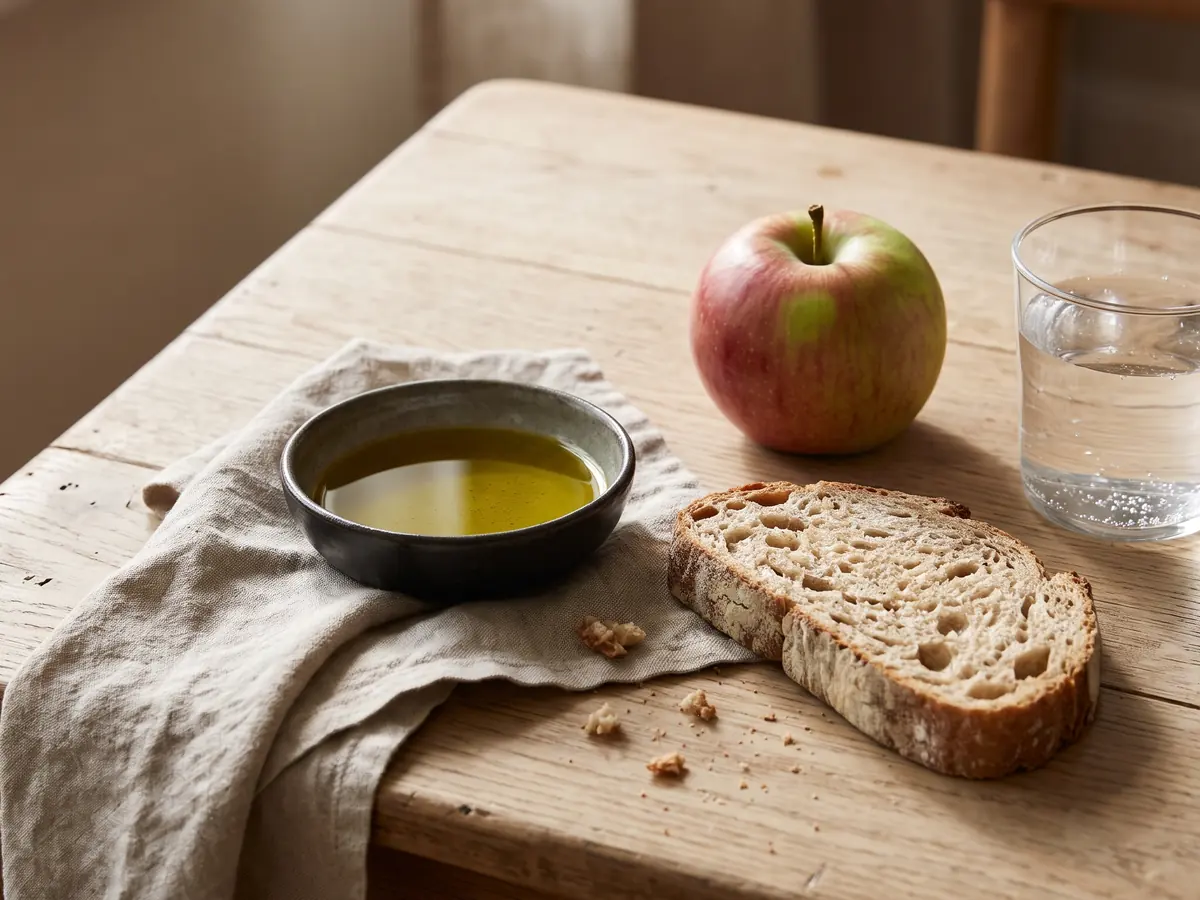
Short answerA calorie measures energy. The Calorie on a food label is a kilocalorie, equal to 4.184 kilojoules, and it tells you how much energy your body can get from that food. Protein and carbohydrate give about 4 calories per gram, fat 9, alcohol 7 and fiber about 2. Calories aren't good or bad in themselves, but the foods they come in can make it easier or harder to eat the right amount.
In this article
What does a calorie measure?
A calorie is a unit of energy. That's the whole definition in science: like a mile measures distance and a pound measures weight, a calorie measures energy, usually the energy released as heat.
The unit began with heat and water. A calorie was defined as about the energy needed to warm 1 gram of water by 1 °C, and the U.S. National Institute of Standards and Technology still lists several versions named after the water temperature used, such as the "15 °C calorie" (4.1858 joules). Today the calorie is tied to the joule, the international (SI) unit of energy. The version used in nutrition is defined as exactly 4.184 joules.
Calorie vs kilocalorie
The calorie in physics is tiny. The calorie on a food label is 1,000 times bigger: it's a kilocalorie (kcal), sometimes written with a capital C as "Calorie." When a label says 100 Calories, it means 100 kcal, or 418.4 kilojoules. In everyday talk about food, "calorie" always means kilocalorie, and this article uses it that way. For converting between kcal, kJ and joules, use the calorie converter.
So the definition of calorie in science is simple: a unit of energy, 4.184 joules, with food using the kilocalorie. Everything else in this article is about where that energy comes from in food and what your body does with it.
What are calories in food?
Calories in food are the chemical energy stored in its protein, carbohydrate, fat and alcohol. Your body breaks those molecules down and uses the released energy to keep you alive and moving: to run your heart, brain and other organs, to keep you warm, to digest food, and to power activity. Energy you don't use is stored, mostly as body fat.
Water, vitamins and minerals give no calories. That's why foods that are mostly water, like cucumber, lettuce and watermelon, are so low in calories, while foods with little water and a lot of fat, like oils and nuts, are so high. Our guide to the 6 main nutrients covers what they do instead.
How many calories you need each day depends on your body size, age, sex and activity. The TDEE calculator estimates it, and the BMR calculator shows how much of it goes on just staying alive at rest.

How food calories are measured
Burning food in a bomb calorimeter
The most direct way to measure the energy in food is to burn it. In a bomb calorimeter, a dried food sample is burned completely in pure oxygen inside a sealed chamber surrounded by water, and the rise in water temperature shows how much heat was released. The FAO describes this as the food's gross energy: "the heat that is measured after complete combustion to carbon dioxide (CO2) and water in a bomb calorimeter."
Why gross energy isn't what you get
Your body isn't a furnace. Some energy is lost in feces, urine and gases, so you get less than the bomb calorimeter measures. What's left is called metabolizable energy, which the FAO describes as "the energy that remains after accounting for the important losses." This is what food labels aim to show.
Atwater factors
Around 1900, the American chemist Wilbur Atwater and his colleagues measured both sides: the energy in foods and the energy lost by the body. Their work gave the general factors still used today, now known as Atwater factors. In the FAO's words: "17 kJ/g (4.0 kcal/g) for protein, 37 kJ/g (9.0 kcal/g) for fat and 17 kJ/g (4.0 kcal/g) for carbohydrates."
Today, nobody burns your granola bar to make its label. Manufacturers measure or look up the grams of protein, carbohydrate and fat, then multiply by these factors. FDA's labeling rule, 21 CFR 101.9, allows several methods, including these general factors.
You can check it on a food yourself. A 32 g slice of whole-wheat bread has, in USDA data, 4.0 g of protein, 13.7 g of carbohydrate and 1.1 g of fat:
(4.0 × 4) + (13.7 × 4) + (1.1 × 9) = 80.7 calories
USDA lists the slice at 81 calories, a near-perfect match.
When the factors are off
Atwater factors are averages, so they don't fit every food. Nuts are a well-known example. In a controlled feeding study at USDA, researchers measured how much energy 18 adults actually absorbed from almonds. They found 4.6 calories per gram, or 129 calories per 28 g serving, while the Atwater factors predicted 168 to 170. The factors overestimated almond calories by 32%.
That doesn't make labels useless; for most foods they're close. It does mean a calorie count is a good estimate, not an exact measurement of what your body absorbs.
Calories from protein, carbs, fat and alcohol
| Source | Calories per gram | Kilojoules per gram |
|---|---|---|
| Fat | 9 | 37 |
| Alcohol | 7 | 29 |
| Protein | 4 | 17 |
| Carbohydrate | 4 | 17 |
| Fiber | 2 | 8 |
Fat is the most energy-dense nutrient, with more than twice the calories of protein or carbohydrate per gram. That's why a tablespoon of olive oil has 119 calories while a cup of strawberries has 49. Alcohol isn't a nutrient your body needs, but at 7 calories per gram it adds up quickly. To turn grams into calories for any food, the calorie converter has a grams-to-calories tool.
Do fiber calories count?
Yes, but less than other carbohydrates. Fiber is a carbohydrate your own enzymes can't digest, so it isn't absorbed in the small intestine like sugar or starch. Some of it is fermented by bacteria in the large intestine, which produces compounds your body can absorb and use for energy. The FAO's general factor for fiber is 2 calories per gram, half the value for other carbohydrates.
So do calories from fiber count? They count, at about 2 per gram rather than 4. On a U.S. label, fiber is part of total carbohydrate, and manufacturers can account for its lower energy value; some do and some don't, so a high-fiber food's calories may be slightly overstated if 4 per gram was used for everything.
In practice the difference is small. The slice of bread above has 1.9 g of fiber. Counting it at 2 calories per gram instead of 4 lowers the slice by about 4 calories. Even on a 40 g fiber day, the gap is about 80 calories.
Fiber also matters for reasons beyond calories: it slows digestion, adds bulk, and helps you feel full. The fiber calculator shows how much you need.
Calories vs carbs vs protein
What's the difference between carbs and calories?
This is one of the most common mix-ups in nutrition. Carbohydrates are a nutrient: sugars, starches and fiber, measured in grams. Calories are a measure of energy. Carbs have calories, but so do protein, fat and alcohol. A food can be low in carbs and still high in calories, like cheese or nuts, or high in carbs and low in calories, like strawberries.
The difference between carbohydrates and calories in one line: grams tell you how much of a nutrient there is, calories tell you how much energy it all adds up to. 30 g of carbs is 120 calories from carbs; the food's total calories also include its protein and fat.
Protein vs calories
Protein vs calories is the same idea. Protein is a nutrient, with 4 calories per gram. When people say a food is "high in protein," they usually mean a lot of its calories come from protein. Chicken breast is a good example: 3 oz has 140 calories and 26 g of protein, so about three-quarters of its calories come from protein. Peanut butter also has protein, 7 g per 2 tbsp, but with 191 calories, most of them from fat.
That's why calories vs protein is a useful comparison when you shop: protein per 100 calories tells you which foods help you reach a protein target without using up your calorie budget. Our nutritional value guide ranks common foods this way, and the macro calculator sets protein, carb and fat targets for your calories.
A calorie picture: what 100 calories looks like
Numbers are easier to understand with a calorie picture. Here's how much of each food gives 100 calories, using USDA values:
| Food | Amount for 100 calories |
|---|---|
| Spinach, raw | 435 g (about 14 cups) |
| Strawberries | 312 g (about 2 cups) |
| Broccoli, cooked | 286 g (about 1¾ cups) |
| Apple | 192 g (about 1 medium) |
| Plain nonfat Greek yogurt | 169 g (1 container) |
| Banana | 112 g (about 1 medium) |
| Brown rice, cooked | 81 g (under ½ cup) |
| Egg | 65 g (about 1¼ large eggs) |
| Chicken breast, cooked | 61 g (about 2 oz) |
| Whole-wheat bread | 40 g (about 1¼ slices) |
| Oats, dry | 26 g (about ⅓ cup) |
| Cheddar cheese | 24 g (under 1 oz) |
| Almonds | 17 g (about 14 nuts) |
| Peanut butter | 17 g (about 1 tbsp) |
| Olive oil | 11 g (under 1 tbsp) |
The pattern follows the calories-per-gram table: foods full of water and fiber take up a lot of space for 100 calories, while foods rich in fat take up very little.
Are calories bad?
No. Calories are energy, and you need energy to live. Even at complete rest, your body burns a lot of it; our metabolism guide shows an example of a woman burning about 1,495 calories a day before any activity. Cutting calories too far causes its own problems, as our 800 calorie diet guide explains.
Calories become a problem when you take in more than you burn for a long time. The extra is stored, and over months that shows up as weight gain.
Good calories vs bad calories
A calorie of energy is the same whatever the food. But foods differ in what comes along with the calories, and in how easy they make it to eat too many.
A 2019 NIH study tested this directly. Twenty adults lived in a research unit for four weeks and ate two diets for two weeks each: one ultra-processed and one unprocessed. The meals offered were "matched for presented calories, energy density, macronutrients, sugar, sodium, and fiber," and people could eat as much as they liked. On the ultra-processed diet, they ate about 508 more calories a day and gained about 0.9 kg; on the unprocessed diet, they lost about 0.9 kg.
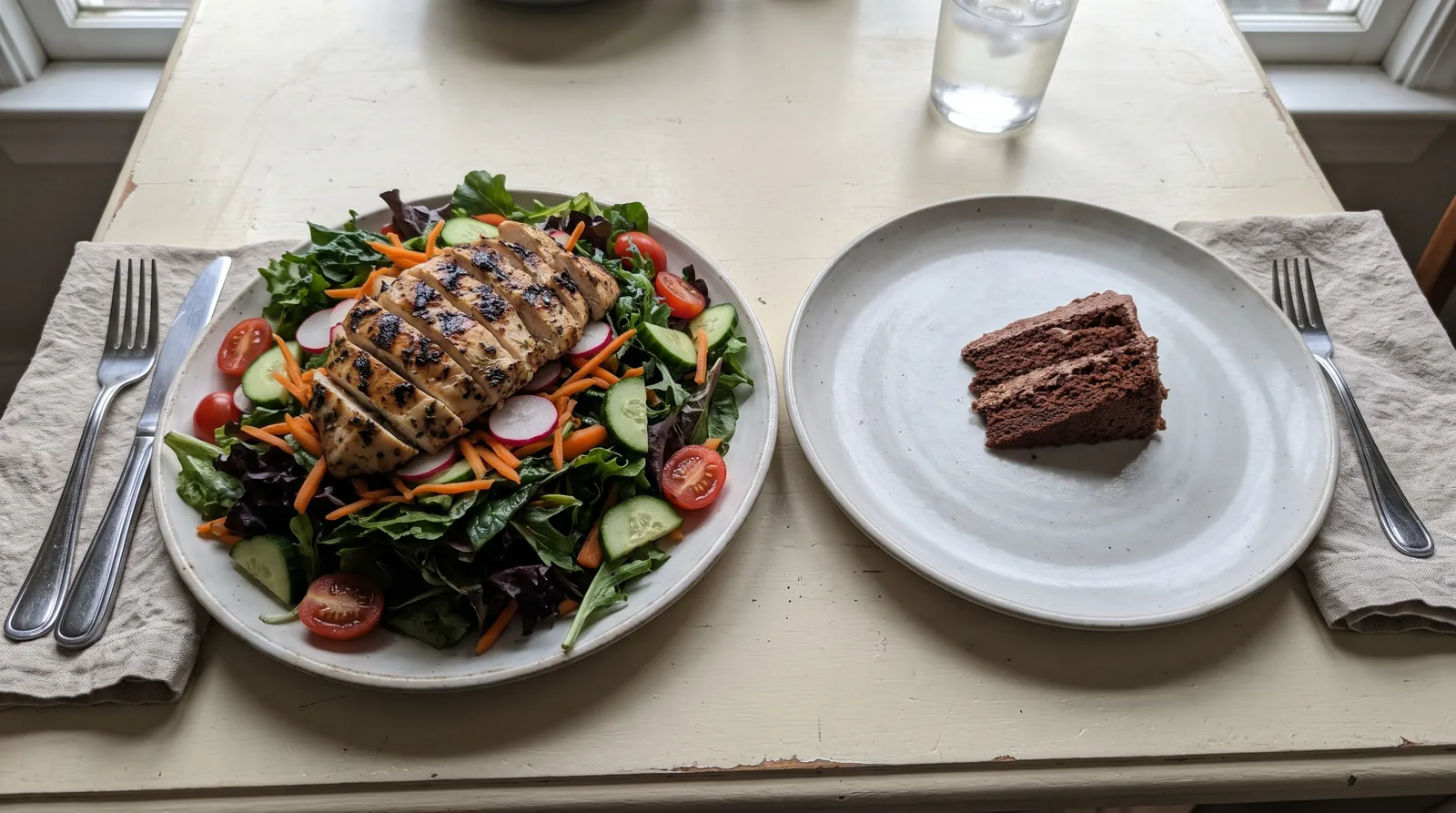
So there's some truth in "good calories vs bad calories," just not in the energy itself. Calories from whole foods with protein, fiber and water tend to come with more nutrients and are easier to stop eating. Calories from highly processed foods are easy to overeat. The 2025–2030 Dietary Guidelines reflect this, asking people to prioritize nutrient-dense foods and cut back sharply on highly processed ones.
Quantity still matters, though. Overeating whole foods can still cause weight gain, and a small treat fits into a healthy diet. The two work together: choose mostly nutrient-dense foods, and keep the total near what you burn.
How many calories do you need?
The 2020–2025 Dietary Guidelines estimate that adult women need roughly 1,600 to 2,400 calories a day and adult men roughly 2,000 to 3,000, depending on age and activity. The low end is for sedentary older adults, the high end for active younger ones. A "moderately active" adult in those tables walks the equivalent of about 1.5 to 3 miles a day on top of daily living.
Those are averages for groups. Your own number depends on your height and weight too, which is why a personal estimate is more useful. Enter your details in the TDEE calculator to see your maintenance calories, then use the weight loss simulator to see what happens if you eat more or less than that.
Reading calories on a label
On a U.S. Nutrition Facts label, calories are the largest number, and they're for one serving only. Labels round them: under 5 calories shows as 0, up to 50 is rounded to the nearest 5, and above 50 to the nearest 10. In countries that use kilojoules, the label shows kJ first; divide by 4.184 to get kcal. For a full walk-through, see how to read nutrition facts labels, and to make a label for your own recipe, try the nutrition label maker.
Calorie FAQ
What does a calorie measure?
A calorie measures energy. On food labels, a Calorie is a kilocalorie, the energy your body can get from a food. One kilocalorie equals 4.184 kilojoules.
What's the difference between carbs and calories?
Carbohydrates are a nutrient you eat in grams; calories are the energy that nutrient gives. Each gram of carbohydrate gives about 4 calories, the same as protein, while fat gives 9 and alcohol 7.
Do fiber calories count?
Partly. Fiber is a carbohydrate but your body gets only about 2 calories per gram from it, mostly through fermentation in the gut, instead of 4. Some labels use the lower value.
Are calories bad?
No. Calories are the energy your body needs to live. Problems come from eating more than you burn over time, or getting calories mostly from highly processed foods that make it easy to overeat.
Is there such a thing as good calories vs bad calories?
A calorie is the same amount of energy wherever it comes from, but foods differ in what comes with it. In an NIH trial, people ate about 508 more calories a day on an ultra-processed diet than on an unprocessed one offered in the same amounts.
Sources
- National Institute of Standards and Technology. NIST Special Publication 811, Appendix B.8: factors for units (calorie definitions in joules).
- FAO. Food energy: methods of analysis and conversion factors, chapter 3. Food and Nutrition Paper 77, 2003 (gross and metabolizable energy, Atwater factors, fiber 2 kcal per gram).
- U.S. Food and Drug Administration. 21 CFR 101.9, Nutrition labeling of food (calorie methods and rounding).
- Novotny JA, Gebauer SK, Baer DJ. Discrepancy between the Atwater factor predicted and empirically measured energy values of almonds in human diets. Am J Clin Nutr, 2012.
- Hall KD, et al. Ultra-processed diets cause excess calorie intake and weight gain: an inpatient randomized controlled trial of ad libitum food intake. Cell Metab, 2019.
- U.S. Department of Agriculture. FoodData Central.
- U.S. Departments of Agriculture and Health and Human Services. Dietary Guidelines for Americans, 2020–2025 (Table A2-2, estimated calorie needs).
- U.S. Departments of Health and Human Services and Agriculture. Dietary Guidelines for Americans, 2025–2030, January 2026.