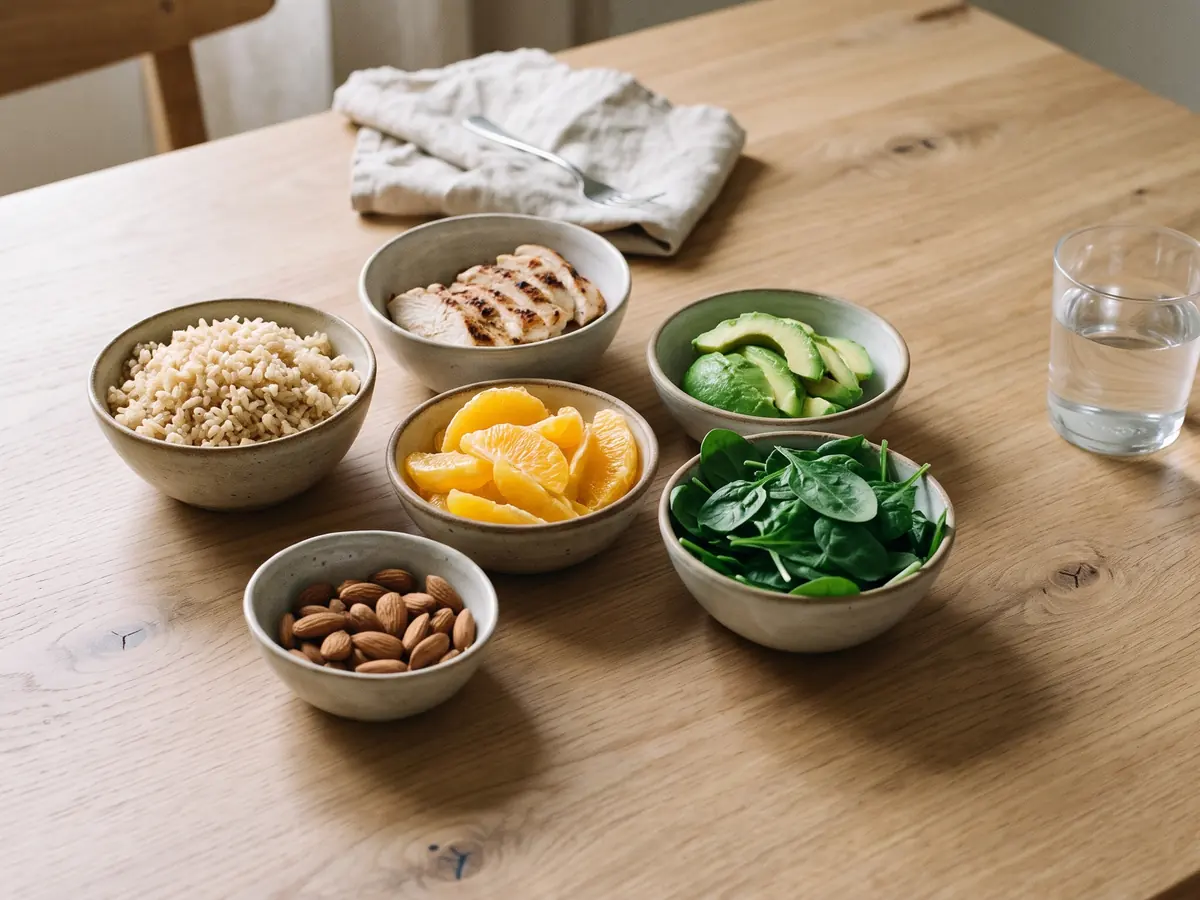
Short answerThe 6 main nutrients are carbohydrates, protein, fat, vitamins, minerals and water. Carbs, protein and fat are macronutrients that give energy. Vitamins and minerals are micronutrients needed in small amounts, and water makes up most of your body. A 7-nutrient list adds fiber; a 5-nutrient list leaves out water.
In this article
List the 6 essential nutrients
"Essential" means your body can't make enough of the nutrient on its own, so it has to come from food and drink. The six are usually split into two groups:
- Macronutrients, needed in large amounts: carbohydrates, protein and fat. These give energy, measured in calories.
- Micronutrients, needed in small amounts: vitamins and minerals. They give no calories but run thousands of processes in the body.
- Water, which doesn't fit either group but is needed in larger amounts than anything else.
Here's a breakdown of nutrients with the adult reference values from the Dietary Reference Intakes (DRIs), the values set for the United States and Canada:
| Nutrient | Main job | Adult target | Calories per gram |
|---|---|---|---|
| Carbohydrates | Main energy source, especially for the brain | RDA 130 g a day; 45–65% of calories | 4 |
| Protein | Builds and repairs tissue, makes enzymes and hormones | RDA 0.8 g per kg; 10–35% of calories | 4 |
| Fat | Energy store, cell membranes, absorbing vitamins A, D, E, K | 20–35% of calories | 9 |
| Vitamins | Help release energy, support immunity, vision, blood and bones | Varies by vitamin | 0 |
| Minerals | Bones, fluid balance, nerves, oxygen transport | Varies by mineral | 0 |
| Water | Fluid for blood, temperature control, digestion | 2.7 L women, 3.7 L men (total water) | 0 |
1. Carbohydrates
Carbohydrates, the first of the 6 main nutrients, are sugars, starches and fiber. During digestion, sugars and starches are broken down into glucose, which your cells use for energy. They give about 4 calories per gram.
How much: the RDA for digestible carbohydrate is 130 g a day for adults. The acceptable range is 45 to 65% of calories. Most people eat well above 130 g, and that's fine within the range.
Best sources: whole grains like oats, brown rice and quinoa; fruit; starchy vegetables like sweet potatoes; beans and lentils. The 2025–2030 Dietary Guidelines advise prioritizing "fiber-rich whole grains" and cutting back on refined carbohydrates like white bread, packaged breakfast foods and crackers.
Fiber
Fiber is the part of carbohydrate your body can't digest. It adds bulk, feeds gut bacteria and helps you feel full. The adequate intake is 25 g a day for women and 38 g for men aged 19 to 30. Beans, lentils, raspberries, whole grains and vegetables are the richest sources. The fiber calculator works out your own target and shows which foods get you there.
2. Protein
Protein, the second of the 6 main nutrients, is made of amino acids, some of which (the essential amino acids) must come from food. Your body uses it to build and repair muscle and other tissue, and to make enzymes, hormones and antibodies. Protein gives 4 calories per gram.
How much: the RDA is 0.8 g per kilogram of body weight a day, which works out to 56 g for a reference man and 46 g for a reference woman in the DRI tables. The acceptable range is 10 to 35% of calories. The 2025–2030 Dietary Guidelines set a higher goal of 1.2 to 1.6 g per kg and say to "prioritize protein foods at every meal."
Best sources: poultry, fish, eggs, meat, dairy, beans, lentils, soy, nuts and seeds. Per calorie, chicken breast and plain Greek yogurt lead: 100 calories of either gives about 17 to 19 g of protein, according to USDA data. The macro calculator sets a protein target for your weight and goal, and the chicken breast nutrition page lists protein by the ounce.
3. Fat
Fat, the third of the 6 main nutrients, is the body's most concentrated energy store, at 9 calories per gram. It's part of every cell membrane, it's needed to absorb vitamins A, D, E and K, and it supplies two fatty acids your body can't make: linoleic acid (an omega-6) and alpha-linolenic acid (an omega-3).
How much: the acceptable range is 20 to 35% of calories. For the two essential fatty acids, the adequate intakes for adults aged 19 to 30 are:
| Fatty acid | Women | Men |
|---|---|---|
| Linoleic acid (omega-6) | 12 g a day | 17 g a day |
| Alpha-linolenic acid (omega-3) | 1.1 g a day | 1.6 g a day |
The Dietary Guidelines add a limit: saturated fat "should not exceed 10% of total daily calories." Best sources of healthy fats, in the guidelines' words, include "omega-3–rich seafood, nuts, seeds, full-fat dairy, olives, and avocados," with olive oil suggested for cooking. The fat intake calculator converts these percentages into grams for your calories.

The three energy nutrients in grams
For a breakdown of nutrients in grams, start with the energy ones. The acceptable ranges for carbs, protein and fat are given as a share of calories, which is hard to picture. Here's what they mean in grams at three common calorie levels, using 4 calories per gram for carbs and protein and 9 for fat:
| Calories | Carbohydrates (45–65%) | Protein (10–35%) | Fat (20–35%) |
|---|---|---|---|
| 1,600 | 180–260 g | 40–140 g | 36–62 g |
| 2,000 | 225–325 g | 50–175 g | 44–78 g |
| 2,500 | 281–406 g | 63–219 g | 56–97 g |
The ranges are wide on purpose. Many different diets fit inside them, from higher-carb to higher-protein. What matters more, as the UK's Eatwell Guide also shows, is that the carbs come mostly from whole grains, fruit, vegetables and beans, the protein from varied sources, and the fat mostly from unsaturated sources. To pick a split within these ranges for your goal, use the macro calculator.
4. Vitamins
Vitamins, the fourth of the 6 main nutrients, are organic compounds your body needs in tiny amounts, measured in milligrams or micrograms. They don't give energy, but many of them help your body release energy from food, and others support vision, blood clotting, the immune system and bones.
The DRI tables list 13 vitamins, plus choline, which is grouped with them:
- Fat-soluble: vitamins A, D, E and K. They're absorbed with fat and stored in the body.
- Water-soluble: vitamin C and the B vitamins: thiamin, riboflavin, niacin, vitamin B6, folate, vitamin B12, pantothenic acid and biotin.
A few vitamins come up most often on food labels and in the Dietary Guidelines:
| Vitamin | Daily Value (FDA) | Example source |
|---|---|---|
| Vitamin A | 900 mcg | 3 oz raw carrots: 586 mcg (65% DV) |
| Vitamin C | 90 mg | 1 navel orange: 83 mg (92% DV) |
| Vitamin D | 20 mcg | Fatty fish, fortified milk |
| Vitamin B12 | 2.4 mcg | Meat, poultry, eggs, dairy |
The 2025–2030 guidelines point to "vitamin B12–rich protein sources such as meats, poultry, eggs, and dairy," "folate-rich legumes," and "vitamin A–rich vegetables." Eating a variety of colorful vegetables and fruit covers most vitamins. For more on carrots and oranges, see the carrot and orange nutrition pages.
5. Minerals
Minerals, the fifth of the 6 main nutrients, are elements from the earth that end up in plants and animals. The DRI tables cover 21 of them, from calcium and iron to trace elements like selenium and iodine. They build bones and teeth, carry oxygen in the blood, keep fluids balanced and help nerves and muscles work.
U.S. Nutrition Facts labels list four minerals in milligrams: sodium, calcium, iron and potassium. FDA lists calcium, iron and potassium among the nutrients to get more of, and sodium among the ones to get less of.
| Mineral | Daily Value (FDA) | Main job | Example sources |
|---|---|---|---|
| Calcium | 1,300 mg | Bones and teeth, muscle contraction | Milk, yogurt, cheese |
| Iron | 18 mg | Carries oxygen in the blood | Meat, beans, lentils, spinach |
| Potassium | 4,700 mg | Fluid balance, nerves, blood pressure | Fruit, vegetables, beans |
| Sodium | 2,300 mg (limit) | Fluid balance | Salt, packaged and restaurant foods |
Two examples from our food pages: 70–85% dark chocolate has 11.9 mg of iron per 100 g, and a navel orange has 232 mg of potassium and 60 mg of calcium. The Dietary Guidelines set the sodium limit at less than 2,300 mg a day for people 14 and older.

6. Water
Water, the last of the 6 main nutrients, is the one you need in the largest amount. It carries nutrients in the blood, helps control body temperature through sweat, cushions joints and is needed for digestion. It has no calories.
How much: the DRI adequate intake for total water, which includes water from food as well as drinks, is 2.7 litres a day for women and 3.7 litres for men aged 19 to 30. Needs go up in hot weather and with exercise. The 2025–2030 guidelines also note that "sodium and electrolytes are essential for hydration."
Best sources: plain water first, plus milk, tea and coffee, and water-rich foods like fruit, vegetables and soup. The guidelines advise avoiding sugar-sweetened drinks. For the calories in common drinks, see water calories.
One day that covers all six
Here's how the six main nutrients show up in a real day of food. This is Day 1 of our 1700 calorie meal plan, counted with USDA data:
| Meal | Foods | Main nutrients it brings |
|---|---|---|
| Breakfast | Avocado toast with 2 eggs, strawberries, a glass of milk | Protein, fat, whole-grain carbs, vitamin C, calcium |
| Lunch | Turkey wrap with lettuce, pepper, tomatoes and hummus | Protein, fiber, vitamins from vegetables |
| Snack | Apple with peanut butter | Carbs, fiber, healthy fat |
| Dinner | Chicken stir-fry with vegetables and brown rice, a pear | Protein, carbs, fiber, vitamins and minerals |
| All day | Water with and between meals | Water |
The day totals 106 g of protein, 180 g of carbohydrate, 65 g of fat and 34 g of fiber, with every food group represented. You don't need to track vitamins and minerals one by one when the plate looks like this; variety does that work for you.
Nutrients that matter more at different ages
The 6 main nutrients are the same for everyone, but the 2025–2030 Dietary Guidelines highlight different priorities at different life stages:
- Teenagers: adolescence brings "increased needs for energy, protein, calcium, and iron—especially for girls due to menstruation," and "adequate calcium and vitamin D are vital for peak bone mass."
- Young adults: the guidelines put "special emphasis on healthy fats, iron, and folate for women and healthy fats and protein for men."
- Pregnancy: "iron, folate, and iodine as top priorities," from foods such as iron-rich meats, folate-rich greens and legumes, choline-rich eggs, calcium-rich dairy and low-mercury omega-3–rich seafood.
- Older adults: some need fewer calories "but still require equal or greater amounts of key nutrients such as protein, vitamin B12, vitamin D, and calcium."
When food alone can't cover these, the guidelines say fortified foods or supplements may be needed, under the advice of a health care professional.
5 nutrients, 6 main nutrients or 7 nutrients?
Different textbooks count nutrients differently, as 5 nutrients, 6 main nutrients or 7 nutrients, but they describe the same things:
- 5 nutrients: carbohydrates, protein, fat, vitamins and minerals. Water is treated separately, often because it isn't "food."
- 6 main nutrients: the five above plus water. This is the most common list.
- 7 nutrients: the six plus fiber. Fiber is technically a carbohydrate, but it behaves so differently that many lists give it its own place.
Whichever list you learned, the principles of nutrition are the same: eat a variety of foods from every food group and you'll cover all of them.
Principles of nutrition
Knowing the six nutrients is the theory. The principles of nutrition turn it into food choices. The Dietary Guidelines for Americans, 2025–2030 give a short version:
- Eat real food. Build meals on "whole, nutrient-dense foods—protein, dairy, vegetables, fruits, healthy fats, and whole grains."
- Prioritize protein. Include a protein food at every meal.
- Eat colorful vegetables and fruit. The goal at 2,000 calories is 3 servings of vegetables and 2 of fruit a day.
- Choose healthy fats and keep saturated fat under 10% of calories.
- Choose whole grains over refined ones.
- Limit highly processed foods, added sugars and sodium.
On top of that comes balance: enough calories for your body, but not too many. The TDEE calculator gives your number. For a fuller picture, read what a balanced diet is, the healthy food list, and what a calorie is. The food nutrition pages show the nutrients in common foods by portion.
Checking packaged foods
For packaged food, the Nutrition Facts label shows most of the six main nutrients on one panel: carbohydrate, fiber, protein and fat in grams, plus vitamin D, calcium, iron, potassium and sodium. FDA's quick rule for the %DV column is that 5% DV or less of a nutrient per serving is low and 20% or more is high. Look for high numbers on fiber, calcium, iron and potassium, and low numbers on saturated fat, sodium and added sugars. For a line-by-line walk-through, see how to read nutrition facts labels.
Nutrients FAQ
What are the 6 main nutrients?
Carbohydrates, protein, fat, vitamins, minerals and water. The first three give calories; vitamins, minerals and water don't, but the body can't work without them.
What are the 7 nutrients?
The 7-nutrient list adds fiber to the six: carbohydrates, protein, fat, vitamins, minerals, water and fiber. Fiber is technically a carbohydrate, but it's often listed on its own because the body handles it differently.
What are the 5 nutrients?
The 5-nutrient list is carbohydrates, protein, fat, vitamins and minerals. It leaves out water, which some lists treat separately even though it's essential.
Which nutrients give energy?
Carbohydrates and protein give about 4 calories per gram and fat 9. Vitamins, minerals and water give no calories.
How much water do you need a day?
The adequate intake of total water, from drinks and food together, is 3.7 litres a day for men and 2.7 litres for women aged 19 to 30, according to the Dietary Reference Intakes.
Sources
- Health Canada. Dietary Reference Intakes: reference values for macronutrients (carbohydrate, protein, fatty acids, fibre, total water, AMDRs).
- Health Canada. Reference values for vitamins and reference values for elements.
- U.S. Food and Drug Administration. Daily Value on the Nutrition and Supplement Facts labels.
- U.S. Food and Drug Administration. How to understand and use the Nutrition Facts label.
- U.S. Departments of Health and Human Services and Agriculture. Dietary Guidelines for Americans, 2025–2030, January 2026.
- FAO. Food energy: methods of analysis and conversion factors, chapter 3. Food and Nutrition Paper 77, 2003.
- U.S. Department of Agriculture. FoodData Central.