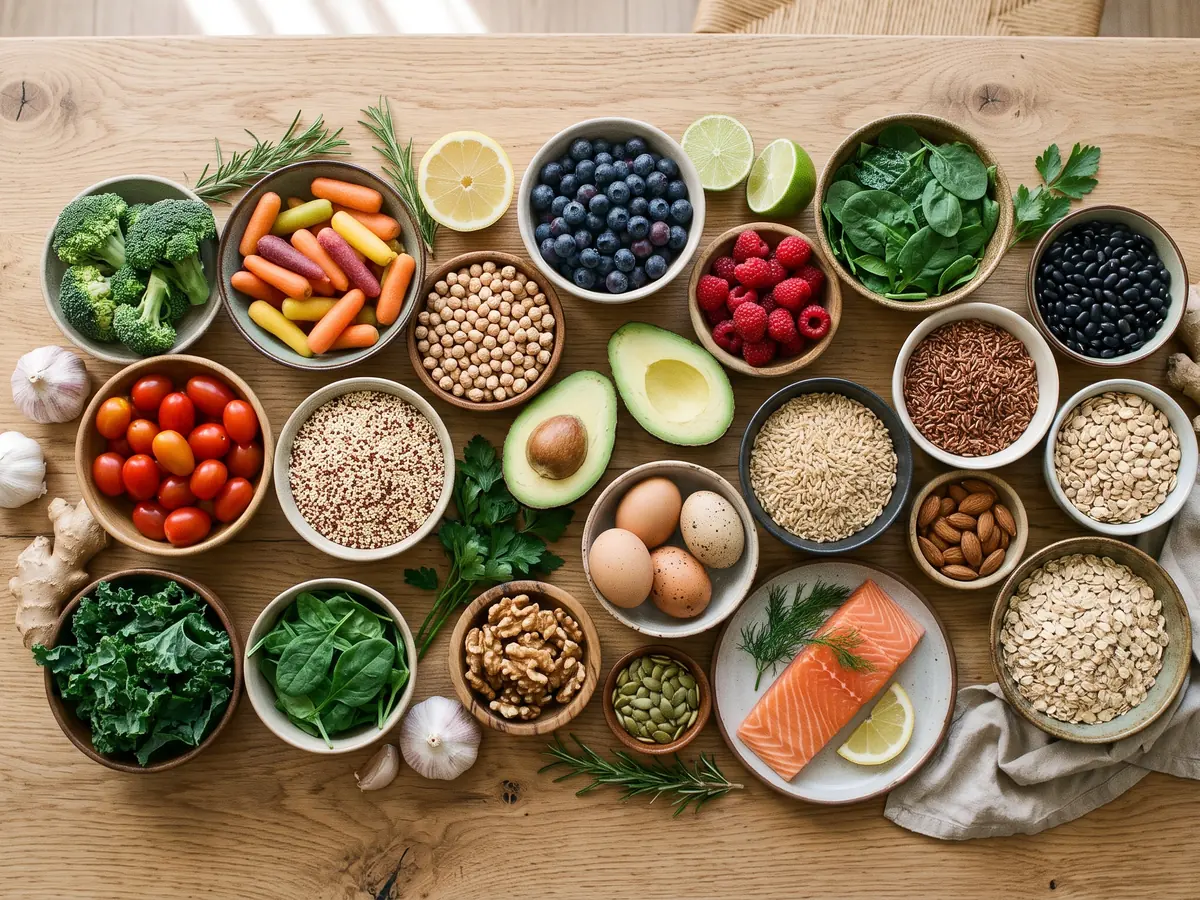
Short answerHealthy things to eat include vegetables (broccoli, spinach, peppers, carrots), fruit (berries, apples, oranges), protein foods (chicken, fish, eggs, lean beef, tofu), beans and lentils, plain dairy (Greek yogurt, milk), whole grains (oats, brown rice, quinoa), and nuts, seeds and olive oil. The 2025–2030 Dietary Guidelines sum it up as "eat real food": whole, nutrient-dense foods, with far fewer highly processed ones.
In this article
What makes a food healthy?
A healthy food gives your body useful nutrients, such as protein, fiber, vitamins and minerals, without a lot of added sugar, sodium or saturated fat. The Dietary Guidelines for Americans, 2025–2030 call these nutrient-dense foods, and they put the message in three words: "eat real food." The guidelines ask households to "prioritize diets built on whole, nutrient-dense foods—protein, dairy, vegetables, fruits, healthy fats, and whole grains," alongside a "dramatic reduction in highly processed foods."
That's the rule this healthy food list follows. Every item is a whole food or close to it. None of them is a superfood on its own, and none is required. The point is to have plenty of options in each group so you can eat a variety, which is what the guidelines ask for.
For each food, the tables show a typical serving with its calories, protein and fiber, from USDA FoodData Central. Numbers are for the form named in each table: raw or cooked vegetables as listed, raw fruit, and cooked meat, fish, beans and grains.
Vegetables
Vegetables are the base of any list of healthy things to eat; our guide to servings of vegetables per day shows how much to aim for. They're mostly water and fiber, so they fill your plate for very few calories. The Dietary Guidelines set a goal of 3 servings a day on a 2,000-calorie pattern, where a serving is 1 cup raw or cooked, or 2 cups of leafy greens. They also say frozen and canned vegetables with no or very limited added sugars "can also be good options." Our guide to servings of vegetables per day has the target for every calorie level and age.
| Food | Serving | Calories | Protein | Fiber |
|---|---|---|---|---|
| Spinach, raw | 1 cup (30 g) | 7 | 0.9 g | 0.7 g |
| Romaine lettuce | 2 cups (94 g) | 16 | 1.2 g | 2.0 g |
| Broccoli, cooked | 1/2 cup (78 g) | 27 | 1.9 g | 2.6 g |
| Cauliflower, cooked | 1/2 cup (62 g) | 14 | 1.1 g | 1.4 g |
| Carrot | 1 medium (61 g) | 25 | 0.6 g | 1.7 g |
| Red bell pepper | 1 medium (119 g) | 31 | 1.2 g | 2.5 g |
| Tomato | 1 medium (123 g) | 22 | 1.1 g | 1.5 g |
| Cucumber | 1/2 cup slices (52 g) | 8 | 0.3 g | 0.3 g |
| Green beans, cooked | 1 cup (125 g) | 44 | 2.4 g | 4.0 g |
| Zucchini, cooked | 1 cup sliced (180 g) | 27 | 2.1 g | 1.8 g |
| Mushrooms, raw | 1 cup sliced (70 g) | 15 | 2.2 g | 0.7 g |
| Onion, raw | 1 medium (110 g) | 44 | 1.2 g | 1.9 g |
| Sweet potato, baked | 1 medium (114 g) | 103 | 2.3 g | 3.8 g |
Some healthy foods in this group are worth knowing in detail. Why these vegetables earn a place:
- Leafy greens (spinach, romaine) are the lowest-calorie foods on the whole list. A full cup of raw spinach has 7 calories.
- Broccoli and cauliflower give fiber and some protein, and work roasted, steamed or in stir-fries.
- Carrots and sweet potatoes are orange because of beta-carotene, which the body turns into vitamin A. A 3 oz serving of raw carrots gives 65% of the Daily Value for vitamin A; see the carrot nutrition page.
- Red peppers and tomatoes add color, crunch and very few calories to salads, sandwiches and sauces.
- Green beans have the most fiber per serving in this group, 4 g a cup.
- Mushrooms and zucchini bulk up pasta sauces, omelets and stir-fries for almost no calories.
- Onions are the start of countless home-cooked meals, which the guidelines encourage over takeout.
Fruits
The guidelines' goal for fruit is 2 servings a day at 2,000 calories, where a serving is 1 cup raw or 1/2 cup dried. They advise eating whole fruit "in their original form" and drinking 100% juice only "in limited portions or diluted with water."
| Food | Serving | Calories | Protein | Fiber |
|---|---|---|---|---|
| Raspberries | 1 cup (123 g) | 64 | 1.5 g | 8.0 g |
| Strawberries | 1 cup (152 g) | 49 | 1.0 g | 3.0 g |
| Blueberries | 1 cup (148 g) | 84 | 1.1 g | 3.6 g |
| Apple | 1 medium (182 g) | 95 | 0.5 g | 4.4 g |
| Pear | 1 medium (178 g) | 101 | 0.6 g | 5.5 g |
| Orange, navel | 1 fruit (140 g) | 69 | 1.3 g | 3.1 g |
| Banana | 1 medium (118 g) | 105 | 1.3 g | 3.1 g |
| Kiwi | 1 fruit (69 g) | 42 | 0.8 g | 2.1 g |
| Peach | 1 medium (150 g) | 58 | 1.4 g | 2.2 g |
| Grapes | 1 cup (151 g) | 104 | 1.1 g | 1.4 g |
| Avocado | 1/3 cup cubes (50 g) | 80 | 1.0 g | 3.4 g |
- Raspberries have the most fiber of any fruit here, 8 g a cup, for 64 calories.
- Strawberries have the fewest calories per cup, 49.
- Apples and pears are easy to carry and give 4.4 to 5.5 g of fiber each.
- Oranges are a vitamin C standout: a navel orange gives 83 mg, 92% of the Daily Value. The orange nutrition page has every size.
- Bananas are filling and need no prep.
- Avocado is botanically a fruit but nutritionally closer to a healthy fat: most of its calories come from fat. The guidelines list avocados among foods rich in healthy fats.
Fruit is a good place to look if you want healthy foods for few calories. The low-calorie fruits list ranks 15 fruits per 100 g and per cup.
Meat, fish, eggs and soy
The 2025–2030 guidelines put protein first. They ask people to "prioritize high-quality, nutrient-dense protein foods" and to eat a variety from animal sources, "including eggs, poultry, seafood, and red meat," and from plants. They set a goal of 1.2 to 1.6 grams of protein per kilogram of body weight per day and suggest baking, broiling, roasting, stir-frying or grilling instead of deep-frying.
| Food | Serving | Calories | Protein | Fat |
|---|---|---|---|---|
| Chicken breast, skinless | 3 oz (85 g) | 140 | 26.3 g | 3.0 g |
| Cod | 3 oz (85 g) | 89 | 19.4 g | 0.7 g |
| Shrimp | 3 oz (85 g) | 84 | 20.4 g | 0.2 g |
| Tuna, canned in water | 3 oz (85 g) | 73 | 16.5 g | 0.8 g |
| Salmon | 3 oz (85 g) | 175 | 18.8 g | 10.5 g |
| Beef sirloin, lean | 3 oz (85 g) | 160 | 25.8 g | 5.6 g |
| Ground turkey | 3 oz (85 g) | 173 | 23.3 g | 8.8 g |
| Egg | 1 large (50 g) | 78 | 6.3 g | 5.3 g |
| Tofu, firm, raw | 1/2 cup (126 g) | 181 | 21.8 g | 11.0 g |
- Chicken breast gives the most protein per serving on this list, 26 g in 3 oz. The chicken breast nutrition page has every portion size.
- Cod, shrimp and tuna are the leanest: around 20 g of protein for under 90 calories. Canned tuna keeps for months in the cupboard.
- Salmon has more fat than white fish, which is why it has more calories. The guidelines list omega-3–rich seafood among sources of healthy fats.
- Lean beef is part of the guidelines' list of animal protein foods. See the steak nutrition page for different cuts.
- Eggs are a quick protein: 6 g each.
- Tofu is the plant protein here, with 22 g in half a cup. Soy is on the guidelines' list of plant protein foods.
Beans and lentils
Beans, peas and lentils count twice in the guidelines: as a protein food and as a vegetable. They're among the few foods that give a lot of both protein and fiber.
| Food | Serving | Calories | Protein | Fiber |
|---|---|---|---|---|
| Lentils | 1/2 cup (99 g) | 115 | 8.9 g | 7.8 g |
| Black beans | 1/2 cup (86 g) | 114 | 7.6 g | 7.5 g |
| Chickpeas | 1/2 cup (82 g) | 134 | 7.3 g | 6.2 g |
| Edamame, shelled | 1/2 cup (78 g) | 94 | 9.3 g | 4.1 g |
Half a cup of lentils covers more than a quarter of the 28 g fiber Daily Value. Beans and lentils work in soups, chili, salads and grain bowls, and canned versions are ready to eat after a rinse. Edamame makes a filling snack straight from the freezer.
Dairy
The new guidelines set a goal of 3 servings of dairy a day on a 2,000-calorie pattern and, when you have dairy, to "include full-fat dairy with no added sugars." They describe dairy as "an excellent source of protein, healthy fats, vitamins, and minerals." A serving is 1 cup of milk, 3/4 cup of yogurt or 1 oz of cheese.
| Food | Serving | Calories | Protein | Sodium |
|---|---|---|---|---|
| Greek yogurt, plain nonfat | 1 container (170 g) | 100 | 17.3 g | 61 mg |
| Cottage cheese | 1/2 cup (113 g) | 92 | 11.8 g | 348 mg |
| Milk, 2% | 1 cup (244 g) | 122 | 8.1 g | 115 mg |
| Cheddar cheese | 1 oz (28 g) | 115 | 6.8 g | 180 mg |
Plain Greek yogurt gives the most protein per calorie of any dairy food here. Cottage cheese is close on protein but higher in sodium. Cheddar has the most calories for its size, so an ounce goes a long way. Choose plain versions and add your own fruit; flavored yogurts can contain added sugar, which the label's "Includes … Added Sugars" line will show.
Whole grains
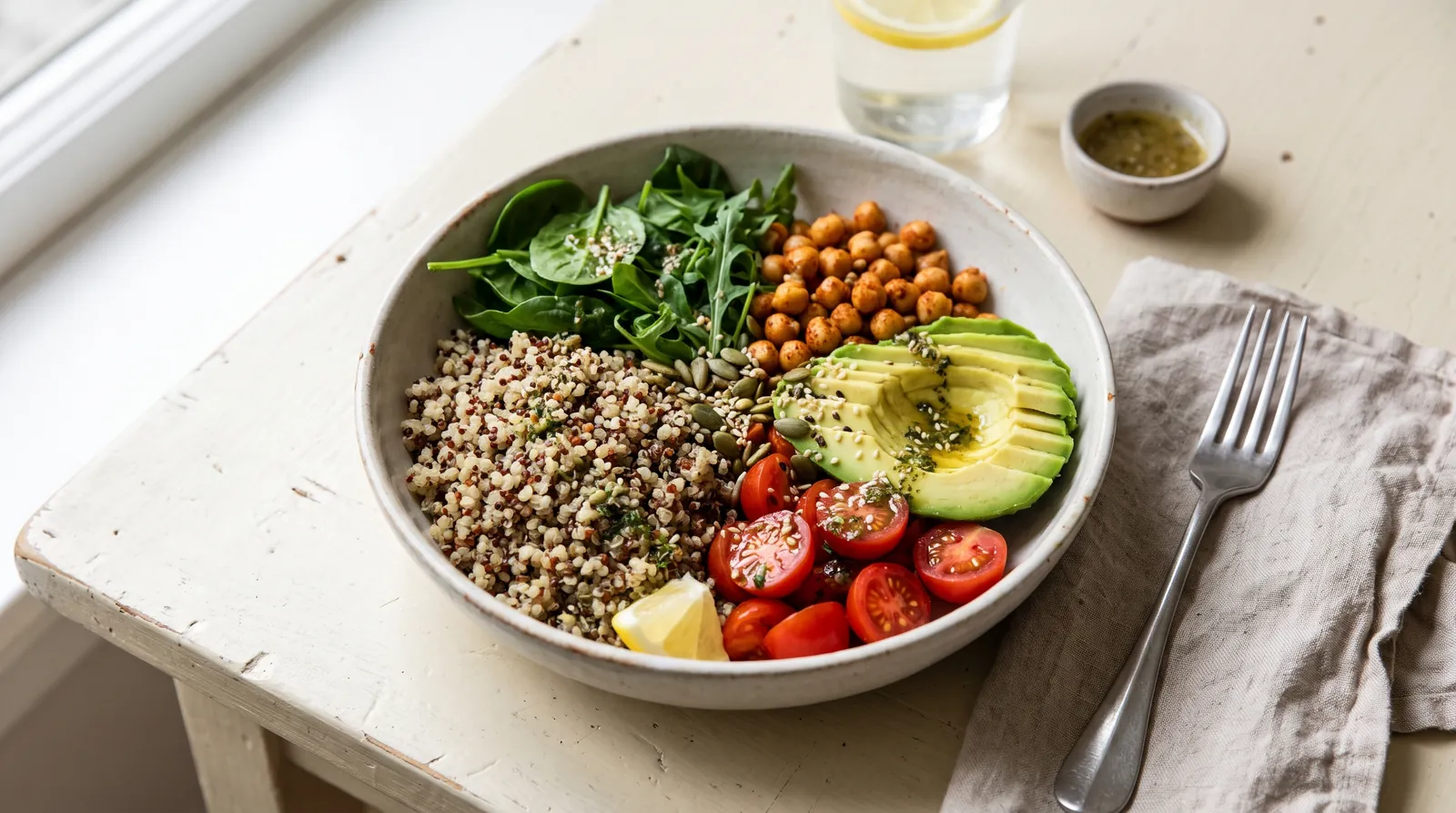
The guidelines say to "prioritize fiber-rich whole grains" and to significantly reduce refined carbohydrates "such as white bread, ready-to-eat or packaged breakfast options, flour tortillas, and crackers." The goal is 2 to 4 servings a day, where a serving is 1/2 cup of cooked oats, brown rice or quinoa, or 1 slice of bread.
| Food | Serving | Calories | Protein | Fiber |
|---|---|---|---|---|
| Oats | 1/2 cup dry (40 g) | 152 | 5.3 g | 4.0 g |
| Quinoa, cooked | 1/2 cup (93 g) | 112 | 4.1 g | 2.6 g |
| Brown rice, cooked | 1/2 cup (101 g) | 124 | 2.8 g | 1.6 g |
| Whole-wheat bread | 1 slice (32 g) | 81 | 4.0 g | 1.9 g |
| Whole-wheat pasta, cooked | 1 cup (117 g) | 174 | 7.0 g | 4.6 g |
Half a cup of dry oats makes about a cup of cooked oatmeal and gives 4 g of fiber. When you buy bread or pasta, check that a whole grain is the first ingredient.
Nuts, seeds and healthy fats
The guidelines say healthy fats "are plentiful in many whole foods," including nuts, seeds, olives and avocados, and that when cooking, people should "prioritize oils with essential fatty acids, such as olive oil." These foods are high in calories, so portions are small.
| Food | Serving | Calories | Protein | Fiber |
|---|---|---|---|---|
| Almonds | 1 oz (28 g) | 164 | 6.0 g | 3.5 g |
| Chia seeds | 1/2 oz (14 g) | 68 | 2.3 g | 4.8 g |
| Peanut butter | 2 tbsp (32 g) | 191 | 7.1 g | 1.6 g |
| Olive oil | 1 tbsp (13.5 g) | 119 | 0 g | 0 g |
An ounce of almonds is about a small handful. Chia seeds are mostly fiber by weight; half an ounce gives almost 5 g. Peanut butter is a protein food in the guidelines' table, but two tablespoons have 191 calories, so measure it. Olive oil is pure fat, 119 calories a tablespoon, and the guidelines count 1 teaspoon as a serving of healthy fats.
What is the most healthiest food?
It's one of the most common questions about healthy eating, and the honest answer is that there isn't one. No single food gives you everything. Salmon has protein and healthy fats but no fiber. Lentils have fiber and protein but little vitamin C. Oranges have vitamin C but almost no protein. That's why the Dietary Guidelines ask for variety within and across food groups rather than naming a winner.
What you can say is which foods give the most of a particular nutrient (see the 6 main nutrients) for their calories. Working from USDA data per 100 calories:
- Most protein per calorie: chicken breast (18.8 g) and plain nonfat Greek yogurt (17.3 g).
- Most fiber per calorie: raspberries (12.5 g), spinach (9.6 g) and broccoli (9.4 g).
- Protein and fiber together: lentils (7.8 g protein, 6.8 g fiber) and black beans (6.7 g and 6.6 g).
Our nutritional value guide has the full per-calorie table and explains how to compare foods this way.
What makes a healthy meal
A healthy food list only helps if it turns into meals. Putting the guidelines together, what makes a healthy meal comes down to five parts:
- A protein food. The guidelines say to "prioritize protein foods at every meal."
- Vegetables, and fruit when it fits. Aim to cover the 3 vegetable and 2 fruit servings across the day.
- A whole grain or starchy vegetable such as oats, quinoa, brown rice or sweet potato.
- A little healthy fat, like olive oil, avocado or nuts.
- Little added sugar. The guidelines say one meal "should contain no more than 10 grams of added sugars."
Two examples built only from this list, with USDA numbers:
Lunch bowl 404 calories · 15 g protein · 16 g fiber
- Base2 cups romaine, ½ cup cooked quinoa128
- Protein½ cup chickpeas134
- Toppings1 tomato, ⅓ cup avocado, 1 tsp olive oil142
Dinner plate 337 calories · 32 g protein · 9 g fiber
- Protein3 oz roast chicken breast140
- Starch1 medium baked sweet potato103
- Vegetables1 cup broccoli with 1 tsp olive oil94
The lunch bowl is lighter on protein; adding 3 oz of chicken or a boiled egg fixes that. For full days built the same way, see the balanced diet guide and the 7-day meal plan.
Healthy eating: what to eat in a day
If you want a simple picture of healthy eating, what to eat across a 2,000-calorie day according to the guidelines' serving table is roughly: 3 cups of vegetables (or 6 cups of leafy greens), 2 cups of fruit, 3 servings of dairy, 2 to 4 servings of whole grains, a protein food at each meal, and about 4½ teaspoons of added healthy fat. Smaller and bigger eaters scale up or down; the TDEE calculator gives your calorie level and the macro calculator splits it into protein, carbs and fat.
Why is healthy food important?
The 2025–2030 Dietary Guidelines open with a stark number: "Nearly 90% of health care spending goes to treating people who have chronic diseases." They argue that many of those illnesses "are not genetic destiny" but the predictable result of a diet built on highly processed foods, combined with too little activity.
Food also affects your gut. The guidelines explain that your gut contains trillions of microorganisms, called the microbiome, and that "vegetables, fruits, fermented foods (e.g., sauerkraut, kimchi, kefir, miso), and high-fiber foods support a diverse microbiome," while highly processed foods can disrupt it.
There's a practical side too. Whole foods like vegetables, fruit, beans and lean protein give more volume and protein for their calories, which makes it easier to eat the right amount. If weight is your goal, the weight loss plan guide shows how food choices and calories fit together.
Whole foods diet food list and "clean eating"
A whole foods diet food list is essentially the list above: foods that look much like they did when they were grown or raised. "Clean eating" is a popular label for the same idea, but it isn't an official or defined term, and it's sometimes used to sell products or to label foods as "dirty," which isn't helpful. The guidelines' wording is clearer: whole, nutrient-dense foods, with fewer highly processed ones.
Whole doesn't have to mean fresh. The guidelines count frozen, dried and canned vegetables and fruits with no or very limited added sugars as good options. Canned beans, canned tuna, frozen berries and frozen vegetables all belong on a whole foods list and keep for weeks or months.
What to cut back on, in the guidelines' words: "highly processed packaged, prepared, ready-to-eat, or other foods that are salty or sweet, such as chips, cookies, and candy," and sugar-sweetened drinks "such as sodas, fruit drinks, and energy drinks." Our 14-day no sugar diet lays out two weeks of meals without them.
Low calorie grocery list
If you're watching calories, these are the lowest-calorie picks from the list, per serving:
- Under 20 calories: spinach (7 per cup), cucumber (8 per ½ cup), cauliflower (14 per ½ cup), mushrooms (15 per cup), romaine (16 per 2 cups).
- Under 50 calories: tomato, carrot, zucchini, broccoli, red pepper, kiwi, green beans, onion, strawberries.
- Lean protein under 100 calories: tuna (73 per 3 oz), shrimp (84), cod (89), egg (78), plain nonfat Greek yogurt (100 per container).
A low calorie grocery list built from these foods lets you fill your plate without going over your target. Add the calories up for a full day in the calorie counter.
Printable grocery list
Here's the whole healthy food list as a grocery list. Print this page, or choose "Save as PDF" in your browser's print window to keep a copy; the menu and footer are hidden when printing. Tick what you need for the week.
Vegetables
- Spinach
- Romaine
- Broccoli
- Cauliflower
- Carrots
- Red peppers
- Tomatoes
- Cucumber
- Green beans
- Zucchini
- Mushrooms
- Onions
- Sweet potatoes
Fruits
- Raspberries
- Strawberries
- Blueberries
- Apples
- Pears
- Oranges
- Bananas
- Kiwis
- Peaches
- Grapes
- Avocados
Protein
- Chicken breast
- Cod
- Shrimp
- Canned tuna
- Salmon
- Lean beef
- Ground turkey
- Eggs
- Tofu
Beans and lentils
- Lentils
- Black beans
- Chickpeas
- Edamame
Dairy
- Plain Greek yogurt
- Cottage cheese
- Milk
- Cheddar
Whole grains
- Oats
- Quinoa
- Brown rice
- Whole-wheat bread
- Whole-wheat pasta
Nuts, seeds, fats
- Almonds
- Chia seeds
- Peanut butter
- Olive oil
Looking for a clean eating food list PDF? Saving this page as a PDF gives you the same thing, built on the guidelines' whole-food groups rather than a diet label, and with the calories for every food in the tables above.
You don't need all 50 every week. Pick a few from each group, rotate them, and the variety takes care of itself. Buying some healthy foods frozen or canned, like berries, vegetables, beans and tuna, means you always have something on hand when the fresh food runs out.
Healthy food FAQ
What are some healthy things to eat?
Vegetables like broccoli, spinach and peppers; fruits like berries, apples and oranges; protein foods like chicken, fish, eggs, beans and lentils; dairy like Greek yogurt and milk; whole grains like oats and quinoa; and nuts, seeds and olive oil.
What is the most healthiest food?
No single food is the healthiest. Each food group brings different nutrients, which is why the Dietary Guidelines ask for a variety of foods. Per calorie, leafy greens, broccoli, berries, beans, fish, chicken breast and Greek yogurt give the most protein or fiber.
What makes a healthy meal?
A protein food, plenty of vegetables, some fruit or whole grains, and a little healthy fat, made mostly from whole foods. The Dietary Guidelines also advise no more than 10 grams of added sugars in one meal.
Why is healthy food important?
What you eat affects your risk of chronic disease. The 2025–2030 Dietary Guidelines note that nearly 90% of U.S. health care spending goes to treating people with chronic diseases, and that many of these illnesses are linked to diet.
What is on a whole foods diet food list?
Foods close to their natural form: fresh, frozen or canned vegetables and fruit without added sugar, meat, poultry, fish, eggs, beans, lentils, plain dairy, whole grains like oats and brown rice, nuts, seeds and olive oil.
Sources
- U.S. Departments of Health and Human Services and Agriculture. Dietary Guidelines for Americans, 2025–2030, January 2026 (food groups, serving goals, daily servings by calorie level).
- U.S. Department of Agriculture. FoodData Central.
- U.S. Food and Drug Administration. Daily Value on the Nutrition and Supplement Facts labels.