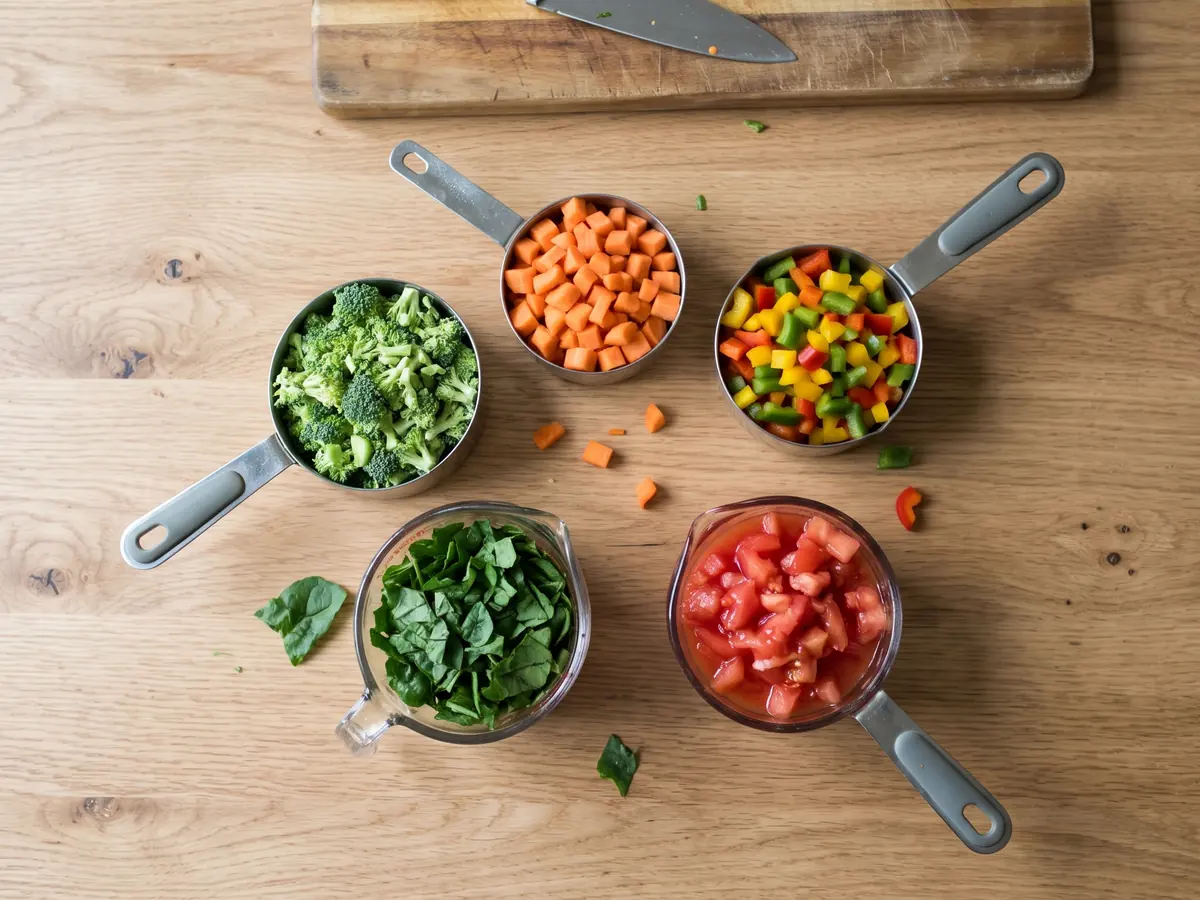
Short answerThe Dietary Guidelines for Americans, 2025–2030 set a goal of 3 servings of vegetables a day on a 2,000-calorie diet, where a serving is 1 cup raw or cooked, or 2 cups of leafy greens. Smaller eaters need fewer (2½ servings at 1,600 calories) and bigger eaters more (up to 4¾). In the UK, the NHS advises at least 5 portions of fruit and vegetables combined, at 80 g each.
In this article
Servings of vegetables by calorie level
The 2025–2030 Dietary Guidelines tie how many servings of vegetables per day you need to how many calories you eat. The more food you need overall, the more of it should be vegetables. Here is the official daily serving table:
| Calories per day | Vegetable servings | Fruit servings |
|---|---|---|
| 1,000 | 1¼ | 1 |
| 1,200 | 1¾ | 1 |
| 1,400 | 1¾ | 1½ |
| 1,600 | 2½ | 1½ |
| 1,800 | 3 | 1½ |
| 2,000 | 3 | 2 |
| 2,200 | 3½ | 2 |
| 2,400 | 3½ | 2 |
| 2,600 | 4¼ | 2 |
| 2,800 | 4¼ | 2½ |
| 3,000 | 4¾ | 2½ |
| 3,200 | 4¾ | 2½ |
So how many servings of vegetables per day do you need? First find your calorie level. The TDEE calculator estimates it from your age, sex, height, weight and activity. Then read across. If you're eating below your maintenance level to lose weight, use the row for the calories you actually eat.
The guidelines present these as goals for a 2,000-calorie pattern, "adjusting as needed based on your individual caloric requirements." They're targets to aim for, not upper limits.
How this changed from the last guidelines
The previous Dietary Guidelines, for 2020–2025, gave vegetables in cup-equivalents and set 2½ cups a day at 2,000 calories. The new edition counts in servings and raises the 2,000-calorie goal to 3. The unit is the same idea: in both editions, 1 cup of raw or cooked vegetables, or 2 cups of leafy salad greens, counts as one.
Servings of vegetables by age and sex
The new guidelines answer how many servings of vegetables per day by calorie level rather than by age. To translate, you can use the estimated calorie needs from the 2020–2025 guidelines, which list typical needs by age, sex and activity. The table below takes the "moderately active" estimate, meaning activity equal to walking about 1.5 to 3 miles a day at 3 to 4 mph, and matches it to the 2025–2030 serving goals.
| Group | Calories per day | Vegetable servings |
|---|---|---|
| Children 4–8 | 1,400–1,600 | 1¾–2½ |
| Girls 9–13 | 1,600–2,000 | 2½–3 |
| Boys 9–13 | 1,800–2,200 | 3–3½ |
| Girls 14–18 | 2,000 | 3 |
| Boys 14–18 | 2,400–2,800 | 3½–4¼ |
| Women 19–25 | 2,200 | 3½ |
| Women 26–50 | 2,000 | 3 |
| Women 51 and older | 1,800 | 3 |
| Men 19–25 | 2,800 | 4¼ |
| Men 26–45 | 2,600 | 4¼ |
| Men 46–65 | 2,400 | 3½ |
| Men 66 and older | 2,200 | 3½ |
If you're less active, your calorie needs are lower, usually by about 200 to 400 calories a day in the same table, and your vegetable target drops a step or two. If you're very active, it goes up. The 2020–2025 guidelines note these calorie figures "are only estimates," which is why a personal number from the TDEE calculator is more useful.
What counts as a serving of vegetables
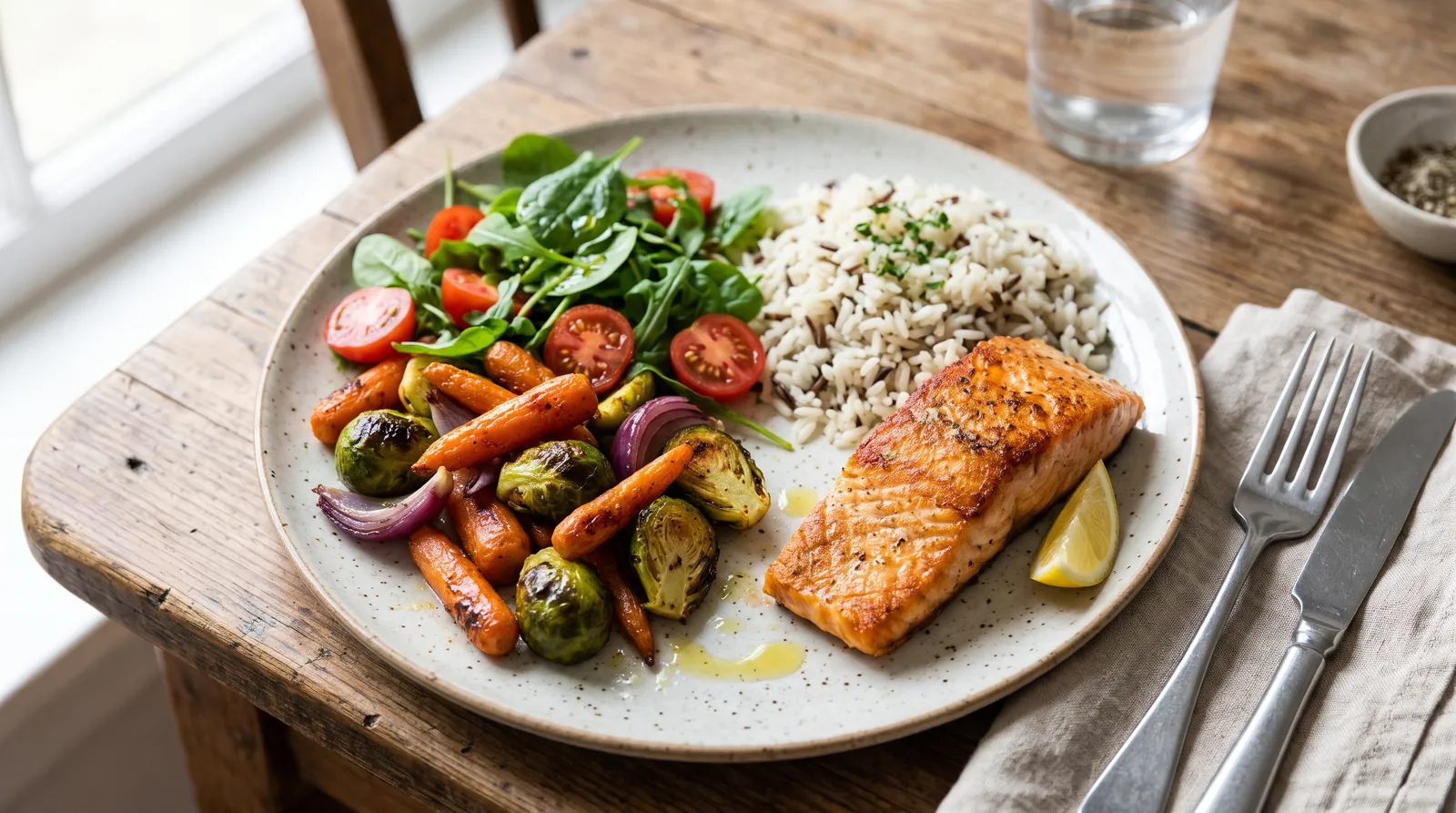
In the Dietary Guidelines, one serving of vegetables is:
- 1 cup of raw or cooked vegetables
- 2 cups of leafy greens, such as lettuce or raw spinach
The 2020–2025 edition also counted 1 cup of 100% vegetable juice and ½ cup of dried vegetables as one cup-equivalent. The new guidelines say 100% juice "should be consumed in limited portions or diluted with water," so whole vegetables are the better way to reach your servings.
Frozen and canned count too. The 2025–2030 guidelines say "frozen, dried, or canned vegetables or fruits with no or very limited added sugars can also be good options." For canned vegetables, the sodium line on the label is worth checking.
Here's what one serving looks like for common vegetables, with calories and fiber from USDA FoodData Central:
| Vegetable | 1 serving | Weight | Calories | Fiber |
|---|---|---|---|---|
| Spinach, raw | 2 cups | 60 g | 14 | 1.3 g |
| Romaine lettuce | 2 cups shredded | 94 g | 16 | 2.0 g |
| Mushrooms, raw | 1 cup sliced | 70 g | 15 | 0.7 g |
| Zucchini, cooked | 1 cup sliced | 180 g | 27 | 1.8 g |
| Cauliflower, cooked | 1 cup | 124 g | 29 | 2.9 g |
| Tomatoes, raw | 1 cup | 180 g | 32 | 2.2 g |
| Tomatoes, canned | 1 cup | 240 g | 38 | 4.6 g |
| Red bell pepper, raw | 1 cup chopped | 149 g | 39 | 3.1 g |
| Green beans, cooked | 1 cup | 125 g | 44 | 4.0 g |
| Carrots, raw | 1 cup chopped | 128 g | 52 | 3.6 g |
| Broccoli, cooked | 1 cup | 156 g | 55 | 5.1 g |
| Sweet potato, baked | 1 cup | 200 g | 180 | 6.6 g |
Three servings of non-starchy vegetables often come to under 150 calories in total, which is why vegetables are the easiest food group to increase when you're watching calories. Starchy vegetables like sweet potatoes have more, but they also bring more fiber per serving.
Raw or cooked: does it change the serving?
The rule is 1 cup either way, except for leafy greens, where 2 cups raw count as one serving. That matters because greens shrink a lot when cooked. Two cups of raw spinach weigh about 60 g, while a cup of cooked spinach packs in far more leaves, because spinach shrinks as it cooks. So a cup of cooked greens gives you more vegetable, and more fiber and vitamins, than a big raw salad of the same serving count. Both count; cooked greens are just a denser way to reach how many servings of vegetables per day you're aiming for.
For other vegetables the difference is smaller. A cup of chopped raw carrots and a cup of cooked carrots both count as one serving, even though the cooked cup holds a little more.
Eating a variety of vegetables
The guidelines ask people to "eat a variety of colorful, nutrient-dense vegetables and fruits." Different vegetables bring different nutrients: carrots and sweet potatoes are rich in vitamin A from beta-carotene (3 oz of raw carrots gives 65% of the Daily Value, as shown on our carrot nutrition page), while beans and lentils add protein and fiber.
The 2020–2025 guidelines spelled out variety as five subgroups, with weekly amounts. At 2,000 calories:
| Subgroup | Cups per week | Examples |
|---|---|---|
| Dark-green | 1½ | Spinach, broccoli, romaine, kale, collards, bok choy |
| Red and orange | 5½ | Carrots, tomatoes, red peppers, sweet potatoes, winter squash |
| Beans, peas, lentils | 1½ | Black beans, chickpeas, lentils, edamame |
| Starchy | 5 | Potatoes, corn, green peas, plantains |
| Other | 4 | Cauliflower, cucumber, green beans, mushrooms, onions, zucchini |
You don't need to track subgroups every week to know how many servings of vegetables per day you're eating. A simple rule: across the week, include something green, something red or orange, some beans or lentils, and a mix of the rest. A plate with a variety of vegetables tends to cover the subgroups on its own.
Note that the U.S. guidelines count green beans as an "other" vegetable, not a bean, and count beans and lentils in the vegetable group as well as the protein group.
Vegetable servings when you're losing weight
If you're eating less to lose weight, the calorie table still tells you how many servings of vegetables per day to aim for: at 1,200 calories the goal is 1¾ servings, at 1,400 also 1¾, and at 1,600 it's 2½. Those are minimums worth hitting, but many people find it helps to go over them when cutting calories, because non-starchy vegetables add volume for very little energy. Going from 2 to 4 servings of the vegetables in the serving table above adds roughly 30 to 110 calories, depending on which ones you pick.
That's why most of our meal plans lean on vegetables. The 7-day meal plan for weight loss averages about 1,500 calories a day and puts vegetables in most meals, and the 1800 calorie meal plan does the same at a higher calorie level. If you're working out how many servings of vegetables per day fit a weight loss plan, start from the calorie row you're eating at, then add extra non-starchy vegetables to meals that leave you hungry.
Starchy vegetables are different. A cup of baked sweet potato has 180 calories, more than three cups of most leafy or crunchy vegetables. It's still a good food with plenty of fiber, but count it like a grain portion when calories are tight.
5 A Day vs U.S. servings
The UK uses a different system. The NHS says "everyone should have at least 5 portions of a variety of fruit and vegetables every day," and that this means "5 portions of fruit and veg in total, not 5 portions of each." It's based on the World Health Organization's recommendation of at least 400 g of fruit and vegetables a day.
One adult portion is 80 g, or 30 g of dried fruit. NHS examples for vegetables:
- 2 broccoli spears
- 2 heaped tablespoons of cooked spinach, or 4 heaped tablespoons of cooked kale, spring greens or green beans
- 3 heaped tablespoons of cooked carrots, peas or sweetcorn, or 8 cauliflower florets
- 3 celery sticks, a 5 cm piece of cucumber, 1 medium tomato or 7 cherry tomatoes
A few NHS rules differ from the U.S. approach to how many servings of vegetables per day count:
- Potatoes don't count. Potatoes, yams, cassava and plantain "mainly contribute starch to the diet," so they're left out. Sweet potatoes, parsnips, swedes and turnips do count. In the U.S. guidelines, potatoes count as starchy vegetables.
- Beans count only once. Beans and pulses count as a maximum of 1 portion a day, however many you eat.
- Juice counts only once. Fruit juice, vegetable juice and smoothies count as at most 1 portion, and the combined total shouldn't be more than 150 ml a day.
How do the two compare? A U.S. serving is usually bigger than a UK portion. Using USDA weights, 1 cup of cooked broccoli weighs 156 g, close to 2 NHS portions, and 1 cup of chopped carrots weighs 128 g, about 1.6 portions. Leafy greens go the other way: 2 cups of raw spinach weigh only 60 g, less than one 80 g portion. So 3 U.S. vegetable servings usually come to about 4 to 6 UK portions of vegetables, plus whatever fruit you eat. The Eatwell Guide post explains how the UK fits fruit and vegetables into the rest of the plate.
Why vegetables matter
The NHS lists several reasons to eat plenty of fruit and vegetables: they're a good source of vitamins and minerals, including folate, vitamin C and potassium; they're "an excellent source of dietary fibre," which helps keep the gut healthy and prevent constipation; and eating them can reduce the risk of heart disease, stroke and some cancers. They're also usually low in fat and calories.
The U.S. guidelines add a point about the gut: "vegetables, fruits, fermented foods ... and high-fiber foods support a diverse microbiome, which may be beneficial for health."
Most people fall short of how many servings of vegetables per day the guidelines set. The 2020–2025 Dietary Guidelines reported that more than 80% of Americans have eating patterns that are low in vegetables, fruits and dairy. Vegetables are also an easy way to add fiber for few calories: the fiber calculator shows how close a day's food gets you to your target, and the healthy food list has calories and fiber for 13 common vegetables.
Easy ways to reach your servings
Whatever the answer to how many servings of vegetables per day is for you, spreading them out makes it manageable. Three servings, for example:
| Meal | Vegetables | Servings |
|---|---|---|
| Breakfast | 2 cups raw spinach wilted into eggs | 1 |
| Lunch | A salad with 2 cups romaine and ½ cup chopped red pepper | 1½ |
| Snack | ½ cup chopped carrots | ½ |
| Dinner | 1 cup cooked broccoli | 1 |
| Total | 4 |
That's 4 servings for about 130 calories, from USDA values for the amounts shown. More ideas:
- Add vegetables to what you already cook. Grated carrot or zucchini in pasta sauce, spinach in soup, peppers in an omelet. The NHS counts vegetables cooked into soups, stews and pasta dishes.
- Keep frozen vegetables in stock. They're ready in minutes and count the same as fresh.
- Fill half the plate. Put the vegetables on first, then add protein and grains.
- Swap some starches. Cauliflower rice or zucchini noodles for part of the rice or pasta adds servings and cuts calories.
- Snack on raw vegetables. Carrots, cucumber, peppers and cherry tomatoes need no cooking.
- Use beans and lentils. In the U.S. guidelines they count toward vegetables and protein.
Fruit is the other half of the picture once you know how many servings of vegetables per day you need. The low-calorie fruits list ranks 15 fruits by calories, and the balanced diet guide shows a full day with vegetables at every meal.
Vegetable servings FAQ
How many servings of vegetables per day should I eat?
The Dietary Guidelines for Americans, 2025–2030 set a goal of 3 servings of vegetables a day on a 2,000-calorie diet. The range runs from 1¼ servings at 1,000 calories to 4¾ at 3,000 to 3,200 calories.
What counts as a serving of vegetables?
In the Dietary Guidelines, one serving of vegetables is 1 cup raw or cooked, or 2 cups of leafy greens. Fresh, frozen and canned vegetables all count.
Is 5 a day fruit and vegetables combined?
Yes. The NHS 5 A Day advice is 5 portions of fruit and vegetables in total, not 5 of each. One adult portion is 80 g.
Do potatoes count as a vegetable serving?
In the U.S. Dietary Guidelines, potatoes are counted as starchy vegetables. The NHS doesn't count potatoes, yams, cassava or plantain toward 5 A Day, because they mainly contribute starch, but sweet potatoes, parsnips, swedes and turnips do count.
Do frozen and canned vegetables count?
Yes. The 2025–2030 Dietary Guidelines say frozen, dried or canned vegetables with no or very limited added sugars can be good options, and the NHS counts frozen and tinned vegetables toward 5 A Day. For canned, choose ones with no added salt or sugar.
Sources
- U.S. Departments of Health and Human Services and Agriculture. Dietary Guidelines for Americans, 2025–2030, January 2026 (vegetable serving goals, daily servings by calorie level).
- U.S. Departments of Agriculture and Health and Human Services. Dietary Guidelines for Americans, 2020–2025 (Table A2-2 estimated calorie needs; Table A3-2 vegetable subgroups and cup-equivalents).
- NHS. 5 A Day portion sizes.
- NHS. 5 A Day: what counts?
- NHS. Why 5 A Day?
- U.S. Department of Agriculture. FoodData Central.