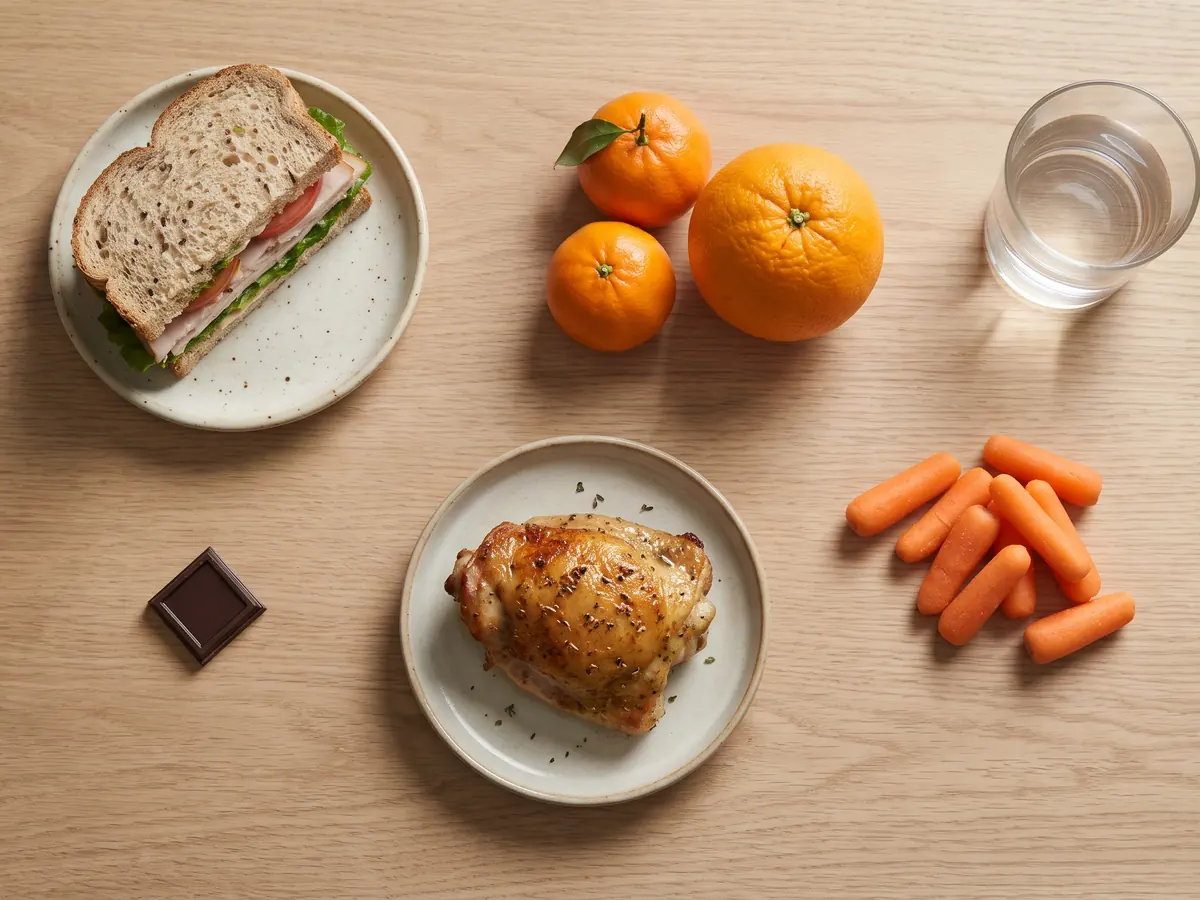
Meat and protein foods
Chicken breast
Protein and calories in 3 to 16 oz, grilled, boiled, fried or raw: 35 g of protein in 4 oz cooked.
Chicken thighs and legs
Calories in a thigh with or without skin, drumsticks, whole legs, wings and whole chicken.
Steak and beef
Protein in a 3, 4, 6 or 8 oz steak, ground beef, roast beef, pork chops and ham.
Sandwiches
BLT, club, turkey, tuna, chicken, roast beef, grilled cheese and 7 more, by size.
Fruit and vegetables
Mandarins and clementines
Calories and carbs in a mandarin, tangerine, Cutie or Halo, plus canned mandarins.
Oranges
Navel orange nutrition for small, medium and large oranges, half an orange and juice.
Lowest calorie fruits
15 fruits ranked by calories per 100 g and per cup, from tomatoes to bananas.
Carrots
Baby carrots calories, raw and cooked carrots, and how many carrots in a cup or pound.
Sweets and drinks
Chocolate
Dark, milk and white chocolate calories, carbs and sugar per square, ounce and bar.
Water and drinks
Why water has no calories, and how soda, juice, lemonade and coconut water compare.
Calories in common foods at a glance
One typical portion of each food covered here, side by side, from USDA data. Each food's page has every size and a full label.
| Food | Portion | Calories | Protein | Carbs |
|---|---|---|---|---|
| Chicken breast, roasted, skinless | 4 oz (113 g) | 187 | 35.2 g | 0 g |
| Chicken thigh, roasted, skinless | 1 thigh (116 g) | 208 | 28.8 g | 0 g |
| Top sirloin steak, lean | 6 oz (170 g) | 320 | 51.5 g | 0 g |
| Turkey sandwich on white | 1 regular (115 g) | 217 | 13.8 g | 30.5 g |
| BLT on white | 1 sandwich (105 g) | 243 | 11.4 g | 31.2 g |
| Navel orange | 1 fruit (140 g) | 69 | 1.3 g | 17.5 g |
| Clementine or Cutie | 1 fruit (74 g) | 35 | 0.6 g | 8.9 g |
| Watermelon | 1 cup diced (152 g) | 46 | 0.9 g | 11.5 g |
| Baby carrots | 3 oz (85 g) | 30 | 0.5 g | 7.0 g |
| Dark chocolate, 70-85% | 1 oz (28 g) | 170 | 2.2 g | 13.0 g |
| Regular cola | 12 fl oz can | 155 | 0 g | 38.5 g |
| Water | Any amount | 0 | 0 g | 0 g |
High-protein foods compared
For a protein target, two numbers matter: protein per 100 g, and protein for every 100 calories. The second shows which foods fill a protein goal without using up your calorie budget. All values are for cooked meat, from USDA data. The nutritional value guide compares vegetables, beans and dairy per 100 calories the same way. For a wider list of healthy things to eat, see our healthy food list.
| Food | Protein per 100 g | Calories per 100 g | Protein per 100 calories |
|---|---|---|---|
| Chicken breast, skinless | 31.0 g | 165 | 18.8 g |
| Top round roast beef | 30.1 g | 163 | 18.5 g |
| Pork loin chop, lean | 30.0 g | 162 | 18.5 g |
| Top sirloin steak, lean | 30.3 g | 188 | 16.1 g |
| Flank steak, lean | 27.8 g | 194 | 14.3 g |
| Chicken thigh, skinless | 24.8 g | 179 | 13.9 g |
| Ground beef, 85% lean | 27.7 g | 256 | 10.8 g |
| Ribeye, lean and fat | 22.7 g | 313 | 7.3 g |
Chicken breast, lean roast beef and pork loin lead on both counts. Ribeye has almost as much protein per gram as chicken thigh but nearly twice the calories for each gram of protein, because of its fat. That doesn't make it a bad food; it just costs more of your day.
Lowest calorie foods on this site
At the other end are foods you can eat in large portions for few calories. Plain water has none at all. Tomatoes have 18 calories per 100 g, watermelon and pink grapefruit 30, strawberries 32 and baby carrots 35. A cup of diced watermelon or strawberry halves is under 50 calories, and a 3 oz serving of baby carrots is 30. These calories in common foods are low because they're low in fat and sugar per bite. The lowest calorie fruits page ranks 15 fruits, and the carrot page covers raw and cooked carrots.
Where the numbers come from
Every food page uses USDA FoodData Central, the U.S. Department of Agriculture's public food composition database. Single foods like chicken, fruit, vegetables and chocolate come from its SR Legacy data, which lists nutrients per 100 g along with household portion weights: one medium carrot, one roasted thigh, one cup of diced watermelon. Mixed dishes like sandwiches come from FNDDS, the database behind USDA's What We Eat in America survey, which describes foods the way people actually eat them. Each page links the exact USDA entries it uses, so you can check any number.
The labels on our food pages round values the way FDA rules require on a real Nutrition Facts label, so a medium mandarin with 47 calories shows "45" on the label and 47 in the big number above it. Both are right: one is the exact value, the other the rounded label value.
Cooked or raw, and why weighing helps
Meat loses water as it cooks, so cooked weight is smaller than raw weight while the protein stays about the same. That's why 4 oz of raw chicken breast has less protein than 4 oz of cooked. Our meat pages give cooked values, and the chicken pages convert a raw weight for you if you tick "I weighed it raw".
Pieces also vary. USDA's medium carrot weighs 61 g and its navel orange 140 g, but the ones in your kitchen can be bigger or smaller. Weighing a food once on a kitchen scale tells you your usual size, and after that counting by the piece is accurate enough.
Using food data with the calculators
Food numbers are most useful next to a daily target. Find yours with the TDEE calculator, split it into protein, carbs and fat with the macro calculator, then log what you eat in the free calorie counter. Cooking a recipe? The recipe nutrition calculator totals the ingredients and works out a serving, and the calorie converter explains how calories per gram of protein, carbs and fat add up.
To see how these foods fit together across a day, read what a balanced diet looks like, with daily servings for every food group. More foods are on the way. If there's a food you'd like covered, tell us.
Sources
- U.S. Department of Agriculture, Agricultural Research Service. FoodData Central (SR Legacy and FNDDS data).
- U.S. Food and Drug Administration. 21 CFR 101.9, Nutrition labeling of food (label rounding).