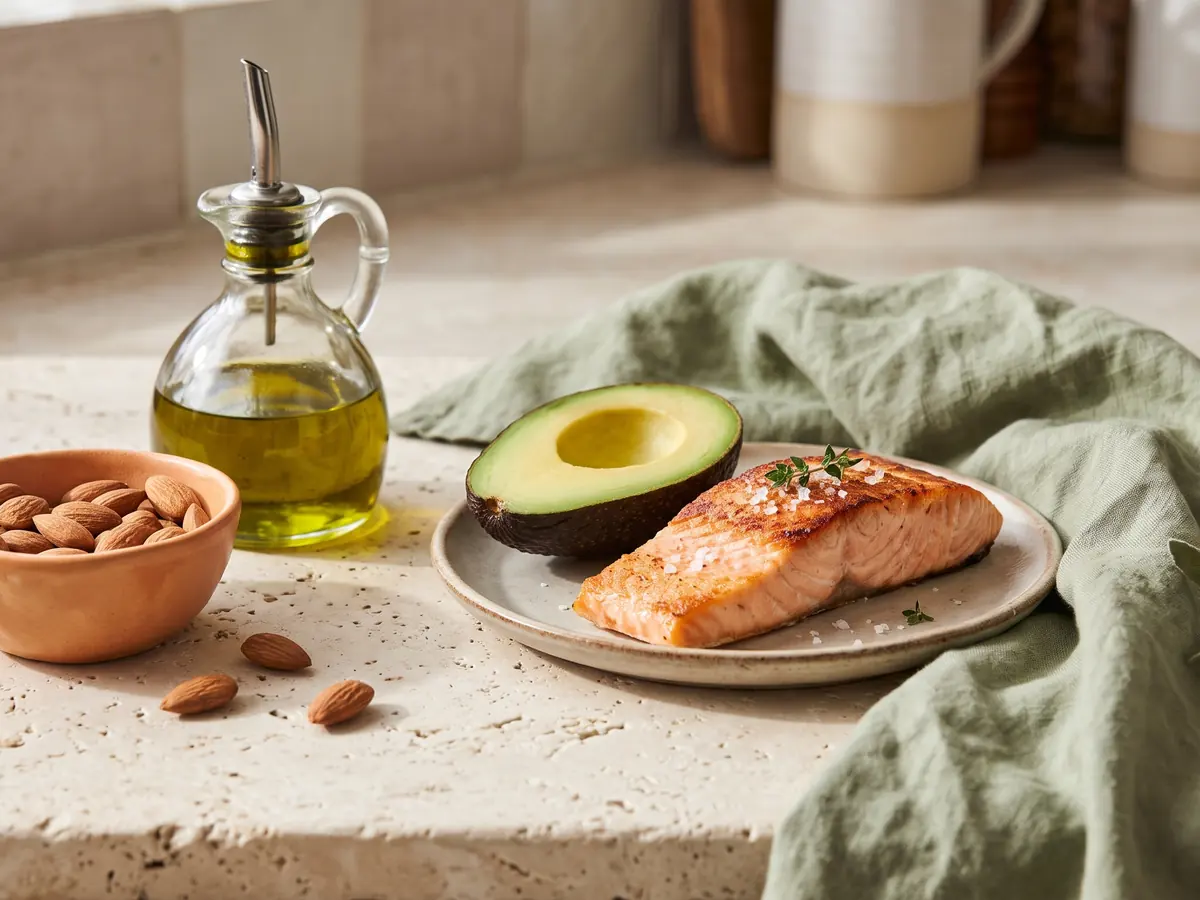
Short answerAdults should get 20 to 35% of their calories from fat. On 2,000 calories a day that's 44 to 78 grams of fat, with saturated fat under 22 grams. Most of it should come from oils, nuts, seeds, fish and avocado rather than butter, cheese and fatty meat.
How to calculate fat intake
To calculate fat intake, you need your daily calories and the share you want from fat:
Grams of fat = calories × fat % ÷ 9
Each gram of fat has 9 calories, more than twice protein or carbs. At 2,000 calories and 30%: 2,000 × 0.30 = 600 calories from fat, ÷ 9 = about 67 grams. The calculator does this for any calorie level and also gives your saturated fat limit. If you don't know your daily calories, the TDEE calculator works them out first.
| Calories | 20% | 30% | 35% | Saturated, under |
|---|---|---|---|---|
| 1,600 | 36 g | 53 g | 62 g | 18 g |
| 1,800 | 40 g | 60 g | 70 g | 20 g |
| 2,000 | 44 g | 67 g | 78 g | 22 g |
| 2,400 | 53 g | 80 g | 93 g | 27 g |
| 2,800 | 62 g | 93 g | 109 g | 31 g |
AMDR for fat
The Acceptable Macronutrient Distribution Range (AMDR) for fat is 20 to 35% of calories for adults, set by the National Academies. Below 20%, it gets hard to absorb vitamins A, D, E and K and to get enough essential fats. Above 35%, calories tend to add up and saturated fat usually rises with them. The Daily Value on food labels, 78 grams, is the top of that range on a 2,000-calorie diet.
Saturated and trans fat
The Dietary Guidelines for Americans, 2025–2030, keep the limit: saturated fat should not exceed 10% of daily calories. On 2,000 calories that's under 22 grams. Main sources are butter, cheese, whole milk, fatty or processed meats, and baked goods. Replacing them with unsaturated fats, like olive and canola oil, nuts, seeds, avocado and fatty fish, is linked to lower LDL cholesterol and heart disease risk. Keep trans fat as low as possible. It's now rare in U.S. foods, but check labels for "partially hydrogenated oils". For which foods help your heart, see food good for the heart.
Fat in common foods
| Food | Portion | Fat | Saturated |
|---|---|---|---|
| Peanut butter | 2 tbsp | 16 g | 3.3 g |
| Almonds | 1 oz | 14.2 g | 1.1 g |
| Olive oil | 1 tbsp | 13.5 g | 1.9 g |
| Ground beef, 85% lean, cooked | 3 oz | 13.2 g | 5.0 g |
| Dark chocolate, 70–85% | 1 oz | 12.1 g | 7.0 g |
| Butter | 1 tbsp | 11.5 g | 7.3 g |
| Avocado | ½ fruit | 10 g | 1.4 g |
| Cheddar cheese | 1 oz | 9.4 g | 5.3 g |
| Whole milk | 1 cup | 7.9 g | 4.6 g |
| Salmon, cooked | 3 oz | 6.9 g | 1.1 g |
| Egg | 1 large | 4.8 g | 1.6 g |
Notice the gap between total and saturated fat: a tablespoon of olive oil and a tablespoon of butter have similar total fat, but butter has almost four times the saturated fat.
Fat intake for weight loss
Low-fat and low-carb diets lead to similar weight loss when calories are the same. What matters is the total. Because fat is so calorie-dense, though, small amounts add up fast: two tablespoons of oil on a salad is about 240 calories. If you're losing weight, the lower end of the fat range (20 to 25%) leaves more room for filling protein and fiber. For a full split, use the macro calculator.
Types of fat, and where to find them
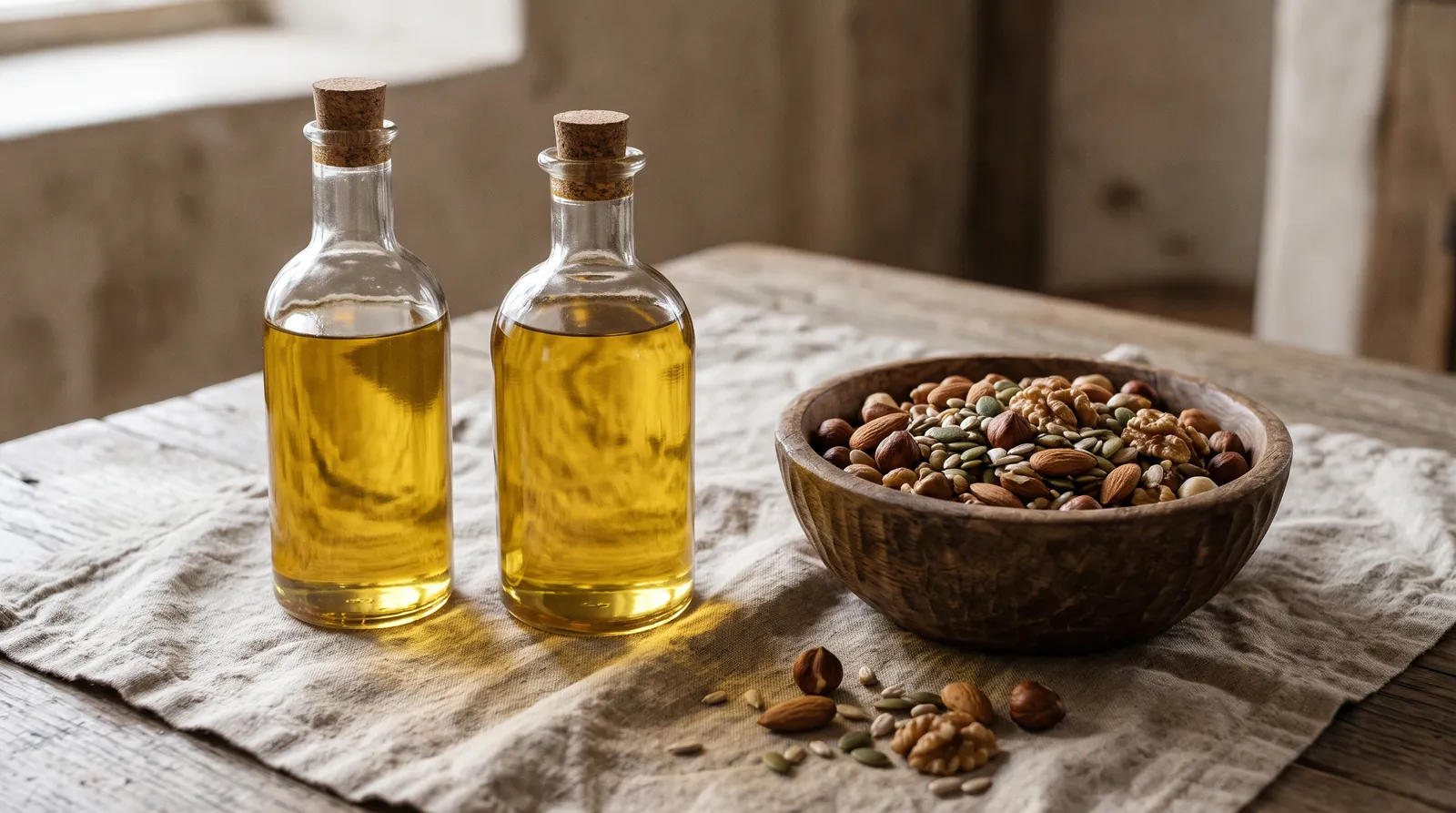
- Monounsaturated fat: olive and canola oil, avocado, almonds, cashews and peanuts. A good default for cooking and dressings.
- Polyunsaturated fat: walnuts, sunflower and flax seeds, soybean oil and fatty fish. Includes the essential omega-3 and omega-6 fats your body can't make.
- Omega-3s: salmon, sardines, trout and herring are the richest sources. The Dietary Guidelines suggest about 8 ounces of seafood a week for most adults.
- Saturated fat: butter, cheese, whole milk, fatty and processed meats, coconut and palm oil. Keep it under 10% of calories.
- Trans fat: now rare after the U.S. phase-out of partially hydrogenated oils, but still found naturally in small amounts in meat and dairy.
Check a day with the fat intake calculator
The food counter under the calculator gives a quick read on a day: tap in what you ate and the two bars show total fat and saturated fat against your limits. For a full day with calories, protein and carbs too, log it in the calorie counter. Reading packaged food? Fat is the first nutrient on a Nutrition Facts panel, and our nutrition label maker shows how those numbers are rounded. For the gram-to-calorie math behind it all, see the calorie converter.
Balance matters as much as the total: a day near your fat target with plenty of fiber from beans, vegetables and whole grains is a better day than one that hits the number with cheese and crackers. Chocolate is another quiet source: an ounce of 70-85% dark chocolate has 6.9 g of saturated fat (see chocolate calories). The fiber calculator helps with that side, and our guide to the 6 main nutrients explains what fat does in the body.
Fat intake FAQ
How many grams of fat should I eat a day?
20 to 35% of your calories. On 2,000 calories that's 44 to 78 grams of fat a day, with saturated fat under 22 grams.
What is the AMDR for fat?
The Acceptable Macronutrient Distribution Range for fat is 20 to 35% of calories for adults.
How do you calculate fat intake?
Multiply your daily calories by the share you want from fat, then divide by 9, because each gram of fat has 9 calories. 2,000 × 0.30 ÷ 9 = about 67 grams.
Sources
- National Academies. Dietary Reference Intakes: macronutrient distribution ranges, 2005.
- U.S. Departments of Health and Human Services and Agriculture. Dietary Guidelines for Americans, 2025–2030, January 2026 (saturated fat under 10% of calories).
- U.S. Departments of Agriculture and Health and Human Services. Dietary Guidelines for Americans, 2020–2025 (seafood amounts).
- U.S. Food and Drug Administration. How to understand and use the Nutrition Facts label (Daily Value for fat, 78 g).
- U.S. Department of Agriculture. FoodData Central (fat in foods).