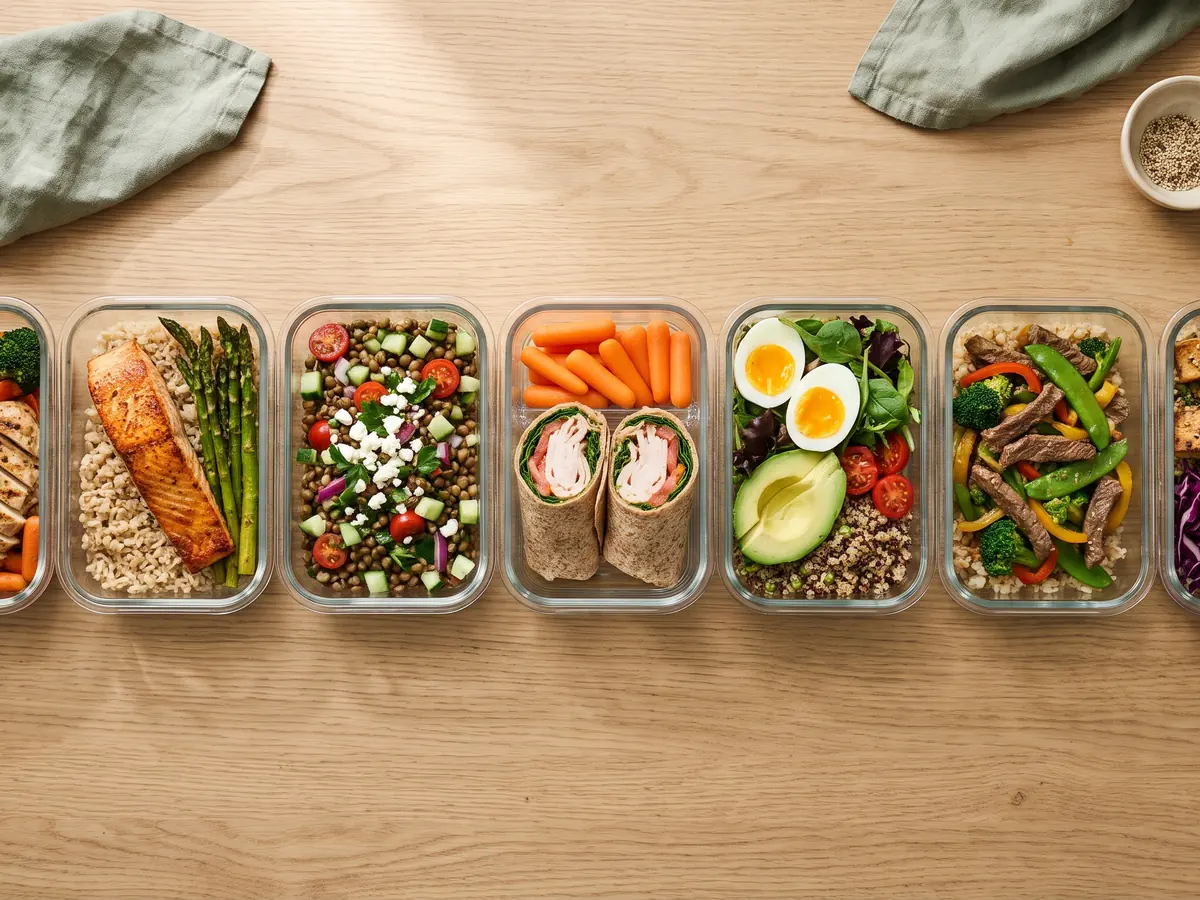
Short answerThis meal plan to reduce weight averages 1,511 calories a day, with 104 g of protein, 35 g of fiber and only 6% of calories from saturated fat. For many adults, that's about 500 calories below maintenance, which works out to roughly 1 pound of fat loss a week. Check your own calorie needs first, then use the plan as written or scale it up or down.
In this article
How this 7-day diet plan for weight loss is built
Most diet meal plans online list foods without numbers, or give round calorie counts nobody checked. Every food in this plan was weighed out in grams and counted with USDA FoodData Central values, and each day was adjusted until it hit these targets:
- About 1,500 calories a day. Days range from 1,480 to 1,555.
- High protein. 93 to 113 g a day, 104 g on average. That meets the 2025–2030 Dietary Guidelines' goal of 1.2 to 1.6 g per kg for adults weighing roughly 65 to 85 kg. Protein helps you stay full and keep muscle while you lose fat.
- High fiber. 28 to 41 g a day from vegetables, fruit, beans, lentils and whole grains.
- Whole foods, no added sugar. All the sugar in the plan comes from fruit, milk and vegetables. That makes it an unprocessed food meal plan in practice: no packaged snacks, sweets or sugary drinks.
- Balanced macros. Over the week, 28% of calories come from protein, 48% from carbohydrate and 27% from fat, all inside the National Academies' acceptable ranges. Saturated fat stays at about 6%, under the 10% limit.
- Low sodium. The week averages about 900 mg a day before any salt you add, well under the 2,300 mg limit.
Each day of this 7-day diet plan for weight loss has a breakfast, lunch, dinner and one snack. Portions are given in cups, ounces and pieces, and the calories next to each item are for that amount. To log them on your phone, see our comparison of the best calorie counter apps.
Is 1,500 calories right for you?
A calorie target only works if it's below what you burn. For many adults, 1,500 calories is about 500 below maintenance, a steady pace of weight loss. But your number depends on your size, sex, age and activity: If 1,500 feels too low, the 1600 kcal meal plan follows the same idea at 1,600.
- If your maintenance is around 2,000 calories, 1,500 is a 500-calorie deficit.
- If you're tall, male or very active, your maintenance may be 2,500 or more, and 1,800 to 2,000 calories will still mean steady loss. See the scaling section.
- If you're small and not very active, 1,500 may be close to maintenance, and you'd lose slowly.
For the reasoning behind a 500-calorie deficit, see our weight loss plan. Get your own number in a minute with the TDEE calculator, then see how quickly a 1,500-calorie day would get you to your goal with the weight loss simulator. If you're pregnant, breastfeeding, have diabetes or another medical condition, talk to your doctor before cutting calories.
The 7-day meal plan
Here's the full 7-day diet plan for weight loss. Leftovers are planned in: the salmon from day 1 comes back for lunch on day 6, and the brown rice and quinoa are cooked in batches.
Day 1 1,555 calories · 99 g protein · 34 g fiber
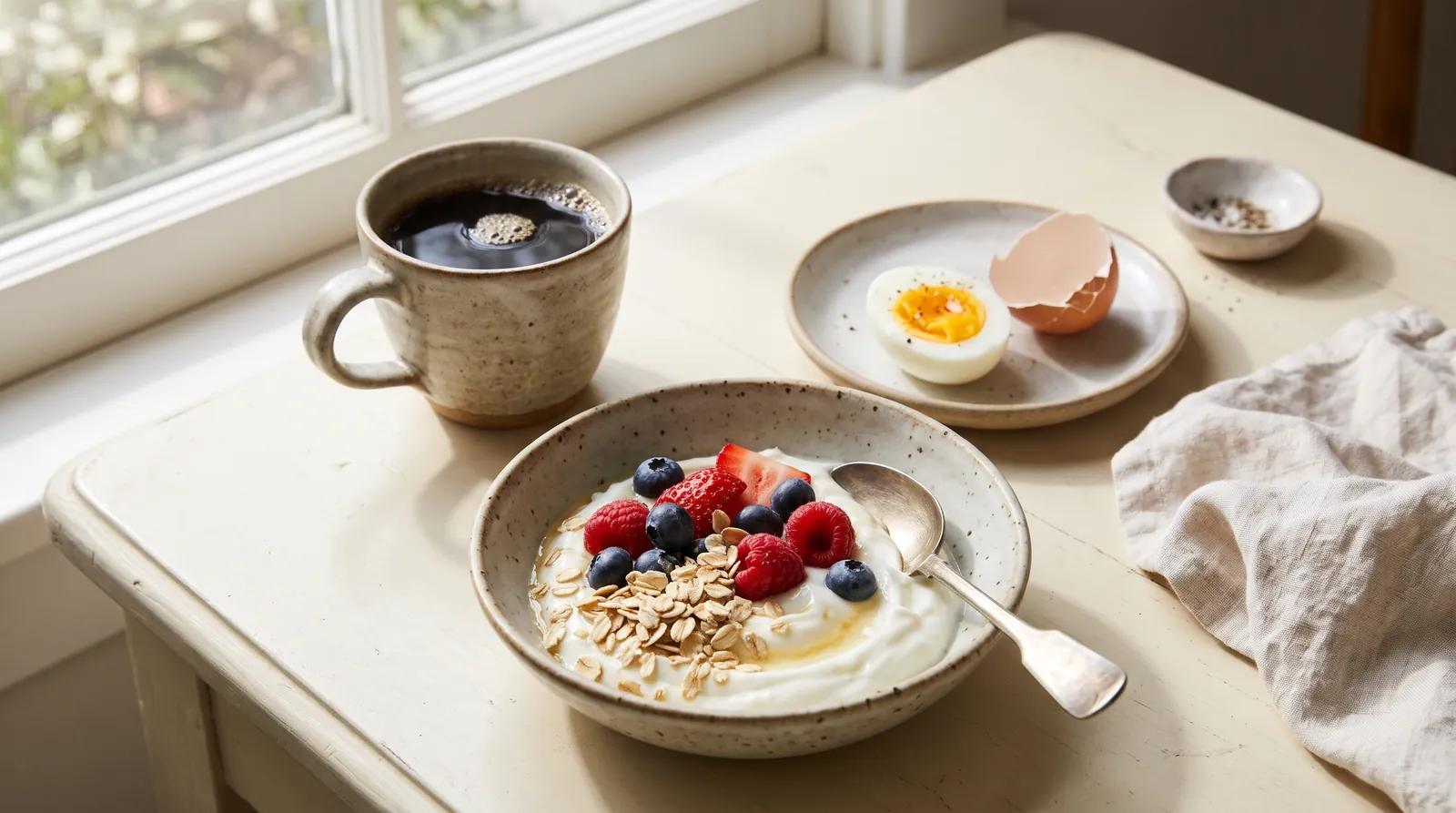
- BreakfastOvernight oats: ½ cup oats, 1 tbsp chia seeds and ½ cup blueberries in 1 container (170 g) plain Greek yogurt343
- LunchChicken quinoa bowl: 3 oz grilled chicken, 1 cup quinoa, 2 cups spinach, ½ cup red pepper, ½ cup cucumber, 2 tsp olive oil483
- Snack1 medium apple, ½ oz almonds176
- Dinner4 oz baked salmon, 1 medium sweet potato, 1 cup broccoli, ½ cup brown rice, 1 tsp olive oil554
Day 2 1,545 calories · 102 g protein · 37 g fiber
- Breakfast2 eggs scrambled with 1 cup spinach, 2 slices whole-wheat toast, 1 navel orange392
- LunchTuna chickpea salad: 3 oz tuna in water, ½ cup chickpeas, 2 cups romaine, 1 tomato, 2 tsp olive oil, ½ whole-wheat pita409
- Snack½ cup cottage cheese, ½ cup raspberries124
- DinnerTurkey burrito bowl: 3 oz lean ground turkey, ½ cup black beans, 1 cup brown rice, ½ cup peppers, ¼ cup onion, 2 tbsp salsa, 1 tsp olive oil620
Day 3 1,480 calories · 106 g protein · 41 g fiber
- Breakfast½ cup oats cooked in 1 cup 2% milk, ½ banana, 1 tbsp peanut butter422
- LunchLentil and vegetable soup: 1 cup cooked lentils, 1 carrot, ¼ cup onion, ½ cup canned tomatoes, 1 cup spinach, 1 tsp olive oil; 1 slice whole-wheat bread417
- Snack1 container Greek yogurt, 1 cup strawberries149
- Dinner4 oz roast chicken breast, 1 cup quinoa, 1 cup green beans, 1 tsp olive oil492
Day 4 1,532 calories · 109 g protein · 28 g fiber
- Breakfast½ cup cottage cheese with 1 sliced peach and ½ oz almonds, 1 slice whole-wheat toast, 1 cup 2% milk434
- LunchChicken pita: 1 whole-wheat pita, 2 tbsp hummus, 3 oz chicken, cucumber, ½ tomato, 1 cup romaine406
- Snack3 oz baby carrots with 1 tbsp hummus, 1 apple160
- Dinner5 oz baked cod, 1 cup brown rice, 1 cup zucchini and ½ cup peppers sautéed in 2 tsp olive oil532
Day 5 1,497 calories · 93 g protein · 37 g fiber
- Breakfast2 boiled eggs, 1 slice whole-wheat toast with ¼ avocado, 1 kiwi337
- LunchTurkey wrap: 1 whole-wheat tortilla, 3 oz ground turkey, ¼ cup black beans, lettuce, ½ tomato, 2 tbsp salsa386
- Snack1 pear, 1 oz mozzarella, ½ cup blueberries215
- DinnerTofu stir-fry: ½ cup firm tofu, 1 cup broccoli, ½ cup peppers, 1 cup mushrooms, 1 tsp oil; 1 cup brown rice559
Day 6 1,482 calories · 105 g protein · 33 g fiber
- Breakfast1 container Greek yogurt, ½ cup raspberries, ½ oz almonds, 1 banana319
- LunchSalmon quinoa salad: 3 oz leftover salmon, 1 cup quinoa, 2 cups spinach, cucumber, ½ tomato, 1 tsp olive oil470
- Snack½ cup edamame, 1 orange163
- Dinner4 oz sirloin steak, 1 sweet potato, 1 cup green beans, ½ cup mushrooms, ½ cup brown rice, 1 tsp oil530
Day 7 1,484 calories · 113 g protein · 35 g fiber
- Breakfast½ cup oats cooked in 1 cup 2% milk with ½ cup blueberries, 1 boiled egg393
- LunchChicken lentil salad: 3 oz chicken, ½ cup lentils, 2 cups romaine, ½ cup pepper, ½ cup cucumber, 2 tsp olive oil; 1 small whole-wheat pita451
- Snack½ cup cottage cheese, 1 pear, ½ oz almonds274
- DinnerShrimp pasta: 4 oz shrimp, 1 cup whole-wheat spaghetti, ½ cup canned tomatoes, ½ cup zucchini, 1 cup spinach, 1 tsp olive oil366
Calories for oats are for dry oats; ½ cup dry makes about 1 cup cooked. Meat and fish weights are cooked weights. Season freely with herbs, spices, lemon, garlic, vinegar and mustard, which add almost no calories.
The week at a glance
| Nutrient | Average a day | Guideline |
|---|---|---|
| Calories | 1,511 | Your target from the TDEE calculator |
| Protein | 104 g (28% of calories) | 1.2–1.6 g per kg of body weight |
| Carbohydrate | 183 g (48%) | 45–65% of calories |
| Fat | 45 g (27%) | 20–35% of calories |
| Saturated fat | 6% of calories | No more than 10% |
| Fiber | 35 g | 25 g women, 38 g men |
| Sodium (before added salt) | about 900 mg | Under 2,300 mg |
| Added sugars | 0 g | None recommended |
The plan also lines up with the 2025–2030 Dietary Guidelines' food groups: dairy or yogurt most days, two to three fruits and three or more vegetable servings every day, whole grains instead of refined ones, and protein foods at every meal. If you want to check a day's macros against your own targets, the macro calculator gives you grams of protein, carbs and fat for your goal.
Grocery list for the week
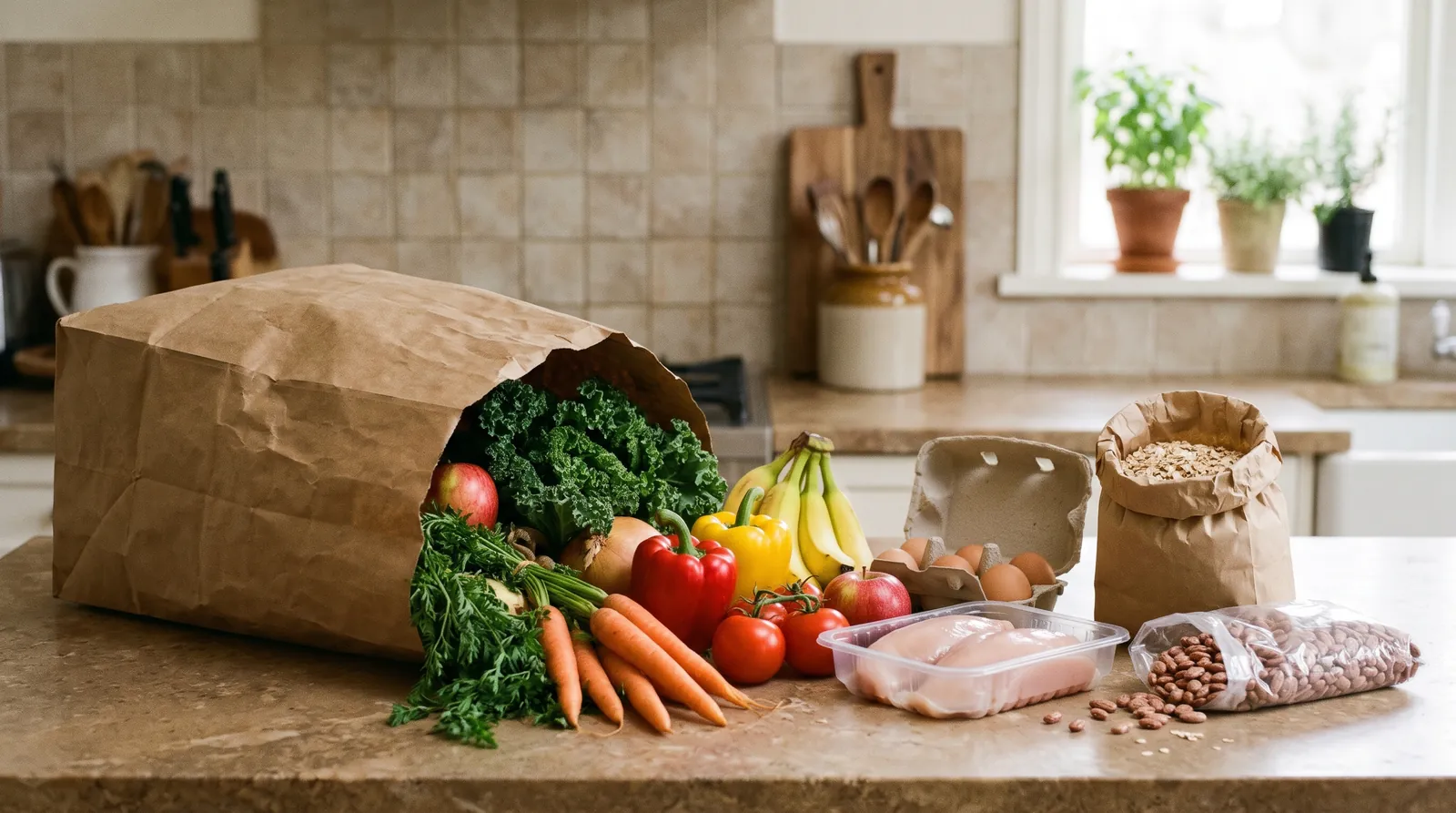
Quantities cover all seven days of the meal plan to reduce weight for one person. Buy a little extra produce if you like bigger salads; leafy greens and vegetables add very few calories.
Protein foods
- Chicken breast: about 13 oz cooked over the week (about 1.1 lb raw)
- Salmon: 7 oz cooked (two portions)
- Cod: 5 oz cooked
- Shrimp: 4 oz cooked
- Lean ground turkey: 6 oz cooked
- Sirloin steak: 4 oz cooked
- Tuna in water: 1 can
- Firm tofu: ½ cup (about 4½ oz)
- Eggs: 5
- Lentils: 1½ cups cooked; chickpeas: ½ cup; black beans: ¾ cup; edamame: ½ cup
- Almonds: 2 oz; chia seeds: 1 tbsp; peanut butter: 1 tbsp; hummus: 3 tbsp
Dairy
- Plain nonfat Greek yogurt: 3 containers (170 g each)
- 2% milk: 3 cups
- Low-fat cottage cheese: 1½ cups
- Part-skim mozzarella: 1 oz
Grains
- Oats: 1½ cups dry
- Brown rice: 4 cups cooked
- Quinoa: 3 cups cooked
- Whole-wheat bread: 5 slices
- Whole-wheat pita: 1 large and 1 small; whole-wheat tortilla: 1; whole-wheat spaghetti: 1 cup cooked
Vegetables
- Spinach: 7 cups; romaine: 6 cups
- Red bell peppers: about 2½ cups chopped (2 to 3 peppers)
- Broccoli: 2 cups; green beans: 2 cups; zucchini: 1½ cups
- Cucumber: 1 large; tomatoes: 3 medium; canned tomatoes: 1 cup
- Sweet potatoes: 2 medium; mushrooms: 1½ cups; onion: 1 small; carrot: 1; baby carrots: 3 oz
- Avocado: 1 (you'll use a quarter); salsa: ¼ cup
Fruit
- Apples: 2; pears: 2; navel oranges: 2; bananas: 2; peach: 1; kiwi: 1
- Blueberries: 1½ cups; raspberries: 1 cup; strawberries: 1 cup
Pantry
- Olive oil (you'll use about 5 tablespoons over the week), herbs, spices, lemon, garlic, vinegar, mustard
Meal prep in two short sessions
You don't need to cook three times a day to follow this unprocessed food meal plan. Two sessions of about an hour cover most of the week:
Sunday
- Cook 3 cups of quinoa and 2 cups of brown rice.
- Roast or grill the chicken for days 1, 3 and 4, and slice it once cool.
- Boil 4 eggs for days 5 and 7.
- Wash and chop peppers, cucumber, onion and broccoli; store them in containers.
- Make the day 1 overnight oats.
Wednesday
- Cook 2 more cups of brown rice and the lentils.
- Make the lentil soup for day 3 if you haven't, and the chicken for day 7.
- Top up chopped vegetables and wash more greens.
On this 7-day diet plan for weight loss, keep prepped food in the fridge and cook fish on the day you eat it. If you change any recipe, add your ingredients to the recipe nutrition calculator to get the new calories per serving.
Scaling the plan to 1,200, 1,800 or 2,000 calories
The 7-day diet plan for weight loss is easy to resize without changing what you eat:
| Target | What to change | Calories changed |
|---|---|---|
| 1,200 | Skip the snack and halve the rice, quinoa or pasta at one meal | about −190 to −400 |
| 1,800 | Add a second snack: 1 container Greek yogurt, 1 banana and ½ oz almonds, or use our full 1800 calorie meal plan | about +286 |
| 2,000 | The 1,800 change, plus ½ cup more brown rice and 1 slice whole-wheat bread | about +491 |
Like most diet meal plans, and any 7 day protein diet plan, keep the protein foods the same when you scale down; trim grains, fruit and fats first. Eating below 1,200 calories a day isn't recommended without medical supervision, because it's hard to get enough protein, vitamins and minerals; our 1000 calorie meal plan article explains why. For dedicated plans at other levels, see our balanced diet guide, which shows the Dietary Guidelines' daily servings for every calorie level. The 1700 calorie meal plan sits in between.
Swaps and variations
A 7 day protein diet plan with more protein
To turn it into a 7 day protein diet plan with more protein, swap 1 snack a day for a container of Greek yogurt (17 g protein, 100 calories) or ½ cup of cottage cheese (12 g, 92 calories), and use 4 oz instead of 3 oz of chicken or fish at lunch. That adds 25 to 35 g of protein for about 100 to 150 calories.
Vegetarian version
For a vegetarian 7-day diet plan for weight loss, replace each meat or fish portion with an equal-protein plant option: ½ cup firm tofu (22 g protein), 1 cup lentils (18 g) or 1 cup edamame. Eggs, Greek yogurt and cottage cheese already cover a lot of the protein.
Dairy-free version
Swap Greek yogurt and cottage cheese for a fortified soy yogurt, and milk for fortified soy milk; check labels for added sugar. Add a little more tofu or beans to keep protein up.
Simple swaps that keep the calories similar
- Any fruit for another: apple, pear, orange and a cup of berries are all within about 50 calories.
- Brown rice and quinoa for each other, cup for cup.
- Chicken, cod, shrimp and tuna for each other; salmon and sirloin have more fat, so use them as written.
- Any non-starchy vegetable for another: they're all very low in calories.
Breakfasts in this meal plan to reduce weight are within about 120 calories of each other, and lunches and dinners within about 250, so you can also move whole meals between days.
Exercise with the plan
You can lose weight on this plan without exercise, but an exercise meal plan to lose weight works better when you move more. Activity burns extra calories and strength training helps you keep muscle while you lose fat. The CDC's activity guidelines advise adults to get at least 150 minutes of moderate activity a week, plus muscle-strengthening activity on 2 or more days.
Alongside these diet meal plans, a brisk 30-minute walk on most days is an easy start; the walking calorie calculator shows what it burns for your weight. If you add a lot of exercise, you may need more food, so watch your energy and hunger and use the 1,800-calorie version on harder training days.
How to stick to a meal plan to reduce weight
The best meal plan to reduce weight is the one you follow for months, not days. A few habits make that much easier:
- Plan your week before you shop. Pick the days you'll cook, the days you'll eat leftovers and the meals you'll take to work. A grocery list built from the plan stops impulse buys.
- Keep the first week simple. If seven different days feel like a lot, repeat your two favorite days and build from there. The calories and protein stay almost the same.
- Eat at regular times. Long gaps make it harder to stop at the planned portion when you finally eat. The snack in each day is there to bridge the afternoon.
- Measure for the first two weeks. Use measuring cups for grains and a spoon for oil until you can judge portions by eye. Oil, nuts and grains are where hidden calories creep in.
- Drink water through the day. It has no calories and fills the gap when you want something to sip.
- Plan for treats instead of banning them. If you want dessert on Saturday, take it from the day's snack or a smaller portion of grains at dinner, and log it.
- Don't restart after a bad day. One big meal doesn't undo a week. Go back to the next planned meal rather than skipping meals to make up for it.
Eating out while following the plan
On any 7-day diet plan for weight loss, restaurant meals are usually larger and richer than home cooking, but you can stay close to the plan. Choose a grilled or baked protein, ask for vegetables or a salad in place of fries, get dressings and sauces on the side, and pick one starch rather than two. A grilled chicken or fish plate with vegetables and a small portion of rice is close to the dinners in this plan. A sandwich can work for lunch too: a regular turkey sandwich on white bread has about 217 calories in USDA survey data; see sandwich calories for other choices.
Why not a crash diet?
Many diet meal plans promise fast results with 800 or 1,000 calories a day. Going that low makes it hard to get enough protein, fiber, vitamins and minerals, leaves you hungry and is difficult to keep up, and very low-calorie diets are meant to be used under medical supervision. A moderate plan like this one, about 500 calories under maintenance, gives steady loss you can see on the scale every couple of weeks while you still eat three full meals and a snack. That's the pace the CDC links with keeping the weight off: people who lose about 1 to 2 pounds a week are more likely to keep it off than people who lose faster.
Using this 7-day diet plan for weight loss long term
After the first week, treat the 7-day diet plan for weight loss as a template rather than a script. Keep the structure (protein at every meal, a vegetable at lunch and dinner, a whole grain or starchy vegetable, one fruit-based snack) and change the foods with the seasons and your taste. Every few weeks, re-check your target with the TDEE calculator: as you lose weight, your maintenance calories drop, so the same 1,500 calories gives a smaller deficit. When you reach your goal, add back about 200 to 300 calories at a time, mostly from whole grains, fruit and dairy, until your weight holds steady.
What to expect from a week of this plan
If 1,500 calories is about 500 below your maintenance, you're creating a weekly deficit of about 3,500 calories, which is roughly 0.5 kg or 1 pound of body fat. Many people see a bigger drop on the scale in the first week, because cutting calories and carbs also releases water. After that, loss settles into a steadier rate and slows a little as your weight falls, since a smaller body burns fewer calories. The CDC suggests aiming for a gradual 1 to 2 pounds a week.
- Days 1 to 3: you may notice hunger at your usual snack times. Drink water and lean on the high-fiber foods.
- Days 4 to 7: meals become routine and most people find the portions filling.
- Week 2 and on: repeat the plan, swap in your favorite days, and weigh yourself at the same time each morning to see the trend rather than daily swings.
Track what you actually eat on the meal plan to reduce weight in the free calorie counter. If you're not losing after two to three weeks, check portion sizes first: oil, nuts and grains are the easiest to underestimate.
Who should not follow this plan as written
This unprocessed food meal plan is designed for healthy adults. Check with your doctor or a registered dietitian first if you're pregnant or breastfeeding, under 18, have diabetes or kidney disease, take medication that affects blood sugar, or have a history of eating disorders. People with food allergies should swap out foods like nuts, shellfish, fish, eggs, dairy and soy for safe equivalents with similar calories and protein, using the swaps above as a guide.
7-day meal plan FAQ
How much weight can I lose with a 7-day diet plan?
If 1,500 calories is about 500 below your maintenance calories, you can expect roughly 0.5 kg (1 lb) of fat loss a week. The scale may drop more in the first week because of water, and the CDC suggests aiming for 1 to 2 pounds a week.
Is 1,500 calories a day enough?
For many adults trying to lose weight, yes, but it depends on your size and activity. Check your maintenance calories with a TDEE calculator first; men, tall people and very active people often need more, such as 1,800 to 2,000 calories, to lose weight safely.
Can I repeat the plan after 7 days?
Yes. Repeat it, swap days you like, or replace meals with ones of similar calories and protein. Re-check your calorie target every few weeks as your weight changes.
Can I swap meals between days?
Yes. Breakfasts are within about 120 calories of each other, and lunches and dinners within about 250, so swapping keeps each day close to 1,500 calories.
Do I need to exercise on this plan?
Not to lose weight, but it helps. Activity raises the calories you burn, and strength training helps keep muscle while you lose fat. Adults are advised to get at least 150 minutes of moderate activity a week.
Sources
- U.S. Department of Agriculture. FoodData Central (SR Legacy values for every food in the plan, including chicken breast 171477, salmon 175168, cod 171956, shrimp 175180, tuna 173709, ground turkey 171506, sirloin 168635, tofu 172475, eggs 173424, lentils 172421, chickpeas 173757, black beans 173735, edamame 168411, Greek yogurt 170894, cottage cheese 172182, milk 171267, oats 173904, brown rice 169704, quinoa 168917, whole-wheat bread 172688, pita 174916, tortilla 174081, pasta 168910).
- U.S. Departments of Health and Human Services and Agriculture. Dietary Guidelines for Americans, 2025–2030, January 2026 (protein, saturated fat, sodium, added sugars).
- National Academies. Dietary Reference Intakes for Energy, Carbohydrate, Fiber, Fat, Fatty Acids, Cholesterol, Protein, and Amino Acids, 2005 (acceptable macronutrient ranges).
- Centers for Disease Control and Prevention. Steps for losing weight.
- Centers for Disease Control and Prevention. Physical activity guidelines for adults.
- Hall KD, Chow CC. Why is the 3500 kcal per pound weight loss rule wrong? Int J Obes, 2013.