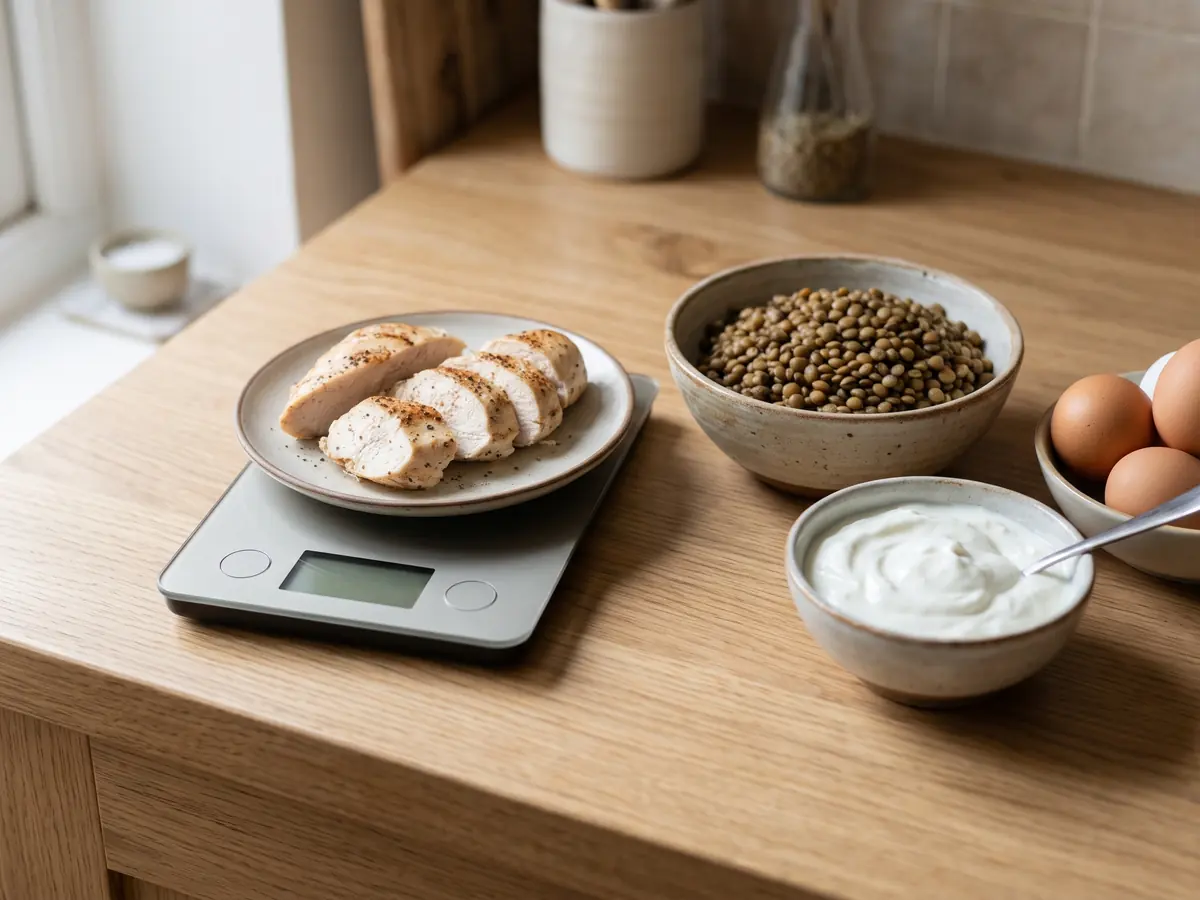
Short answerAn ounce is 28.35 grams of food, not 28 grams of protein. One ounce of cooked chicken breast contains about 8.8 g of protein, an ounce of salmon about 6.3 g, and an ounce of cooked lentils about 2.6 g, according to USDA data. So 4 oz of chicken gives about 35 g of protein. To reach 100 g of protein a day, you'd need about 11 oz of cooked chicken breast, or more usually a mix of foods across your meals.
In this article
An ounce of food vs a gram of protein
So, how many grams in an ounce of protein? The question mixes two different measurements. An ounce is a unit of weight: 1 ounce equals 28.35 grams. When a recipe or meal plan says "4 oz of chicken," it means 4 ounces of chicken, about 113 g of meat on the scale.
Grams of protein measure one nutrient inside that food. Cooked chicken breast is about 31% protein by weight, according to USDA data; most of the rest is water, plus a little fat. So 113 g of chicken contains about 35 g of protein, not 113.
Grams of protein = weight of food in grams × protein per 100 g ÷ 100
For example, 1 ounce (28.35 g) of cooked chicken breast × 31 g ÷ 100 = 8.8 g of protein. That's why "how many grams in 1 ounce of protein" has no single answer: it depends entirely on the food. A useful rule of thumb for cooked meat, poultry and fish is 6 to 9 g of protein per ounce, so 3 oz gives roughly 20 to 26 g and 4 oz roughly 25 to 35 g.
The weight conversion itself is fixed. To convert ounces to grams, multiply by 28.35; to go from grams to ounces, divide by 28.35. Our calorie converter also turns grams of protein into calories, at 4 calories per gram.
Protein per ounce of common foods
Here's how much protein is in one ounce of common foods, from USDA FoodData Central, with the amount of each you'd need for 30 g of protein:
| Food | Protein per oz | Calories per oz | For 30 g protein |
|---|---|---|---|
| Chicken breast, cooked | 8.8 g | 47 | 3.4 oz |
| Sirloin steak, cooked | 8.6 g | 53 | 3.5 oz |
| Ground turkey, cooked | 7.8 g | 58 | 3.9 oz |
| Cheddar cheese | 6.9 g | 116 | 4.4 oz |
| Shrimp, cooked | 6.8 g | 28 | 4.4 oz |
| Cod, cooked | 6.5 g | 30 | 4.6 oz |
| Salmon, cooked | 6.3 g | 58 | 4.8 oz |
| Peanut butter | 6.3 g | 170 | 4.8 oz |
| Almonds | 6.0 g | 164 | 5.0 oz |
| Tuna, canned in water | 5.5 g | 24 | 5.5 oz |
| Tofu, firm | 4.9 g | 41 | 6.1 oz |
| Egg | 3.6 g | 44 | 8.4 oz (about 5 eggs) |
| Edamame | 3.4 g | 34 | 8.9 oz |
| Greek yogurt, plain nonfat | 2.9 g | 17 | 10.4 oz |
| Cottage cheese | 2.9 g | 23 | 10.2 oz |
| Lentils, cooked | 2.6 g | 33 | 11.7 oz |
| Black beans, cooked | 2.5 g | 37 | 11.9 oz |
Two things stand out. Cooked meat and fish give the most protein per ounce, about 6 to 9 g. Foods with more water, like yogurt, cottage cheese and beans, give less per ounce but are still good sources per calorie: Greek yogurt has 17 calories an ounce, so 30 g of its protein costs only about 175 calories. Nuts and peanut butter have plenty of protein per ounce but also a lot of calories, so they're better as an addition than as the main protein.
Raw vs cooked weight
All the meat and fish numbers above are for cooked food. Meat loses water when it cooks, so the same piece weighs less afterwards and its protein per ounce goes up. If you weigh chicken raw, its protein per ounce is lower than the cooked figure. Pick one way of weighing and stick with it, and match it to the right USDA entry. The chicken breast nutrition page covers raw, grilled and roasted weights.
How much protein in 4 oz of protein food?
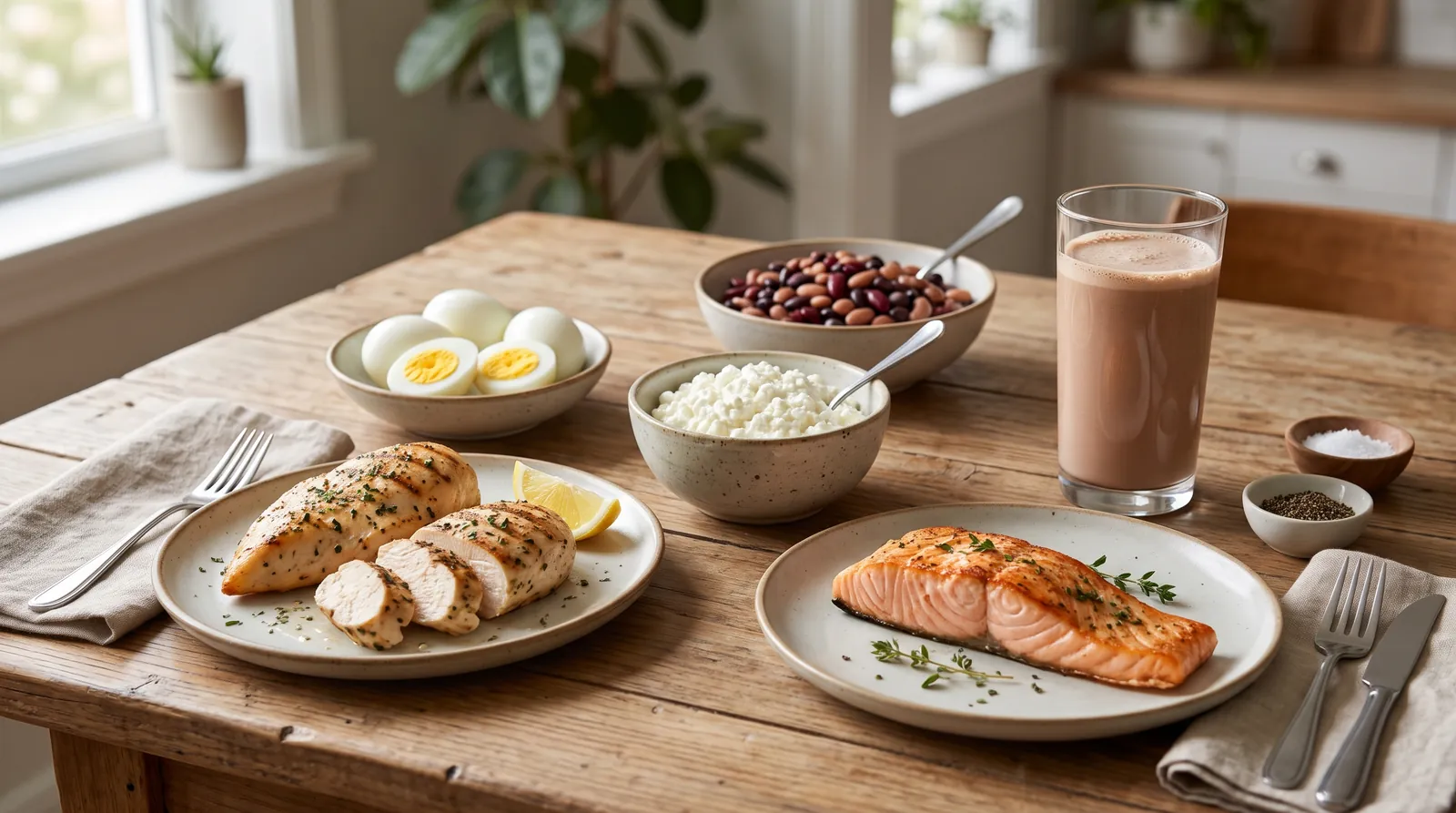
Four ounces is a common portion of meat or fish. Here's what 4 oz of protein food gives you, from USDA data:
| 4 oz of | Protein | Calories |
|---|---|---|
| Chicken breast | 35 g | 186 |
| Sirloin | 34 g | 212 |
| Ground turkey | 31 g | 229 |
| Shrimp | 27 g | 112 |
| Cod | 26 g | 119 |
| Salmon | 25 g | 233 |
| Tuna, canned | 22 g | 97 |
| Firm tofu | 20 g | 163 |
So 4 oz of protein food usually means about 20 to 35 g of actual protein, depending on what it is. For more cuts and sizes, see the steak nutrition and chicken thigh nutrition pages.
"Ounces of protein" in the Dietary Guidelines
Part of the confusion about how many grams in an ounce of protein comes from official guidance. The 2020–2025 Dietary Guidelines measured protein foods in "ounce-equivalents." One ounce-equivalent of protein foods is "1 ounce lean meats, poultry, or seafood; 1 egg; ¼ cup cooked beans or tofu; 1 tbsp nut or seed butter; ½ ounce nuts or seeds." When older guidance said "5½ ounces of protein foods a day," it meant 5½ ounce-equivalents of these foods, not 5½ ounces of pure protein.
The 2025–2030 Dietary Guidelines switched to servings: one serving of protein foods is 3 oz of cooked meat, poultry or seafood, 1 egg, ½ cup of beans, peas or lentils, 1 oz of nuts or seeds, 2 tbsp of nut or seed butter, or 3 oz of soy. At 2,000 calories, the goal is 3 to 4 servings a day. They also set a separate goal in grams of protein: 1.2 to 1.6 g per kg of body weight a day. That's the number to compare with nutrition labels and food tables.
How much protein you need
| Body weight | RDA (0.8 g/kg) | DGA goal (1.2–1.6 g/kg) | Active (1.4–2.0 g/kg, ISSN) |
|---|---|---|---|
| 55 kg (121 lb) | 44 g | 66–88 g | 77–110 g |
| 65 kg (143 lb) | 52 g | 78–104 g | 91–130 g |
| 75 kg (165 lb) | 60 g | 90–120 g | 105–150 g |
| 85 kg (187 lb) | 68 g | 102–136 g | 119–170 g |
| 95 kg (209 lb) | 76 g | 114–152 g | 133–190 g |
The RDA of 0.8 g per kg is the National Academies' minimum to meet the needs of nearly all healthy adults. The 2025–2030 Dietary Guidelines set a higher goal of 1.2 to 1.6 g per kg. For people who exercise, the International Society of Sports Nutrition says "an overall daily protein intake in the range of 1.4-2.0 g protein/kg body weight/day" is sufficient for most. The macro calculator gives a personal number.
What 100, 120 and 140 g of protein look like
If all of it came from chicken breast, 100 g of protein would take about 11.4 oz of cooked chicken, 120 g about 13.7 oz and 140 g about 16 oz. Nobody eats that way, so here are real days from our meal plans, counted with USDA data:
About 100 g of protein 1,314 calories · 103 g protein
- Breakfast2 eggs with spinach and pepper, 1 slice whole-wheat toast, strawberries · 19 g301
- Lunch3 oz tuna, ½ cup chickpeas, romaine, tomato, 1 tsp olive oil · 26 g285
- SnackGreek yogurt with raspberries and ½ oz almonds · 21 g214
- Dinner4 oz shrimp, 1 cup brown rice, broccoli, pepper, 2 tsp oil · 37 g514
How much is 120 g of protein? 1,597 calories · 121 g protein
- Breakfast2 eggs with spinach and mushrooms, 2 slices toast, 1 orange · 25 g407
- Lunch3 oz salmon, ½ cup brown rice, ½ cup edamame, cucumber, carrot · 32 g427
- SnackGreek yogurt with strawberries and ½ oz almonds · 21 g230
- Dinner4 oz sirloin, sweet potato, broccoli, ½ cup brown rice, 1 tsp olive oil · 43 g534
How much is 140 grams of protein? 1,991 calories · 140 g protein
- BreakfastGreek yogurt with ½ cup oats, strawberries, chia and a banana · 27 g474
- Lunch4 oz ground turkey in 2 whole-wheat tortillas with vegetables and avocado · 42 g581
- Snack½ cup cottage cheese, peach, ½ oz almonds, kiwi · 17 g273
- Dinner4 oz chicken with 1½ cups whole-wheat pasta, tomatoes, spinach and 1 oz mozzarella · 54 g664
From our 1300 calorie diet, 1600 calorie meal plan and 2000 calorie meal plan. Totals from USDA FoodData Central.
The pattern is the same in all three: protein at every meal, usually 20 to 50 g each, with the biggest dose at dinner. Grains, vegetables, dairy and nuts add a surprising amount too; the 2 slices of toast and orange at breakfast alone contribute about 9 g on the 120 g day.
How to measure protein in food
- Weigh the food, ideally in grams. A kitchen scale is the most accurate tool you can have for this.
- Find its protein per 100 g from the Nutrition Facts label (per serving, then adjust) or from USDA data. Our food nutrition pages list protein by portion for common foods.
- Multiply: grams of food × protein per 100 g ÷ 100.
- Add up the day. Log meals in the calorie counter to see daily protein and calories together.
No scale? Use household measures with known weights: a large egg is about 50 g (6.3 g protein), a 170 g container of Greek yogurt has 17 g, and ½ cup of cooked lentils weighs about 99 g (9 g protein). These are estimates, so a scale is worth it if you're tracking closely.
Common protein counting mistakes
- Counting the meat's weight as protein. 6 oz of chicken is about 53 g of protein, not 170 g.
- Mixing raw and cooked numbers. Weighing raw meat but using cooked protein values overstates protein, and the other way round understates it.
- Ignoring the "other" protein. Grains, milk, beans, nuts and even vegetables add up. Two slices of whole-wheat bread have about 8 g, a cup of milk about 8 g and a cup of cooked quinoa about 8 g.
- Reading the label serving, not your portion. Protein on a Nutrition Facts label is per serving; if you eat two servings, double it. Our guide to reading nutrition labels covers this.
- Loading protein into one meal. The ISSN suggests spreading it across the day in doses of about 20 to 40 g.
Getting these right usually matters more than which protein foods you choose. Once your weights and sources are consistent, daily totals become reliable enough to adjust with, week to week.
How much protein to eat after a workout (for women and men)
The International Society of Sports Nutrition's general recommendation per meal is "0.25 g of a high-quality protein per kg of body weight, or an absolute dose of 20-40 g," with doses "evenly distributed, every 3-4 h, across the day." The guidance is the same for women and men; what changes is body weight.
| Body weight | Protein per meal | Example after a workout |
|---|---|---|
| 55 kg | about 14 g (aim for 20 g) | Greek yogurt and a banana (19 g) |
| 65 kg | about 16 g (aim for 20 g) | Greek yogurt and 1 cup milk (25 g) |
| 75 kg | about 19 g | 2 eggs on 2 slices toast (21 g) |
| 90 kg | about 23 g | 3 oz chicken breast in a wrap (30 g) |
So how much protein should a woman eat after a workout? For most women, a meal or snack with 20 to 30 g of protein is a practical target, such as Greek yogurt with milk, eggs on toast, or a chicken salad. The ISSN guidance is about spreading protein through the day, so treat the post-workout meal as one of your three or four protein doses rather than a special event.
Protein grams and ounces FAQ
How many grams in an ounce of protein?
An ounce is 28.35 grams of food, not of protein. One ounce of cooked chicken breast weighs 28.35 g but contains about 8.8 g of protein; the rest is mostly water. Most cooked meats and fish give about 6 to 9 g of protein per ounce.
How much protein is in 4 oz of protein food?
4 oz of cooked chicken breast has about 35 g of protein, 4 oz of sirloin about 34 g, 4 oz of shrimp about 27 g and 4 oz of salmon about 25 g, according to USDA data.
How much is 120 g of protein?
About 14 oz of cooked chicken breast if you got it all from chicken. Spread over a day it looks like this: 2 eggs with toast at breakfast, a salmon rice bowl at lunch, Greek yogurt as a snack, and a steak dinner, about 1,600 calories and 121 g of protein.
How do you measure protein in food?
Weigh the food, then use its protein per 100 g or per ounce from the label or USDA data. For packaged food, the Nutrition Facts label gives grams of protein per serving.
How much protein should a woman eat after a workout?
The International Society of Sports Nutrition suggests about 0.25 g of high-quality protein per kg of body weight per meal, or 20 to 40 g, spread every 3 to 4 hours. For a 65 kg woman that's roughly 16 to 40 g, such as a container of Greek yogurt plus a glass of milk.
Sources
- U.S. Department of Agriculture. FoodData Central (protein per 100 g of every food).
- National Institute of Standards and Technology. NIST Special Publication 811, Appendix B.8: factors for units (ounce to gram).
- U.S. Departments of Agriculture and Health and Human Services. Dietary Guidelines for Americans, 2020–2025 (protein foods ounce-equivalents).
- U.S. Departments of Health and Human Services and Agriculture. Dietary Guidelines for Americans, 2025–2030, January 2026 (protein servings and 1.2–1.6 g/kg goal).
- Health Canada. Dietary Reference Intakes: reference values for macronutrients (protein RDA 0.8 g/kg).
- Jäger R, et al. International Society of Sports Nutrition position stand: protein and exercise. J Int Soc Sports Nutr, 2017.