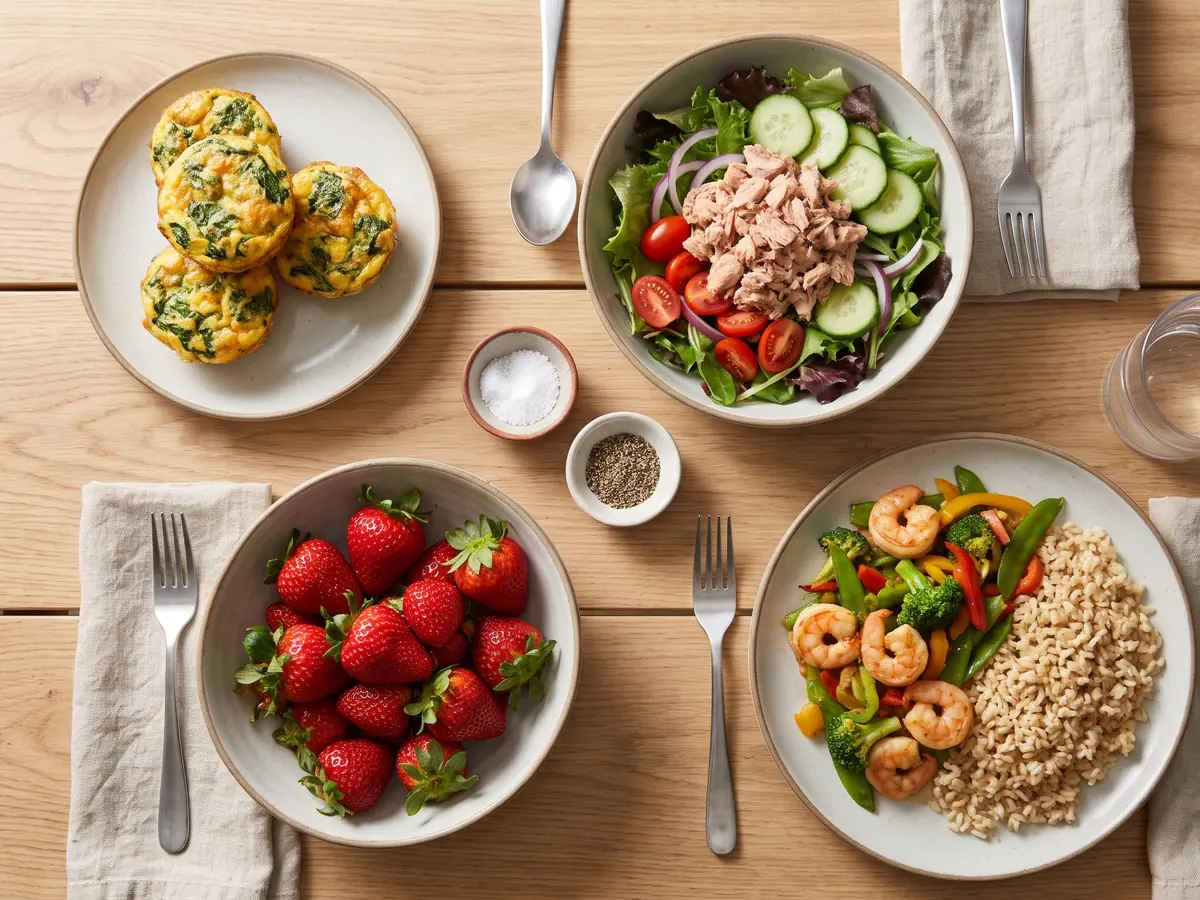
Short answerA 1300 calorie diet splits into roughly a 290-calorie breakfast, 350-calorie lunch, 190-calorie snack and 470-calorie dinner. This week averages 1,300 calories, 95 g of protein and 30 g of fiber. It suits smaller or less active women who want to lose weight steadily. For most men and active people, it's too low; aim higher. Removing about 100 calories a day gives a simple 1200 calorie meal plan.
Before you start: at 1,200 to 1,300 calories, many adults eat below their BMR, the calories they burn at rest. If that's you, or if you're pregnant, breastfeeding, under 18, managing a medical condition or have a history of eating disorders, talk to a doctor or registered dietitian first. See our medical disclaimer.
In this article
Who a 1300 calorie diet suits
Whether 1,300 calories is a sensible target depends entirely on your maintenance. Six examples, using the Mifflin-St Jeor equation and the activity levels in our TDEE calculator:
| Person | BMR | Maintenance | Daily gap at 1,300 |
|---|---|---|---|
| Woman, 60, 155 cm, 58 kg, sedentary | about 1,088 | about 1,305 | Maintenance |
| Woman, 45, 160 cm, 70 kg, sedentary | about 1,314 | about 1,577 | −277 |
| Woman, 55, 158 cm, 62 kg, lightly active | about 1,172 | about 1,611 | −311 |
| Woman, 30, 163 cm, 68 kg, lightly active | about 1,388 | about 1,908 | −608 |
| Woman, 35, 165 cm, 75 kg, lightly active | about 1,445 | about 1,987 | −687 |
| Man, 40, 175 cm, 80 kg, sedentary | about 1,699 | about 2,038 | −738 |
The pattern is clear. For smaller, older or less active women, a 1300 calorie diet is a moderate deficit or even maintenance. For younger, larger or more active women, and for most men, it's a steep cut. Those people usually do better at 1,500 to 1,800 calories, which still produces steady loss with less hunger; see the 1600 calorie meal plan or the 1,500-calorie 7-day plan.
The NHS advises aiming to lose 0.5 to 1 kg (1 to 2 lb) a week, and NIDDK suggests a goal of 5 to 10% of starting weight over six months for people who are overweight. A gap of 300 to 600 calories a day fits those paces.
1300 calories vs your BMR
Your BMR, or basal metabolic rate, is what your body burns at complete rest. Eating below it isn't automatically dangerous, but it makes it harder to get enough protein, fiber, vitamins and minerals, and it's a sign the deficit is large. In the table above, 1,300 is below BMR for the 30- and 35-year-old women and for the man. For them, a 1300 calorie diet should be used only with professional guidance, if at all.
Find your own BMR with the BMR calculator. If 1,300 is above it and below your maintenance, a 1300 calorie diet is a reasonable weight loss tool. If it's below your BMR, choose a higher calorie plan, or talk to your doctor. For very low intakes, our 1000 calorie meal plan explains why intakes far below what you burn need medical supervision.
The 7-day 1300 calorie meal plan
Each 1300 calorie meal plan day lists its meals with calories on the right. Meat, fish, grains and beans are cooked weights; "Greek yogurt" is one 170 g container of plain nonfat Greek yogurt, and milk is 2%.
Day 1 1,314 calories · 103 g protein · 32 g fiber
- Breakfast2 eggs scrambled with 1 cup spinach and ¼ cup red pepper; 1 slice whole-wheat toast; 1 cup strawberries301
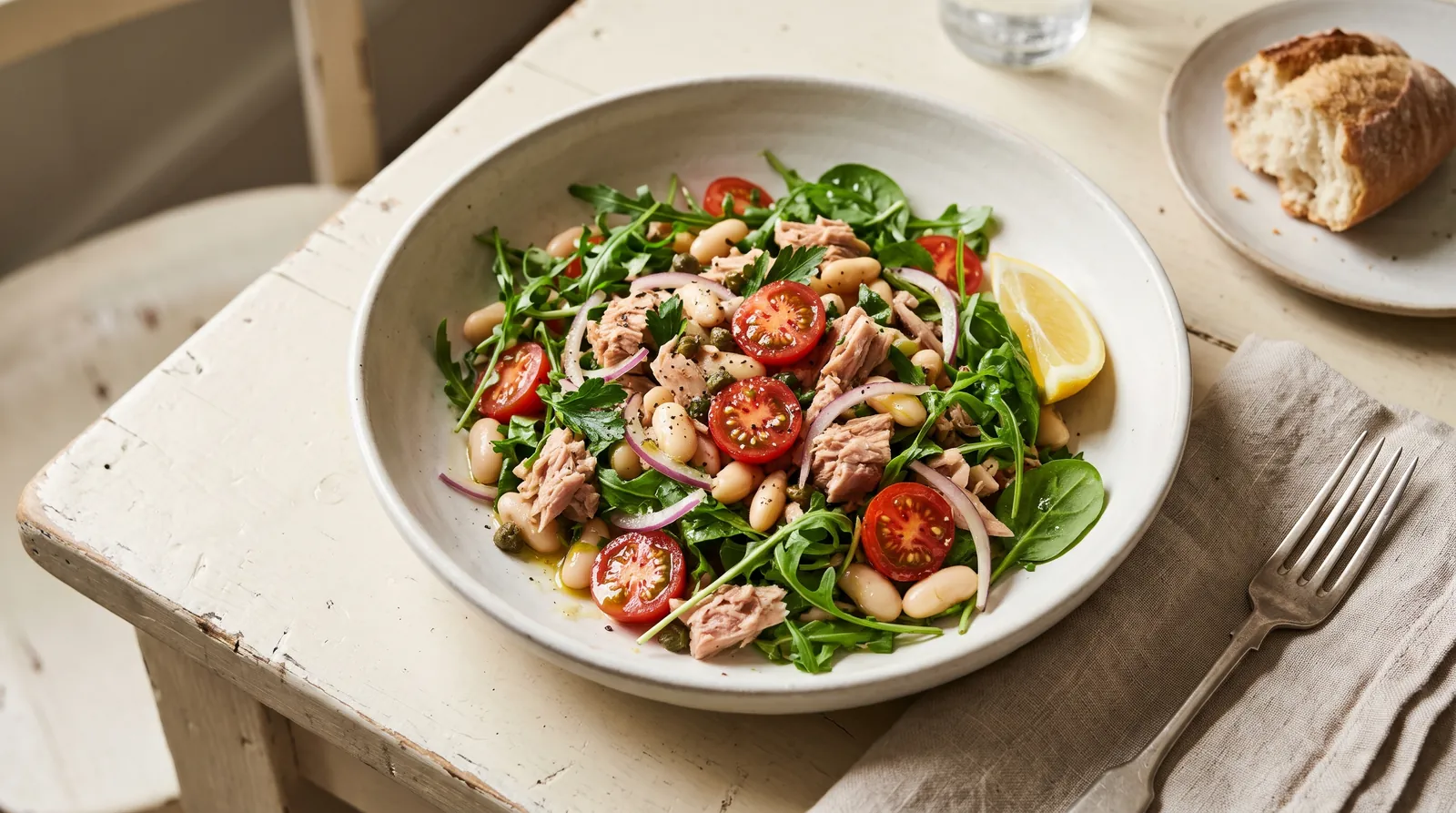
- LunchTuna salad: 3 oz tuna, ½ cup chickpeas, 2 cups romaine, 1 tomato, 1 tsp olive oil285
- SnackGreek yogurt with ½ cup raspberries and ½ oz almonds214
- Dinner4 oz shrimp, 1 cup brown rice, 1 cup broccoli, ½ cup red pepper, 2 tsp oil514
Day 2 1,306 calories · 97 g protein · 31 g fiber
- Breakfast½ cup oats cooked in 1 cup milk, ½ cup blueberries316
- LunchChicken salad: 3 oz chicken, 2 cups romaine, ½ cup cucumber, ½ tomato, ½ cup chickpeas, 1 tsp olive oil; 1 slice whole-wheat bread430
- Snack1 apple, ½ oz cheddar, ½ cup strawberries176
- Dinner5 oz baked cod, 1 sweet potato, 1 cup green beans, 2 tsp olive oil383
Day 3 1,293 calories · 92 g protein · 36 g fiber
- BreakfastGreek yogurt with 1 cup strawberries, ⅓ cup oats and ½ oz almonds332
- LunchLentil soup: ½ cup lentils, 2 cups spinach, ½ cup canned tomatoes, 1 carrot, 1 tsp olive oil; 1 boiled egg290
- Snack3 oz baby carrots with 2 tbsp hummus, 1 apple195
- Dinner4 oz chicken breast, 1 cup quinoa, 1 cup zucchini, 1 tsp olive oil475
Day 4 1,307 calories · 82 g protein · 30 g fiber
- Breakfast½ cup cottage cheese, 1 peach, 1 slice whole-wheat toast231
- LunchTurkey tacos: 3 oz ground turkey, 2 whole-wheat tortillas, 1 cup lettuce, ½ cup red pepper, 2 tbsp salsa465
- Snack1 orange, ½ oz almonds150
- Dinner3 oz baked salmon, 1 cup broccoli, 1 cup cauliflower, 2 tsp olive oil, ½ cup brown rice462
Day 5 1,287 calories · 118 g protein · 24 g fiber
- Breakfast2 eggs with 1 cup mushrooms, 1 slice whole-wheat toast, 1 kiwi293
- LunchChicken quinoa bowl: 3 oz chicken, ½ cup quinoa, ¼ cup black beans, 1 tomato, 1 cup lettuce339
- SnackGreek yogurt with ½ cup blueberries and ½ oz almonds224
- Dinner5 oz baked cod, 1 cup zucchini, 1 cup green beans, 2 tsp olive oil, ½ cup brown rice432
Day 6 1,299 calories · 87 g protein · 32 g fiber
- Breakfast½ cup oats cooked in 1 cup milk, ½ cup raspberries306
- LunchTuna plate: 3 oz tuna, 1 cup cucumber, 1 tomato, 2 cups romaine, 1 tsp olive oil; 1 small whole-wheat pita240
- SnackGreek yogurt, 1 pear202
- DinnerTofu stir-fry: ½ cup tofu, 1 cup broccoli, ½ cup red pepper, ½ cup mushrooms, 1 tsp oil, over 1 cup brown rice551
Day 7 1,294 calories · 89 g protein · 28 g fiber
- BreakfastGreek yogurt with ½ cup blueberries, ½ cup strawberries and ⅓ cup oats269
- LunchEgg salad plate: 2 boiled eggs, 2 cups spinach, 1 tomato, ½ cup cucumber, 1 tsp olive oil; 2 slices whole-wheat bread400
- Snack1 apple, ½ oz almonds176
- Dinner4 oz grilled sirloin, 1 sweet potato, 1 cup broccoli, 2 tsp olive oil449
Totals from USDA FoodData Central for the amounts listed. Herbs, spices, lemon and vinegar aren't counted.
What a 1300 calorie meal day looks like
Eating 1300 calories a day still leaves room for real food. A 1300 calorie meal pattern leaves room for four real meals as long as they're built on lean protein and vegetables. Dinner is the largest, because a satisfying evening meal helps many people avoid late snacking. Day 1's shrimp, brown rice and vegetables come to 514 calories; the tuna salad at lunch is only 285, yet has 3 oz of tuna, half a cup of chickpeas and two cups of greens.
| Nutrient | Average a day | Guideline |
|---|---|---|
| Calories | 1,300 | Your target |
| Protein | 95 g (29%) | 1.2–1.6 g per kg (DGA) |
| Carbohydrate | 149 g (46%) | 45–65% of calories |
| Fat | 40 g (28%) | 20–35% of calories |
| Saturated fat | about 6% of calories | Under 10% |
| Fiber | 30 g | 28 g Daily Value |
| Sodium (before added salt) | about 770 mg | Under 2,300 mg |
Even on a 1300 calorie diet, the week clears the 28 g fiber Daily Value and keeps saturated fat and sodium well under their limits. That's the advantage of building a low-calorie plan from vegetables, fruit, beans, whole grains and lean protein: they bring nutrients without many calories.
Simple 1200 calorie meal plan
To turn the menu into a simple 1200 calorie meal plan, remove about 100 calories from each day. Pick one item per day from this list:
| Day | Remove | Saves | New total |
|---|---|---|---|
| 1 | ½ cup of the brown rice at dinner | 124 | 1,190 |
| 2 | The slice of bread at lunch, and the strawberries | 105 | 1,201 |
| 3 | The apple at snack | 95 | 1,198 |
| 4 | One tortilla at lunch | 127 | 1,180 |
| 5 | The ½ cup brown rice at dinner | 124 | 1,163 |
| 6 | ½ cup of the brown rice at dinner | 124 | 1,175 |
| 7 | One slice of bread at lunch | 81 | 1,213 |
Cutting 100 calories this way from 1300 calories keeps protein almost unchanged, because the items removed are starches and fruit rather than protein foods. The 1,200-calorie version averages about 1,189 calories a day. Our calculators don't suggest going below 1,200 calories for women or 1,500 for men without medical supervision, so treat 1,200 as a floor, not a goal.
Protein first at low calories
The lower your calories, the more protein matters, and 1300 calories is low. It keeps meals filling and helps protect muscle while you lose weight. The 2025–2030 Dietary Guidelines set a goal of 1.2 to 1.6 g of protein per kg of body weight and say to "prioritize protein foods at every meal."
This plan averages 95 g a day, which meets 1.2 g per kg for people up to about 79 kg. Every meal includes a protein food: eggs, Greek yogurt, cottage cheese, chicken, fish, turkey, beef, tofu or lentils. If you weigh more, add protein before anything else: a second container of Greek yogurt adds 100 calories and 17 g of protein, and 1 oz more chicken adds 47 calories and 9 g. The macro calculator sets a protein target for your weight.
On 1300 calories, strength training two or more days a week, which the CDC recommends for all adults, also helps keep muscle while you're in a deficit.
Managing hunger on a 1300 calorie diet
- Lead with vegetables. Two cups of romaine have 16 calories; a cup of broccoli 55. They fill the plate for very little.
- Keep the snack. In a 1300 calorie diet, a 150 to 225-calorie snack between lunch and dinner makes the evening easier.
- Choose whole fruit over juice. The 2025–2030 guidelines say juice should be limited or diluted; whole fruit keeps its fiber.
- Drink water. The guidelines advise avoiding sugar-sweetened drinks, which use up calories without filling you.
- Measure oil. One tablespoon of olive oil is 119 calories, almost a tenth of 1300 calories.
- Plan, don't improvise. On a 1300 calorie diet, an unplanned snack can be a quarter of the day.
A 1300 calorie diet for men?
For most men it's too low. Even the sedentary 40-year-old man in the first table burns about 2,038 calories a day, and 1,300 is below his BMR of about 1,699. A target of 1,500 to 1,800 gives him a steady deficit with enough room for protein and normal meals. The 1800 calorie meal plan is a better starting point for many men.
Simple swaps
If you don't like a 1300 calorie meal in the plan, swap within the same type and the day stays close to its total. From USDA data: 3 oz of cod (89 calories, 19 g protein), shrimp (84, 20 g) and tuna (73, 17 g) are interchangeable lean proteins; 3 oz of chicken breast (140, 26 g) is a little higher. For starches, ½ cup of brown rice (124), ½ cup of quinoa (112) and one sweet potato (103) are close. For snacks, a container of Greek yogurt (100) can replace ½ cup of cottage cheese (92).
How fast will you lose weight?
With the gaps in the first table and the common starting estimate of 3,500 calories per pound, the sedentary 45-year-old woman would lose about 2.2 lb in four weeks and the lightly active 55-year-old about 2.5 lb. Larger gaps lose faster, but those are also the people for whom 1,300 is below BMR and a higher plan is the better choice. Over time, loss slows as maintenance falls; the weight loss simulator shows this for your numbers.
Vegetarian 1300 calorie diet
In this 1300 calorie meal plan, Day 3's lunch is lentil-based and Day 6's dinner uses tofu. For a fully vegetarian week, replace each 3 to 5 oz portion of meat or fish with one of these, from USDA data:
- ½ cup firm tofu: 181 calories, 22 g protein
- 2 eggs: 155 calories, 13 g protein
- ½ cup cottage cheese plus 1 egg: 170 calories, 18 g protein
- ½ cup cooked lentils plus ½ cup cottage cheese: 206 calories, 21 g protein
These are a little higher in calories than lean fish or chicken, so drop ½ cup of rice or quinoa at that meal to stay near 1,300. Protein will average a little lower than the original plan, around 85 g, so lean on Greek yogurt and cottage cheese at breakfast and snack.
Meal prep for a week of 1300 calorie meals
- Cook grains once or twice: about 3 cups of brown rice and 1½ cups of quinoa cover all seven days. If someone else eats with you, the recipe scaler resizes the amounts.
- Cook chicken and boil eggs early: they appear in lunches through the week.
- Make the lentil soup ahead for Day 3's 1300 calorie meal plan; it keeps well and reheats quickly.
- Wash greens and chop vegetables for salads: romaine, spinach, tomatoes, cucumber and peppers.
- Portion snacks: ½ oz bags of almonds, yogurt containers and fruit within reach.
On a 1300 calorie diet, prep matters more than at higher calorie levels. When every meal is ready, there's less temptation to grab something unplanned that uses up a quarter of the day.
Common mistakes on a 1300 calorie diet
- Choosing 1,300 when a higher number would work. If your maintenance is around 2,000, a 1,500 to 1,600 target still loses weight with far less hunger.
- Cutting protein to save calories. Protein foods keep a 1300 calorie meal filling; cut starch or fat first.
- Skipping meals. Each 1300 calorie meal plan day has four eating times for a reason: saving calories for later usually leads to overeating in the evening.
- Forgetting drinks and cooking oil. On a 1300 calorie diet, a latte or an unmeasured pour of oil is a big share of the day.
- Staying at 1,300 too long without checking. Review your weekly average weight; if loss is faster than about 1 kg a week, eat more.
Eating out on a 1300 calorie diet
One restaurant meal can fit into 1300 calories, but there's little margin. Keep breakfast and the snack light, around 250 and 150 calories, which leaves about 900 for lunch and dinner. At the restaurant, pick grilled fish or chicken with vegetables or salad, ask for dressing and sauces on the side, and skip the bread basket and sugary drinks. Sandwiches can be surprisingly high: a club sandwich on white bread has about 289 calories and around 1,000 mg of sodium in USDA survey data, before any sides. Our sandwich calories page has more.
After you reach your goal
A 1300 calorie diet is a weight loss tool, not a forever plan for most people. When you reach your goal, raise calories in steps of about 100 to 200 a week and watch your weekly average weight. When it stays steady, you've found your maintenance. For many smaller women that lands between 1,500 and 1,800, and our 1600, 1700 and 1800 calorie meal plans use the same style of meals at those levels.
Why 1,200 is a floor
There's no official minimum calorie intake for adults on a general diet, but the lower you go, the harder it becomes to fit in enough protein, fiber, vitamins and minerals from ordinary food. That's why our calculators won't suggest less than 1,200 calories a day for women or 1,500 for men without medical supervision. Below 800 calories a day is classed as a very low calorie diet; a National Institutes of Health task force concluded those diets should be used only with medical supervision. Our 800 calorie diet guide covers why, including the higher risk of gallstones with rapid weight loss.
The space between 800 and 1,200 calories, covered in our 1000 calorie meal plan, also needs care. For most people, a plan at 1,300 or above is easier to stick to and safer to follow on your own.
Tracking your progress
On a 1300 calorie diet, weigh yourself a few mornings a week at the same time and compare weekly averages, not single days. Water and food in your system move the scale up and down from day to day. If your weekly average drops by roughly 0.25 to 1 kg (0.5 to 2 lb), the plan is working at a sensible pace.
If it isn't moving after three or four weeks, check portions first: oil, nuts, bread and rice are the usual culprits. Log a few days in the calorie counter to see where the extra calories come from. If you're losing faster than about 1 kg a week, eat more; the NHS advises aiming for 0.5 to 1 kg a week.
Grocery list for the 1300 calorie meal plan
Protein
- Chicken breast, 10 oz
- Cod, 10 oz
- Canned tuna, 6 oz
- Shrimp, 4 oz
- Salmon, 3 oz
- Sirloin, 4 oz
- Ground turkey, 3 oz
- Firm tofu, ½ cup
- Eggs, 7
Dairy
- Plain Greek yogurt, 5 containers
- 2% milk, 2 cups
- Cottage cheese, ½ cup
- Cheddar, ½ oz
Grains and beans
- Brown rice, 3 cups cooked
- Quinoa, 1½ cups cooked
- Oats, 1⅔ cups
- Whole-wheat bread, 6 slices
- Whole-wheat tortillas, 2
- Small whole-wheat pita, 1
- Chickpeas, 1 cup
- Lentils, ½ cup cooked
- Black beans, ¼ cup
- Hummus, 2 tbsp
Vegetables
- Broccoli, 4 cups
- Romaine or lettuce, 8 cups
- Spinach, 5 cups
- Tomatoes, 4–5
- Red peppers, 2
- Zucchini, 2
- Cucumber, 1–2
- Green beans, 2 cups
- Cauliflower, 1 cup
- Mushrooms, 1½ cups
- Sweet potatoes, 2
- Carrot, 1, plus 3 oz baby carrots
- Canned tomatoes, ½ cup
Fruit
- Strawberries, 3 cups
- Blueberries, 1½ cups
- Raspberries, 1 cup
- Apples, 3
- Orange, 1
- Pear, 1
- Peach, 1
- Kiwi, 1
Pantry
- Almonds, 2½ oz
- Olive oil, about 6 tbsp
- Salsa, 2 tbsp
Save the 1300 calorie meal plan as a PDF
Want a simple 1200 calorie meal plan PDF, or the 1,300 version, to keep on your phone or fridge? Use your browser's print option and choose "Save as PDF." The site menu, footer and related links are left out, so the printout contains the menus, the 1,200-calorie table and the grocery list.
1300 calorie diet FAQ
Is a 1300 calorie diet safe?
For many smaller or less active women it can be, if meals are planned for protein, fiber and nutrients. It's a large cut for most men and active people. If 1,300 is below your BMR, get advice from a doctor or dietitian first.
How much weight will I lose on 1,300 calories?
It depends on your maintenance. A sedentary 45-year-old woman at 160 cm and 70 kg burns about 1,577 calories, so 1,300 gives a gap of about 280 a day, roughly half a pound a week at first. A lightly active 35-year-old woman at 165 cm and 75 kg has a gap of about 690.
What does a 1300 calorie meal look like?
A 1300 calorie day is four small meals: about a 290-calorie breakfast, a 350-calorie lunch, a 190-calorie snack and a 470-calorie dinner. For example, eggs with spinach and strawberries, a tuna and chickpea salad, Greek yogurt with raspberries, and shrimp with brown rice and vegetables.
How do I turn this into a 1200 calorie meal plan?
Remove about 100 calories a day: ½ cup of brown rice (124), a slice of whole-wheat bread (81), ½ oz of almonds (82) or an apple (95). The week then averages about 1,200 calories.
Can I save this meal plan as a PDF?
Yes. Use your browser's print option and choose 'Save as PDF'. The menu and footer are left out of the printout.
Sources
- U.S. Department of Agriculture. FoodData Central (every food in the menus).
- U.S. Departments of Health and Human Services and Agriculture. Dietary Guidelines for Americans, 2025–2030, January 2026 (protein goal, juice, sugary drinks, limits).
- National Institute of Diabetes and Digestive and Kidney Diseases. Dieting and gallstones (5 to 10% over six months).
- NHS. Tips to help you lose weight.
- Centers for Disease Control and Prevention. Physical activity guidelines for adults.
- Frankenfield D, et al. Comparison of predictive equations for resting metabolic rate in healthy nonobese and obese adults: a systematic review. J Am Diet Assoc, 2005.
- National Academies. Dietary Reference Intakes: macronutrient distribution ranges, 2005.