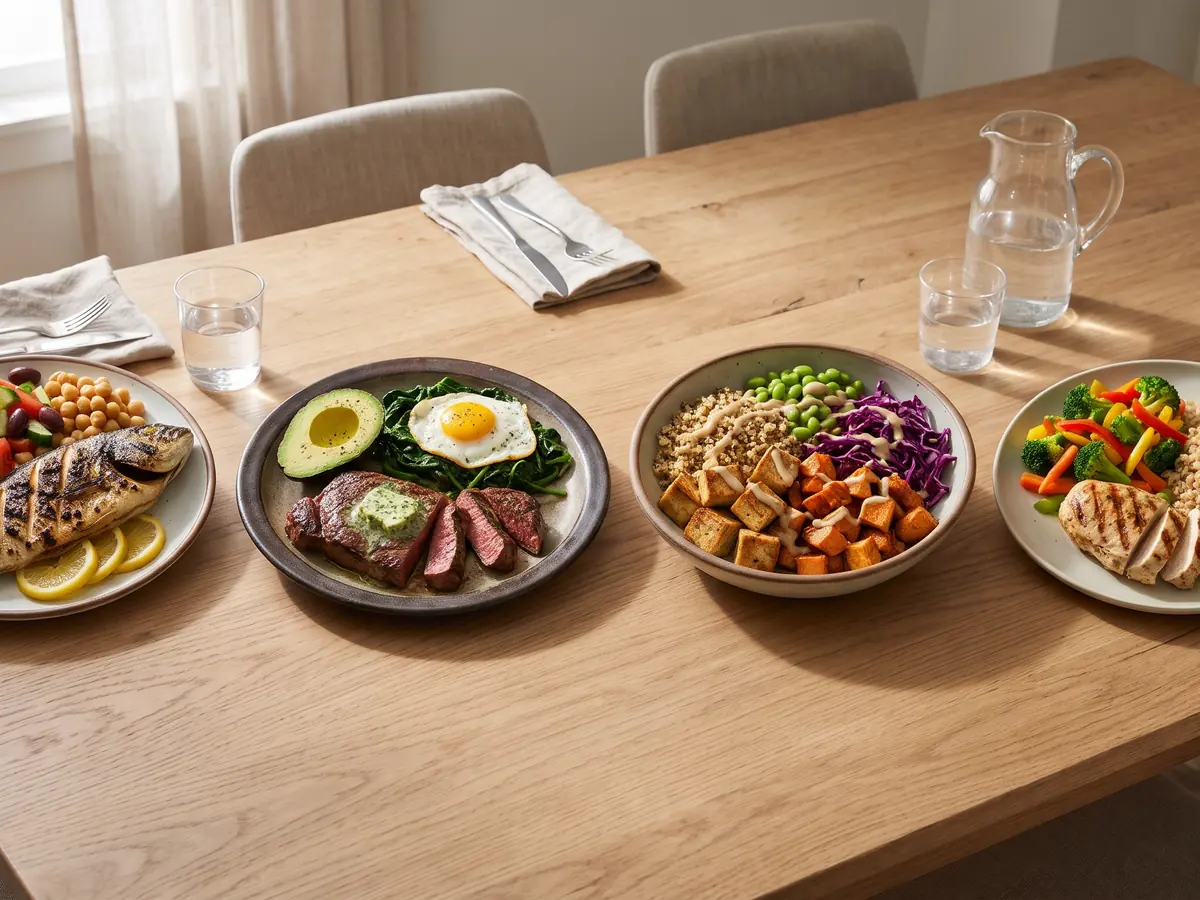
Short answerThe best-studied diets for long-term health are the Mediterranean and DASH patterns, both backed by large randomized trials. For weight loss, most diets work about equally well when calories are matched: in the year-long DIETFITS trial, healthy low-fat and healthy low-carb diets differed by less than a kilogram. Keto, paleo and intermittent fasting help some people eat less, but don't beat other approaches on their own. The carnivore diet has almost no controlled research.
In this article
The 10 diets at a glance
Different types of diets mostly change three things: which foods are in or out, how calories split between carbohydrate, protein and fat, and when you eat. Here's how the ten compare. The macro splits are typical examples (protein / carbs / fat as a share of calories); the ones for keto, low-carb, high-protein and carnivore are the presets in our macro calculator.
| Diet | Main idea | Typical macros (P/C/F) | Evidence |
|---|---|---|---|
| Mediterranean | Vegetables, olive oil, fish, nuts, whole grains | Moderate in all three | Strong (large heart trial) |
| DASH | Vegetables, fruit, low-fat dairy, less sodium | Moderate in all three | Strong (blood pressure trials) |
| Keto | Very low carb so the body burns fat for fuel | 20 / 5 / 75% | Moderate; small weight edge |
| Low-carb | Cut sugars and starches, keep vegetables | 30 / 25 / 45% | Good; similar to low-fat |
| Intermittent fasting | Eat within a time window | Any | Mixed; no edge on its own |
| Vegetarian | No meat or fish | Usually higher carb | Good (position statements) |
| Vegan | No animal products | Usually higher carb | Good, with B12 planning |
| Paleo | Meat, fish, vegetables, fruit, nuts; no grains, dairy, legumes | Higher protein | Limited, short term |
| Carnivore | Animal foods only | 35 / 2 / 63% | Very limited (surveys) |
| High-protein | Protein at every meal, often 1.2 g/kg or more | 35 / 40 / 25% | Good for satiety and muscle |
To compare these types of diets with a middle-of-the-road split, our balanced preset is 25 / 50 / 25%, and the National Academies' acceptable ranges for adults are 10 to 35% protein, 45 to 65% carbohydrate and 20 to 35% fat. Keto and carnivore sit well outside the carbohydrate range; most of the others fit inside it.
One day on four different types of diets
Descriptions of different types of diets only go so far. Here's what a day of about 1,800 calories looks like on four of the different types of diets, built from the same USDA FoodData Central values we use in our meal plans.
Mediterranean 1,775 calories · 91 g protein · 39 g fiber
- BreakfastGreek yogurt with 1 cup blueberries and ½ oz almonds; 1 banana371
- LunchChickpea salad: 1 cup chickpeas, 1 tomato, 1 cup cucumber, 1 tbsp olive oil; 1 whole-wheat pita594
- Snack1 orange, ½ oz almonds150
- Dinner5 oz baked salmon, 1 cup quinoa, 1 cup zucchini sautéed in 1 tbsp olive oil661
DASH 1,772 calories · 123 g protein · 41 g fiber
- Breakfast½ cup oats cooked in 1 cup milk, 1 banana379
- LunchChicken sandwich: 3 oz chicken, 2 slices whole-wheat bread, lettuce, ½ tomato; ½ cup black beans; 1 apple529
- SnackGreek yogurt with 1 cup strawberries, ½ oz almonds230
- Dinner5 oz baked cod, 1 sweet potato, 1 cup broccoli, 1 cup brown rice, 2 tsp olive oil634
Keto 1,804 calories · 120 g protein · 43 g carbs
- Breakfast3 eggs scrambled with 1 cup spinach and 1 oz cheddar in 1 tsp olive oil394
- LunchChicken salad: 4 oz chicken, 2 cups romaine, ½ cup avocado, ½ cup cucumber, 1 tbsp olive oil450
- Snack2 oz almonds328
- Dinner6 oz salmon, 1 cup broccoli and 1 cup cauliflower roasted in 5 tsp olive oil632
Vegan 1,746 calories · 98 g protein · 67 g fiber
- Breakfast½ cup oats with 1 tbsp peanut butter, 1 cup raspberries, ½ oz chia seeds379
- LunchLentil bowl: 1 cup lentils, ½ cup quinoa, 2 cups spinach, ½ cup canned tomatoes, 2 tsp olive oil454
- Snack1 cup edamame, 1 apple282
- DinnerTofu stir-fry: ¾ cup tofu, 1 cup broccoli, 1 cup red pepper, 2 tsp oil, over ¾ cup brown rice631
Totals from USDA FoodData Central for the amounts listed.
| Diet | Protein | Carbs | Fat | Fiber | Sat. fat |
|---|---|---|---|---|---|
| Mediterranean | 91 g (20%) | 212 g (47%) | 70 g (35%) | 39 g | 4% of calories |
| DASH | 123 g (27%) | 250 g (56%) | 35 g (17%) | 41 g | 4% |
| Keto | 120 g (26%) | 43 g (9%) | 132 g (65%) | 23 g | 12% |
| Vegan | 98 g (22%) | 220 g (50%) | 64 g (33%) | 67 g | 4% |
Three things stand out. First, all four days reach roughly 90 to 120 g of protein, so a high protein intake is possible on any of these types of diets with planning. Second, fiber varies enormously: the vegan day has nearly three times the fiber of the keto day, because beans, lentils, whole grains and fruit are where most fiber comes from. Third, even a keto day built on olive oil, salmon and almonds lands at 12% of calories from saturated fat, above the Dietary Guidelines' 10% limit, because eggs and cheese add up quickly.
None of these different types of diets is better for weight loss at the same calories. What differs is how full each keeps you, how easy it is to follow, and what it does for blood pressure, cholesterol and fiber intake. You can set any of them up for your own calorie target with the macro calculator, and log a test day in the calorie counter.
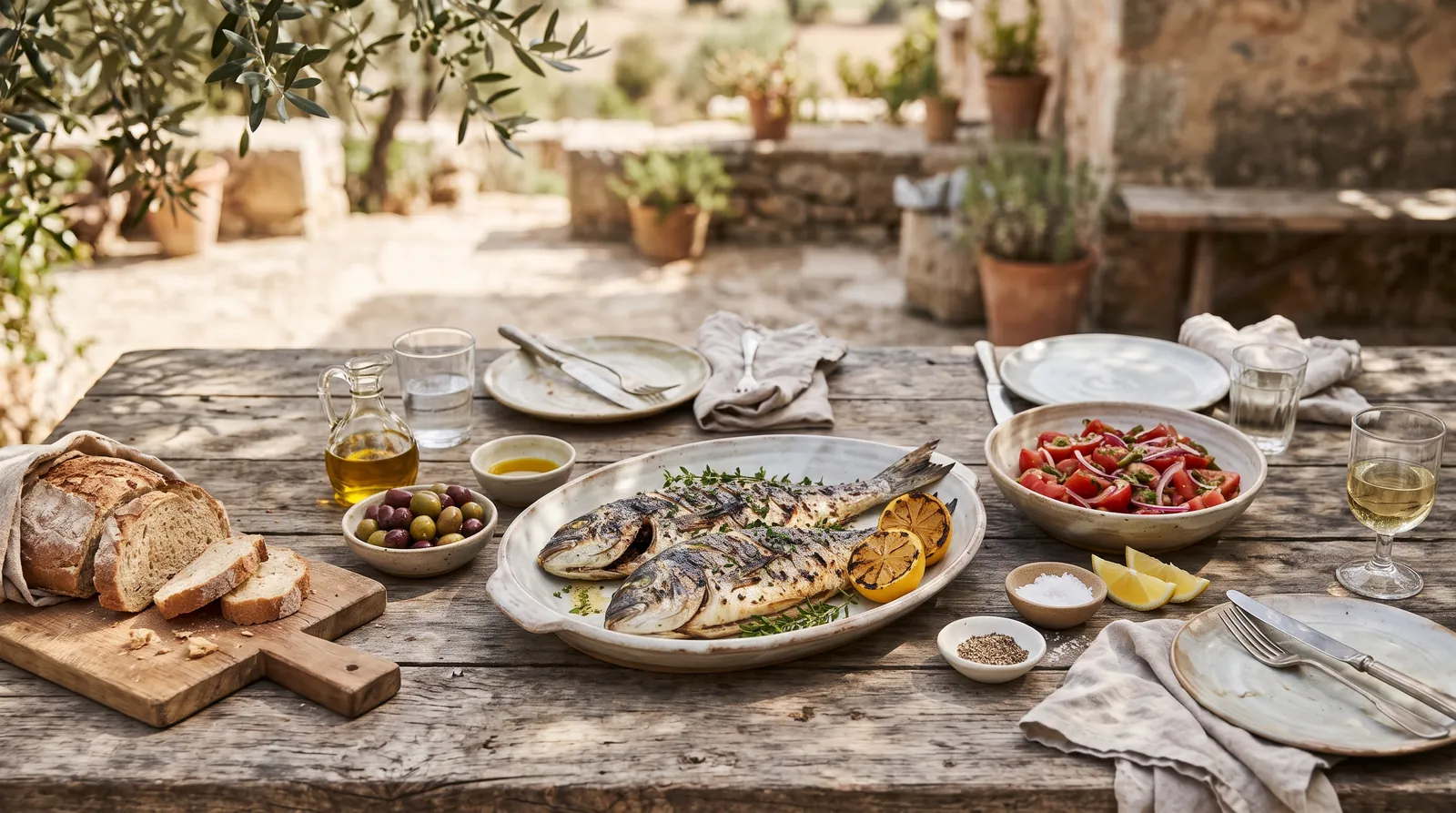
1. Mediterranean diet
What you eat: lots of vegetables, fruit, beans, whole grains, nuts and olive oil; fish and seafood often; moderate dairy and poultry; little red meat and sweets.
Evidence: the strongest of all the types of diets on this list for heart health. The PREDIMED trial in Spain assigned 7,447 people aged 55 to 80 at high cardiovascular risk to a Mediterranean diet with extra-virgin olive oil, a Mediterranean diet with nuts, or a control diet with advice to reduce fat. After a median of 4.8 years, major cardiovascular events (heart attack, stroke or cardiovascular death) were lower in both Mediterranean groups, with hazard ratios of 0.69 for olive oil and 0.72 for nuts compared with the control group. In plain terms, that's roughly 30% fewer events.
The trial's first report from 2013 was withdrawn and republished in 2018 with revised analyses because of problems with how some participants were randomized; the results were similar after removing those people.
Who it suits: almost anyone. Of all the diet types here, it asks the fewest trade-offs. It's flexible, doesn't ban food groups, and overlaps heavily with the 2025–2030 Dietary Guidelines' emphasis on whole, nutrient-dense foods and olive oil for cooking.
2. DASH diet
What you eat: DASH stands for Dietary Approaches to Stop Hypertension. The National Heart, Lung, and Blood Institute describes it as "a flexible and balanced eating plan that helps create a heart-healthy eating style for life." It emphasizes "vegetables, fruits, and whole grains" and "fat-free or low-fat dairy products, fish, poultry, beans, nuts, and vegetable oils," and limits foods high in saturated fat and sugar-sweetened drinks and sweets. The standard plan has 2,300 mg of sodium a day, and NHLBI notes that 1,500 mg "lowers blood pressure even further."
Evidence: the DASH-Sodium trial fed 412 adults either a typical American diet or the DASH diet at three sodium levels. Both DASH and lower sodium lowered blood pressure, and the effects added up. Compared with the control diet at high sodium, DASH with low sodium gave a systolic blood pressure 7.1 mm Hg lower in people without hypertension and 11.5 mm Hg lower in people with hypertension.
Who it suits: anyone with high or borderline blood pressure, and anyone who wants a structured, well-tested eating plan rather than a specialty diet. Our heart-healthy diet guide adds a low sodium chart and a sample day.
3. Keto diet
What you eat: very little carbohydrate, usually 20 to 50 g a day, so the body shifts to burning fat and producing ketones. Meals are built on meat, fish, eggs, cheese, butter, oils, nuts, avocado and non-starchy vegetables. Bread, rice, pasta, most fruit, beans and sugar are out. Our macro calculator's keto preset is 20% protein, 5% carbs and 75% fat.
Evidence: a 2013 meta-analysis of 13 randomized trials lasting at least a year compared very-low-carbohydrate ketogenic diets with low-fat diets. People on keto lost a little more: 0.91 kg more on average, across 1,415 participants. That's a real but small difference over a year.
Who it suits: people who find that cutting carbs reduces their hunger and who don't mind giving up grains and most fruit, which few other types of diets ask for. It's hard to sustain for many, it falls far below the 130 g carbohydrate RDA, and anyone on diabetes medicine needs medical advice first because the dose may need to change.
4. Low-carb diet
What you eat: a less extreme version of keto. Sugars, refined grains and starchy foods are cut back, but vegetables, some fruit, dairy and sometimes beans stay. Our low-carb preset is 30% protein, 25% carbs and 45% fat.
Evidence: the DIETFITS trial, published in JAMA in 2018, randomized overweight adults to a healthy low-fat or a healthy low-carbohydrate diet for 12 months, with both groups coached to eat whole foods and plenty of vegetables. Average weight loss was 5.3 kg on low-fat and 6.0 kg on low-carb, a difference the researchers did not find significant.
Who it suits: people who prefer fewer starches and feel fuller with more protein and fat, but find keto too strict a specialty diet. Choose unsaturated fats, since the Dietary Guidelines say saturated fat should stay under 10% of calories.
5. Intermittent fasting
What you eat: anything, but within a time window. Common versions are time-restricted eating, such as eating only between noon and 8 pm (16:8), or fasting on some days of the week. Intermittent fasting changes when you eat, not what.
Evidence: the TREAT trial randomized 116 adults with overweight or obesity to eat only between 12 pm and 8 pm, or to eat three structured meals a day, for 12 weeks. The fasting group lost 0.94 kg and the regular-meals group 0.68 kg; the difference between groups, 0.26 kg, wasn't significant. The authors concluded that time-restricted eating, on its own, "is not more effective in weight loss than eating throughout the day."
Who it suits: people who naturally skip breakfast or snack late at night, and who find a clear cut-off time easier than counting. It works when it leads to eating less overall. The fasting calculator maps out a window that fits your day.
6. Vegetarian diet
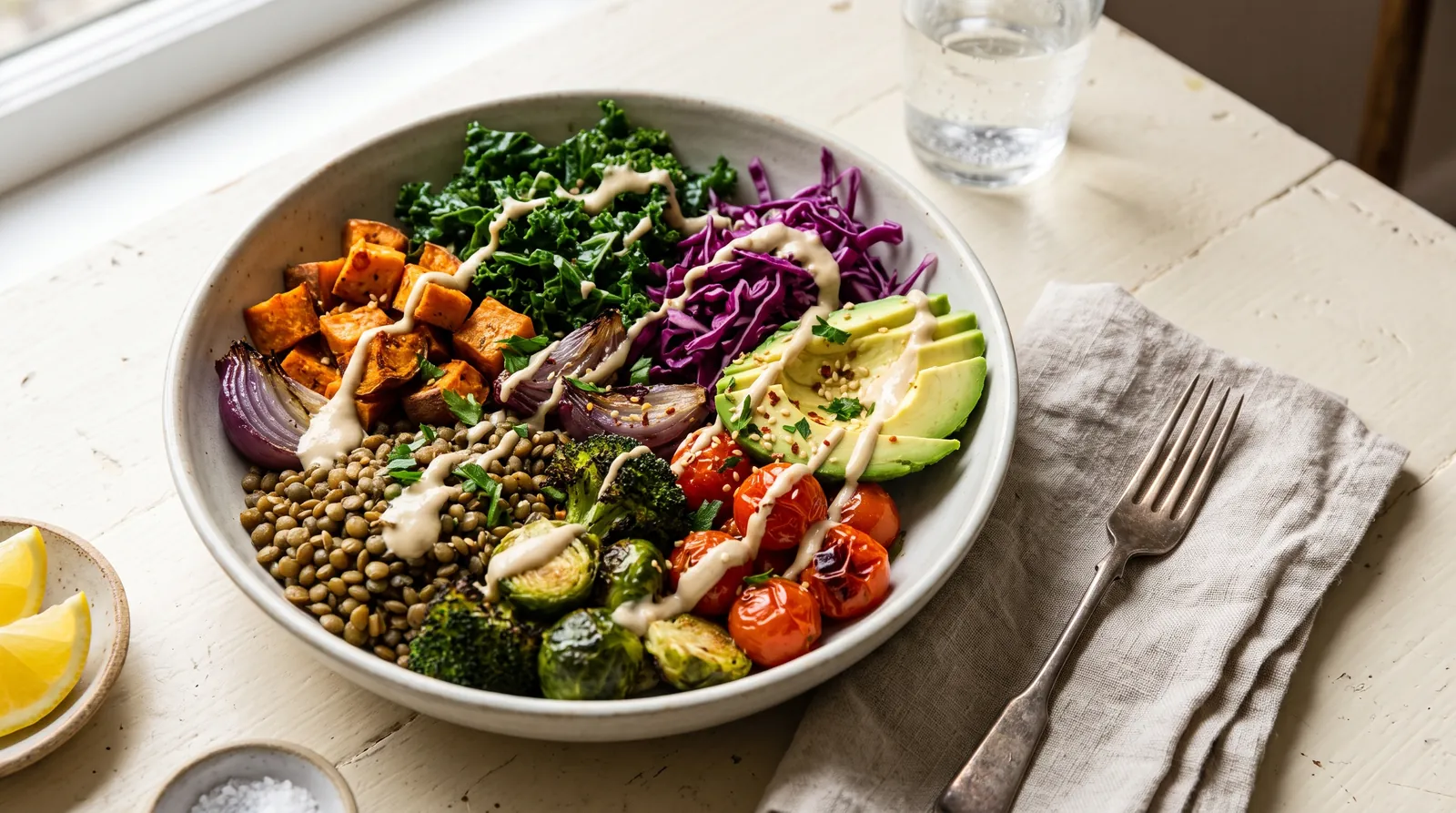
What you eat: no meat, poultry or fish. Most vegetarians eat eggs and dairy (lacto-ovo vegetarian). Protein comes from beans, lentils, tofu, eggs, dairy, nuts and seeds.
Evidence: the Academy of Nutrition and Dietetics' position is that "appropriately planned vegetarian, including vegan, diets are healthful, nutritionally adequate, and may provide health benefits for the prevention and treatment of certain diseases."
Who it suits: anyone who prefers not to eat meat, for health, ethical or environmental reasons. It's one of the easier specialty diets to keep long term. The key word in the position statement is "planned": include protein at each meal, plenty of beans and lentils, and dairy or fortified alternatives for calcium. Our healthy food list has calories and protein for beans, tofu and dairy.
7. Vegan diet
What you eat: no animal products at all: no meat, fish, eggs, dairy or honey. Protein comes from beans, lentils, soy foods like tofu and edamame, nuts, seeds and whole grains.
Evidence: the same Academy position covers vegan diets: healthful and nutritionally adequate when appropriately planned.
Who it suits: people committed to avoiding animal products. Planning matters more than on any of the other types of diets here. Vitamin B12 comes naturally from animal foods (the Dietary Guidelines list "meats, poultry, eggs, and dairy" as B12-rich sources), so vegans need fortified foods or a supplement. A registered dietitian can help plan the rest of a vegan diet.
8. Paleo diet
What you eat: foods thought to be available before farming: meat, fish, eggs, vegetables, fruit, nuts and seeds. Grains, dairy, legumes, refined sugar and processed foods are out.
Evidence: limited. A 2015 meta-analysis found four randomized trials with 159 people in total, measured over six months or less. Compared with guideline-based diets, paleo gave somewhat larger short-term improvements in waist size (2.4 cm more) and triglycerides. There's no long-term trial data.
Who it suits: people who like a whole-foods, meat-and-vegetables style of eating and don't mind a specialty diet with a fixed food list. The main downside is dropping whole grains, beans and dairy, which the Dietary Guidelines include as core food groups.
9. Carnivore diet
What you eat: only animal foods: meat, fish, eggs and sometimes dairy. No vegetables, fruit, grains, beans or nuts. Our carnivore preset is 35% protein, 2% carbs and 63% fat.
Evidence: very limited. The largest study is a 2021 social media survey of 2,029 adults who had followed a carnivore diet for at least six months. Respondents reported few side effects and high satisfaction, but their reported LDL cholesterol was "markedly elevated" at a median of 172 mg/dL. Because it was a self-selected, self-reported survey of people who chose to stay on the diet, it can't show whether the diet is safe or effective. The authors say the long-term effects "require further study."
Who it suits: of all the different types of diets in this guide, it's the hardest to recommend. It has no fiber, no fruit or vegetables, and lacks the controlled research behind other diets. If you try it, talk to your doctor and check your cholesterol.
10. High-protein diet
What you eat: a protein food at every meal, aiming well above the 0.8 g per kg RDA. The 2025–2030 Dietary Guidelines themselves set a goal of 1.2 to 1.6 g per kg and say to "prioritize protein foods at every meal." Our high-protein preset is 35% protein, 40% carbs and 25% fat.
Evidence: for active people, the International Society of Sports Nutrition says 1.4 to 2.0 g per kg a day is sufficient for most exercising individuals. Protein also helps keep meals filling, which is why most of our meal plans are built around it.
Who it suits: people losing weight who want to protect muscle, people who strength train, and older adults, who the guidelines say may need "equal or greater amounts of key nutrients such as protein." People with kidney disease should check with their doctor before raising protein.
Which diet is best?
After comparing all these different types of diets, there's no single winner, but the research points to a few clear conclusions:
- For weight loss, calories matter more than the label. Low-fat vs low-carb in DIETFITS, keto vs low-fat in the meta-analysis, fasting vs regular meals in TREAT: the differences were small or not significant. Each diet works when it helps you eat less than you burn. The TDEE calculator gives that number.
- For heart health, Mediterranean and DASH have the strongest evidence, from large randomized trials with hard outcomes like heart attacks and measured blood pressure.
- The best diet is the one you can keep. A plan you follow for years beats a "better" plan you drop after a month.
- Quality matters in all types of diets. DIETFITS coached both groups to eat whole foods and vegetables. A low-carb diet of processed meat or a vegan diet of chips and soda misses the point.
| Your main goal | Diets with the best support |
|---|---|
| Heart health and longevity | Mediterranean, DASH |
| Lower blood pressure | DASH with less sodium |
| Weight loss | Any you can sustain with a calorie deficit; high-protein helps with hunger |
| Building muscle | High-protein with strength training |
| Avoiding animal products | Well-planned vegetarian or vegan |
| Fewer decisions about food | Intermittent fasting or a fixed meal plan |
Whichever of the types of diets you choose, the basics from the 2025–2030 Dietary Guidelines apply: build meals on whole, nutrient-dense foods, eat plenty of vegetables and fruit, choose healthy fats, and limit highly processed foods, added sugars and sodium. Our weight loss plan guide shows how to turn any of these diets into a step-by-step plan, and the balanced diet guide explains the food groups.
Mixing approaches
Different types of diets aren't mutually exclusive. A Mediterranean diet can be vegetarian if beans, lentils, eggs and dairy replace the fish. DASH can be high-protein by adding Greek yogurt, poultry and fish at each meal. Intermittent fasting can sit on top of any of the other diet types, since it only changes timing. Many people end up with a personal mix of diet types: Mediterranean foods, a protein target, and a rough eating window. That's fine, as long as the result covers the food groups and keeps calories where you want them. If you're unsure where to start, the Mediterranean pattern is the easiest base to build on, because it removes nothing essential.
Specialty diets
"Specialty diets" usually means eating patterns that limit or focus on particular foods. Some are chosen, like most of the types of diets in this guide. Others are medical, set by a doctor or dietitian for a condition: a gluten-free diet for celiac disease, a low-sodium diet for heart failure, or a carbohydrate-controlled plan for diabetes. If you have a medical condition, follow the specialty diet your health care team gives you rather than a popular one, and ask before switching.
Specialty diets can also change how you plan calories and macros. For any specialty diet, the macro calculator has presets for balanced, high-protein, low-carb, keto and carnivore splits, so you can see what each looks like in grams at your calorie target.
How to try a new diet safely
- Check with your doctor first if you take medicine for diabetes or blood pressure, are pregnant or breastfeeding, or have kidney disease or a history of eating disorders.
- Set your calories. Most types of diets fail or succeed on total intake. Start from your TDEE.
- Keep protein and vegetables in every version. They fit every one of these diet types except carnivore.
- Give it time. Judge any of the different types of diets over at least a few weeks, using weekly average weight rather than single weigh-ins.
- Track for a while. Logging meals in the calorie counter shows whether a new specialty diet actually changed what you eat.
Types of diets FAQ
What are the different types of diets?
Common types include the Mediterranean diet, the DASH diet, keto and other low-carb diets, intermittent fasting, vegetarian and vegan diets, paleo, the carnivore diet and high-protein diets. These types of diets differ in which foods they include, how they split carbs, protein and fat, and how much research supports them.
Which diet is best for weight loss?
The one you can stick with. In the DIETFITS trial, people lost 5.3 kg on a healthy low-fat diet and 6.0 kg on a healthy low-carb diet over a year, a small difference. Weight loss depends mainly on eating fewer calories than you burn.
Which diet has the strongest evidence for heart health?
The Mediterranean and DASH diets. In the PREDIMED trial, a Mediterranean diet with extra-virgin olive oil or nuts lowered major cardiovascular events (hazard ratios 0.69 and 0.72). DASH with low sodium lowered systolic blood pressure by 11.5 mm Hg in people with hypertension.
Is intermittent fasting better than regular eating?
Not for weight loss on its own. In the 12-week TREAT trial, eating only between noon and 8 pm did not produce significantly more weight loss than three regular meals a day.
What are specialty diets?
Specialty diets are eating patterns that limit or emphasize particular foods, either by choice, like vegan or keto, or for medical reasons set by a doctor or dietitian. Most of the popular types of diets in this guide are specialty diets of the first kind.
Sources
- Estruch R, et al. Primary prevention of cardiovascular disease with a Mediterranean diet supplemented with extra-virgin olive oil or nuts. N Engl J Med, 2018.
- National Heart, Lung, and Blood Institute. DASH eating plan.
- Sacks FM, et al. Effects on blood pressure of reduced dietary sodium and the Dietary Approaches to Stop Hypertension (DASH) diet. N Engl J Med, 2001.
- Bueno NB, et al. Very-low-carbohydrate ketogenic diet v. low-fat diet for long-term weight loss: a meta-analysis of randomised controlled trials. Br J Nutr, 2013.
- Gardner CD, et al. Effect of low-fat vs low-carbohydrate diet on 12-month weight loss in overweight adults: the DIETFITS randomized clinical trial. JAMA, 2018.
- Lowe DA, et al. Effects of time-restricted eating on weight loss and other metabolic parameters: the TREAT randomized clinical trial. JAMA Intern Med, 2020.
- Melina V, Craig W, Levin S. Position of the Academy of Nutrition and Dietetics: vegetarian diets. J Acad Nutr Diet, 2016.
- Manheimer EW, et al. Paleolithic nutrition for metabolic syndrome: systematic review and meta-analysis. Am J Clin Nutr, 2015.
- Lennerz BS, et al. Behavioral characteristics and self-reported health status among 2029 adults consuming a "carnivore diet". Curr Dev Nutr, 2021.
- Jäger R, et al. International Society of Sports Nutrition position stand: protein and exercise. J Int Soc Sports Nutr, 2017.
- National Academies. Dietary Reference Intakes: macronutrient distribution ranges, 2005.
- U.S. Departments of Health and Human Services and Agriculture. Dietary Guidelines for Americans, 2025–2030, January 2026.