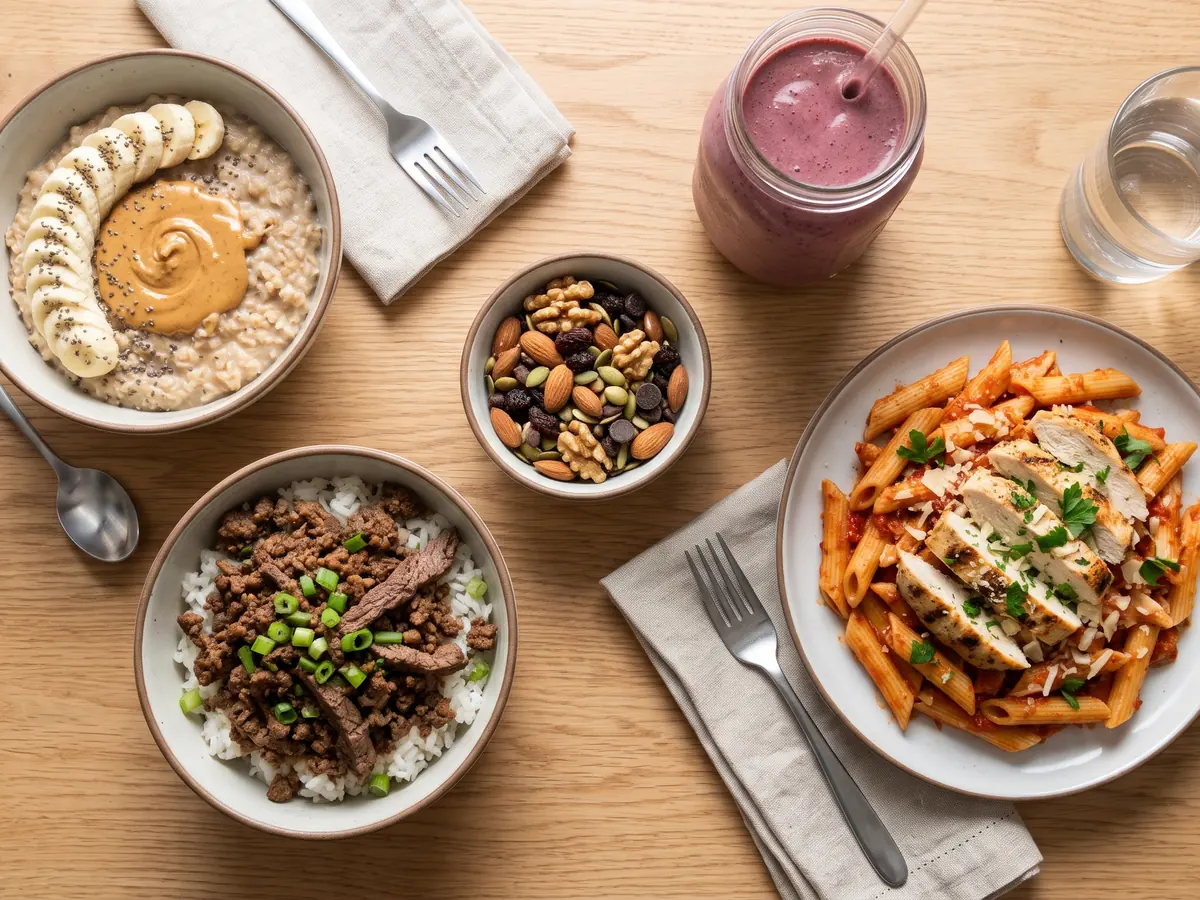
Short answerA 3000 calorie diet plan works best as five eating occasions of about 700, 750, 400, 750 and 400 calories. This one averages 2,997 calories a day with 180 g of protein, using oats, rice, pasta, peanut butter, nuts, milk and lean meat. It's a gaining plan for people whose maintenance is around 2,500 to 2,750 calories; for very active people it may simply be maintenance. Gain slowly, about 0.25 to 0.5% of your body weight a week, and pair it with strength training.
In this article
Who needs a 3000 calorie diet plan?
Three thousand calories is a surplus for some people and maintenance for others. Using the Mifflin-St Jeor equation and the activity levels in our TDEE calculator:
| Person | Maintenance | Gap at 3,000 | Likely result |
|---|---|---|---|
| Man, 30, 178 cm, 75 kg, moderately active | about 2,662 | +338 (13%) | Slow, steady gain |
| Woman, 25, 170 cm, 60 kg, very active | about 2,374 | +626 (26%) | Faster gain than most guidance suggests |
| Man, 35, 175 cm, 70 kg, lightly active | about 2,233 | +767 (34%) | Too fast; try 2,500 |
| Man, 25, 183 cm, 80 kg, very active | about 3,146 | −146 | About maintenance |
| Man, 20, 185 cm, 90 kg, very active | about 3,383 | −383 | Slight loss |
A 3000 calorie diet plan fits best for men of average size who train regularly and want to gain, and for tall or very active people who simply need this much to keep their weight. Smaller or less active people usually do better with the 2,500 or 2,800 calorie versions below.
If you're underweight or have lost weight without trying, see a doctor before starting. The NHS advises speaking to a GP if you've lost weight suddenly or without changing your diet or exercise, as it "could be a sign of an underlying health condition."
How fast should you gain?
Even on a 3000 calories diet plan, gaining weight too fast mostly adds fat. A 2019 review of nutrition for bodybuilders in the off-season recommends a calorie surplus of about 10 to 20% with "a target weight gain of ~0.25-0.5% of bodyweight/week" for novice and intermediate lifters, and a smaller surplus for advanced ones.
For a 75 kg person, that's about 0.2 to 0.4 kg (0.4 to 0.8 lb) a week. The first man in the table above, maintaining at about 2,662 calories, would aim for roughly 2,930 to 3,190 calories a day on that guidance, so a 3000 calories meal plan fits him almost exactly.
The NHS gives similar advice for people gaining weight for health: "gain weight gradually by adding healthy calories – adults could try adding around 300 to 500 extra calories a day."
Weigh yourself a few mornings a week and compare weekly averages. If you're gaining faster than this, trim 200 to 300 calories; if the scale hasn't moved in two or three weeks, add the same amount.
The 7-day 3000 calorie meal plan
Each day of the 3000 calories meal plan has breakfast, lunch, an afternoon snack, dinner and an evening snack. Amounts are cooked weights for meat, fish, grains and beans. "Greek yogurt" means a 170 g container of plain nonfat Greek yogurt; milk is 2%.
Day 1 2,994 calories · 177 g protein · 60 g fiber
- Breakfast1 cup oats cooked in 1 cup milk, 1 banana, 2 tbsp peanut butter725
- LunchSteak bowl: 4 oz sirloin, 1½ cups brown rice, ½ cup black beans, ½ cup red pepper, ⅓ cup avocado, 2 tbsp salsa809
- SnackGreek yogurt, 1 oz almonds, 1 cup blueberries349
- DinnerChicken pasta: 4 oz chicken, 2 cups whole-wheat pasta, ½ cup canned tomatoes, 1 tbsp olive oil, 1 oz mozzarella; 1 cup broccoli799
- Evening1 cup milk, 1 apple, 1 tbsp peanut butter312
Day 2 3,013 calories · 181 g protein · 51 g fiber
- Breakfast3 eggs, 2 slices whole-wheat toast, ⅓ cup avocado, 1 orange, 1 cup milk664
- Lunch4 oz chicken, 1½ cups quinoa, ½ cup chickpeas, 2 cups spinach, 1 tsp olive oil; 1 slice whole-wheat bread789
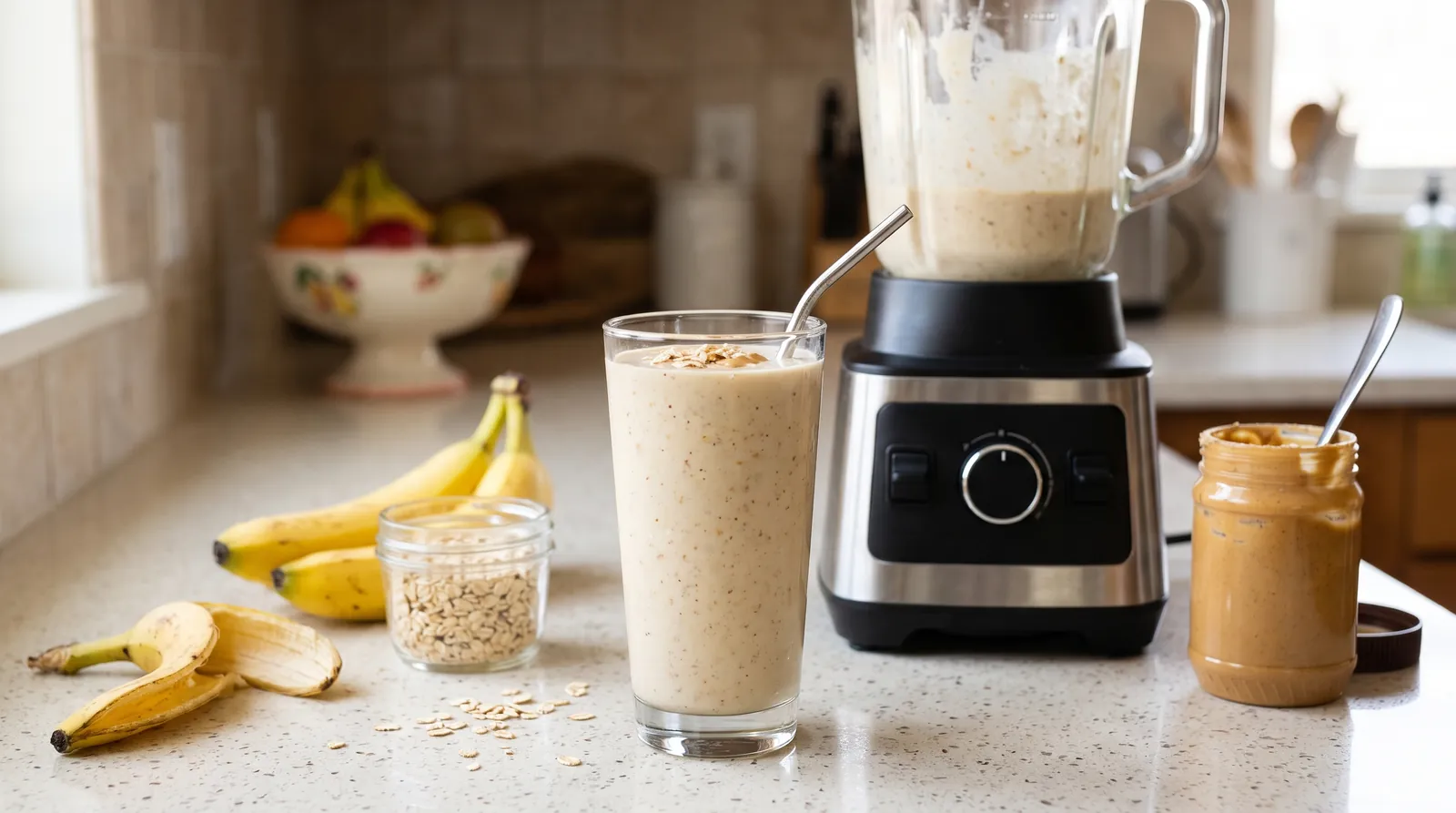
- SnackSmoothie: 1 cup milk, 1 banana, 2 tbsp peanut butter, ⅓ cup oats521
- Dinner6 oz baked salmon, 1 cup brown rice, 1 cup green beans, 1 tsp olive oil682
- Evening½ cup cottage cheese, 1 pear, 1 oz almonds357
Day 3 3,000 calories · 184 g protein · 62 g fiber
- Breakfast2 Greek yogurts with ⅔ cup oats, 1 cup strawberries, ½ oz chia seeds, ½ oz almonds603
- LunchTurkey wraps: 4 oz ground turkey, 2 whole-wheat tortillas, 4 tbsp hummus, 2 cups lettuce, 1 tomato, ½ cup red pepper683
- Snack2 slices whole-wheat bread with 2 tbsp peanut butter and 1 sliced banana458
- Dinner6 oz baked cod, 2 baked sweet potatoes, 1 cup broccoli, 1 tbsp olive oil, ½ cup brown rice682
- Evening1 cup milk, 1 cup grapes, 1 oz cheddar, 1 oz almonds, 1 orange574
Day 4 3,006 calories · 169 g protein · 69 g fiber
- Breakfast1 cup oats cooked in 1 cup milk with 1 cup raspberries and 1 oz almonds; 2 eggs812
- LunchLentils and rice: 1 cup lentils, 1 cup brown rice, 2 cups spinach, ½ cup canned tomatoes, 1 tbsp olive oil; Greek yogurt; 1 slice whole-wheat bread811
- Snack1 apple with 2 tbsp peanut butter, 1 cup milk408
- Dinner5 oz grilled sirloin, 2 baked sweet potatoes, 1 cup green beans, 2 tsp olive oil, ½ cup brown rice720
- Evening½ cup cottage cheese, 1 peach, 1 banana255
Day 5 3,007 calories · 183 g protein · 53 g fiber
- BreakfastBreakfast burritos: 3 eggs, 1 cup spinach, 1 cup mushrooms, 2 whole-wheat tortillas, 1 oz cheddar, 2 tbsp salsa; 1 orange703
- LunchTuna pasta: 1 can tuna, 2 cups whole-wheat pasta, 4 tsp olive oil, 1 tomato, 1 cup cucumber687
- SnackGreek yogurt, 1 banana, 1 oz almonds369
- DinnerChicken fried rice: 4 oz chicken, 1½ cups brown rice, ½ cup broccoli, ½ cup red pepper, ½ cup edamame, 2 tsp oil780
- Evening⅓ cup oats cooked in 1 cup milk with 1 tbsp peanut butter; 1 banana; 1 kiwi467
Day 6 2,978 calories · 178 g protein · 54 g fiber
- Breakfast3 slices whole-wheat toast with 2 tbsp peanut butter and 1 banana; 1 cup milk; 1 orange729
- LunchSalmon bowl: 4 oz salmon, 1 cup quinoa, ½ cup brown rice, ⅓ cup avocado, ½ cup cucumber, ½ cup edamame761
- Snack1 cup cottage cheese with 1 cup blueberries267
- DinnerTurkey pasta: 5 oz ground turkey, 2 cups whole-wheat pasta, 1 cup canned tomatoes, ½ cup zucchini, 2 tsp olive oil, 1 oz mozzarella839
- Evening1 oz almonds, 1 apple, 1 cup milk381
Day 7 2,978 calories · 189 g protein · 50 g fiber
- Breakfast3 eggs, 2 slices toast, ⅓ cup avocado, 1 cup blueberries, 1 cup milk680
- LunchChicken pitas: 4 oz chicken, 2 whole-wheat pitas, 4 tbsp hummus, ½ cup cucumber, 1 tomato694
- SnackSmoothie: 1 cup milk, 1 banana, ⅓ cup oats, 2 tbsp peanut butter521
- Dinner6 oz shrimp, 1½ cups brown rice, 1 cup broccoli, ½ cup red pepper, 1 tbsp oil734
- EveningGreek yogurt, 2 kiwis, 1 oz almonds349
Totals for this 3000 calorie diet plan come from USDA FoodData Central for the amounts listed. Seasonings aren't counted.
What does 3000 calories look like?
Split across five eating occasions, an average day in this 3000 calories a day meal plan looks like this:
So what does 3000 calories look like on a plate? Roughly twice what most people eat at each meal: a full cup of dry oats instead of half, two cups of pasta instead of one, three eggs instead of two, plus two real snacks. Spreading it out matters, because cramming 3,000 calories into three meals means meals of 1,000 calories each.
| Nutrient | Average a day | Guideline |
|---|---|---|
| Calories | 2,997 | Your target |
| Protein | 180 g (24%) | 1.4–2.0 g per kg (ISSN) |
| Carbohydrate | 349 g (47%) | 45–65% of calories |
| Fat | 108 g (32%) | 20–35% of calories |
| Saturated fat | about 8% of calories | No more than 10% |
| Fiber | 57 g | 14 g per 1,000 calories |
| Sodium (before added salt) | about 1,670 mg | Under 2,300 mg |
Fiber is high at 57 g a day because this 3000 calories a day meal plan uses whole grains, beans and lots of fruit. That's in line with the National Academies' adequate intake of 14 g per 1,000 calories, which works out to 42 g at 3,000, but it's a lot of bulk. If it fills you up too much to finish the day, swap some whole grains for white rice or regular pasta, or replace a fruit with a smoothie.
Calorie-dense foods for weight gain
When your appetite is the limit on a 3000 calorie diet plan, choose foods that pack more calories into a smaller volume. From USDA FoodData Central:
| Food | Portion | Calories | Protein |
|---|---|---|---|
| Whole-wheat pasta, cooked | 2 cups | 349 | 14 g |
| Oats, dry | 1 cup | 307 | 11 g |
| Sirloin, cooked | 5 oz | 267 | 43 g |
| Brown rice, cooked | 1 cup | 248 | 6 g |
| Avocado | 1 cup cubes | 240 | 3 g |
| Peanut butter | 2 tbsp | 191 | 7 g |
| Dark chocolate, 70–85% | 1 oz | 170 | — |
| Almonds | 1 oz | 164 | 6 g |
| Hummus | 4 tbsp | 142 | 5 g |
| Milk, 2% | 1 cup | 122 | 8 g |
| Olive oil | 1 tbsp | 119 | 0 g |
| Cheddar cheese | 1 oz | 115 | 7 g |
The NHS's healthy weight gain advice points the same way: "add extra calories to your meals with cheese, nuts, and seeds" and "have high-calorie drinks in between meals, such as milkshakes." It also warns: "do not rely on chocolate, cakes and sugary drinks to gain weight." A square of dark chocolate is fine, but most of the extra calories should come from foods like those above. For more detail on meat and chocolate, see the steak nutrition and chocolate nutrition pages.
2500, 2800 and 3500 calorie meal plans
The same menus scale up to a 3500 calorie meal plan or down to a 2800 calorie meal plan with a few changes:
| Target | Change | Average day |
|---|---|---|
| 2,500 calories | Skip the evening snack and use 1 tbsp less olive oil | about 2,490 |
| 2,800 calories | Halve the evening snack, or remove 1 tbsp oil and ½ cup rice from one meal | about 2,750–2,800 |
| 3,000 calories | Follow the menus as written | 2,997 |
| 3,500 calories | Add the 521-calorie smoothie (1 cup milk, 1 banana, 2 tbsp peanut butter, ⅓ cup oats) on days that don't already have it | about 3,500 |
Whichever level you choose, the 3000 calories diet plan menus stay the same and only the portions move. A 2800 calorie meal plan suits many active women and smaller men who want to gain; a 3500 calorie meal plan suits tall, very active people or anyone whose weight hasn't moved on 3,000. For a meal plan for 3500 calories, the smoothie is the easiest addition because it's quick to drink and doesn't add much fiber. On the two days that already include it, add a second evening snack of Greek yogurt with 1 oz of almonds and a banana (369 calories) plus 1 tbsp of olive oil at dinner (119).
Gaining muscle, not just weight
Extra calories from a 3000 calorie diet plan build muscle only when there's a reason to: resistance training. Without it, most of a surplus is stored as fat. The NHS suggests building muscle "with strength training or yoga," and notes exercise can also improve your appetite.
Protein
The International Society of Sports Nutrition says "an overall daily protein intake in the range of 1.4-2.0 g protein/kg body weight/day (g/kg/d) is sufficient for most exercising individuals." For per-meal amounts it suggests "0.25 g of a high-quality protein per kg of body weight, or an absolute dose of 20-40 g," spread every 3 to 4 hours. The off-season bodybuilding review suggests 1.6 to 2.2 g per kg.
This 3000 calories meal plan averages 180 g a day; our guide to grams of protein per ounce shows what that means in meat, fish and eggs. That's 2.0 g per kg at 90 kg, or 2.4 g per kg at 75 kg, more than most people need. If you weigh less, you can swap some meat for extra rice or pasta and still be well within those ranges. The macro calculator works out protein, carbs and fat for your weight and goal.
Carbs and fat
The same review recommends fat at 0.5 to 1.5 g per kg and "sufficient amounts (≥3-5 g/kg/day)" of carbohydrate to fuel training. At 75 kg, this plan's 349 g of carbs is about 4.7 g per kg and its 108 g of fat about 1.4 g per kg, both inside those ranges.

If you're trying to lose fat and gain muscle at the same time rather than bulk, a surplus isn't the right tool; see the body recomposition calculator instead.
Vegetarian version
Day 4 is already built around lentils, eggs and dairy. To turn the other days into a vegetarian 3000 kcal meal plan, replace each 4 to 6 oz portion of meat or fish with one of these:
| Swap | Calories | Protein |
|---|---|---|
| 1 cup firm tofu | 363 | 44 g |
| 2 Greek yogurts | 201 | 35 g |
| 1 cup cottage cheese | 183 | 24 g |
| 3 eggs | 232 | 19 g |
| 1 cup shelled edamame | 188 | 19 g |
| 1 cup cooked lentils | 230 | 18 g |
| 1 cup chickpeas | 269 | 15 g |
In a vegetarian 3000 kcal meal plan, tofu is the closest swap for meat, with more protein per cup than 5 oz of chicken. Beans and lentils bring a lot of fiber with their protein, so on a high-calorie plan, use them alongside dairy and eggs rather than as the only protein, or the volume becomes hard to finish.
Meal prep for a week of 3,000 calories
Cooking a 3000 calories diet plan is easier in batches:
- Cook grains in bulk. The week uses about 8 cups of cooked brown rice, 6 cups of pasta and 2½ cups of quinoa. Cook rice and quinoa twice a week.
- Prepare proteins ahead. Roast the chicken and brown the turkey on day 1. Cook fish on the day you eat it.
- Portion the snacks. Bag 1 oz servings of almonds (about 23 nuts) and keep peanut butter, bananas and yogurt where you'll see them.
- Set up the smoothie. Pre-measure oats into containers so the smoothie takes a minute to make.
- Bake sweet potatoes together. Four go in the oven at once for Days 3 and 4.
Common mistakes when eating for weight gain
- Gaining too fast. More than about 0.5% of body weight a week usually means more fat than muscle. Slow down by 200 to 300 calories.
- Relying on junk food. Sweets and sugary drinks add calories without much protein, fiber or vitamins, and the NHS advises against relying on them.
- Skipping strength training. A surplus without resistance training mostly becomes fat.
- Inconsistent days. Eating 3,000 on training days and 2,000 on rest days averages out to much less than planned.
- Not adjusting. As you gain, your maintenance rises too. Recheck it in the TDEE calculator every month or so.
If 3,000 is too much: 2500 calories a day
For smaller people or those who gain easily, 2500 calories may be the better starting point. Follow the menus without the evening snack and with one tablespoon less olive oil, and the average day comes to about 2,490 calories with about 162 g of protein. Use the same weekly check: if you're gaining 0.25 to 0.5% of your body weight a week, stay there.
Tips for eating 3000 calories a day
- Eat more often. The NHS suggests eating "smaller meals more often, adding healthy snacks between meals." Five eating occasions make 3,000 calories manageable.
- Drink some calories. Milk and smoothies go down more easily than the same calories as solid food. Have them between meals: the NHS advises, "do not fill up on drinks before eating meals."
- Add fats to food you already eat. An extra tablespoon of olive oil on pasta is 119 calories; 2 tbsp of peanut butter on toast is 191.
- Go bigger on grains. Moving from 1 to 1½ cups of rice adds 124 calories with almost no effort.
- Keep snacks ready. Nuts, peanut butter, yogurt and bananas need no cooking.
- Track for two weeks. Log a few days in the calorie counter to see how close you really are to 3,000.
Grocery list for the week
This is everything the 3000 calories diet plan uses across all seven days. Buy fish and berries frozen if you shop once a week; both keep well and count the same in the menus.
Protein
- Chicken breast, 1 lb
- Sirloin, 9 oz
- Ground turkey, 9 oz
- Salmon, 10 oz
- Cod, 6 oz
- Shrimp, 6 oz
- Tuna, 1 can
- Eggs, 11
Dairy
- 2% milk, about 12 cups (¾ gallon)
- Plain Greek yogurt, 6 containers
- Cottage cheese, 2 cups
- Cheddar, 2 oz
- Mozzarella, 2 oz
Grains and beans
- Brown rice, 8 cups cooked
- Whole-wheat pasta, 6 cups cooked
- Quinoa, 2½ cups cooked
- Oats, 3⅔ cups
- Whole-wheat bread, 11 slices
- Whole-wheat tortillas, 4
- Whole-wheat pitas, 2
- Lentils, 1 cup cooked
- Black beans, ½ cup
- Chickpeas, ½ cup
- Edamame, 1 cup
- Hummus, 8 tbsp
Fruit
- Bananas, 8
- Oranges, 4
- Apples, 3
- Kiwis, 3
- Pear, 1
- Peach, 1
- Avocados, 2
- Blueberries, 3 cups
- Strawberries, 1 cup
- Raspberries, 1 cup
- Grapes, 1 cup
Vegetables
- Broccoli, 3½ cups
- Sweet potatoes, 4
- Spinach, 5 cups
- Green beans, 2 cups
- Red peppers, 2–3
- Tomatoes, 3
- Canned tomatoes, 2 cups
- Cucumber, 1–2
- Mushrooms, 1 cup
- Zucchini, 1 small
- Lettuce, 2 cups
Pantry
- Peanut butter, 14 tbsp
- Almonds, 7½ oz
- Chia seeds, ½ oz
- Olive oil, 8 tbsp
- Salsa, 4 tbsp
3000 calorie diet FAQ
What does 3000 calories look like?
About five eating occasions: a 700-calorie breakfast, a 750-calorie lunch, a 400-calorie snack, a 750-calorie dinner and a 400-calorie evening snack. For example: oatmeal with banana and peanut butter, a steak and rice bowl, Greek yogurt with almonds and berries, chicken pasta, and milk with an apple.
Is 3000 calories a day good for gaining weight?
It is for people whose maintenance is around 2,500 to 2,750 calories. A review of bodybuilding nutrition suggests a surplus of about 10 to 20% above maintenance, aiming to gain about 0.25 to 0.5% of body weight a week.
How much protein do I need on a 3000 calorie diet?
The International Society of Sports Nutrition suggests 1.4 to 2.0 g of protein per kg of body weight a day for most exercising people. This plan averages about 180 g a day, which is 2.0 g per kg for a 90 kg person.
How do I turn this into a 3500 calorie meal plan?
Add a smoothie of 1 cup milk, 1 banana, 2 tbsp peanut butter and ⅓ cup oats, which is about 521 calories and 20 g of protein. That brings the average day to about 3,500.
What are the best calorie-dense foods for weight gain?
Nuts, nut butters, olive oil, avocado, cheese, oats, rice, pasta and milk pack a lot of calories into small portions. The NHS suggests adding cheese, nuts and seeds to meals and having milkshakes between meals rather than relying on chocolate, cakes and sugary drinks.
Sources
- U.S. Department of Agriculture. FoodData Central (every food in the menus).
- Jäger R, et al. International Society of Sports Nutrition position stand: protein and exercise. J Int Soc Sports Nutr, 2017.
- Iraki J, Fitschen P, Espinar S, Helms E. Nutrition recommendations for bodybuilders in the off-season: a narrative review. Sports, 2019.
- NHS. Healthy ways to gain weight.
- National Academies. Dietary Reference Intakes: dietary, functional and total fiber, 2005.
- National Academies. Dietary Reference Intakes: macronutrient distribution ranges, 2005.
- U.S. Departments of Health and Human Services and Agriculture. Dietary Guidelines for Americans, 2025–2030, January 2026 (saturated fat and sodium limits).
- Frankenfield D, et al. Comparison of predictive equations for resting metabolic rate in healthy nonobese and obese adults: a systematic review. J Am Diet Assoc, 2005.